








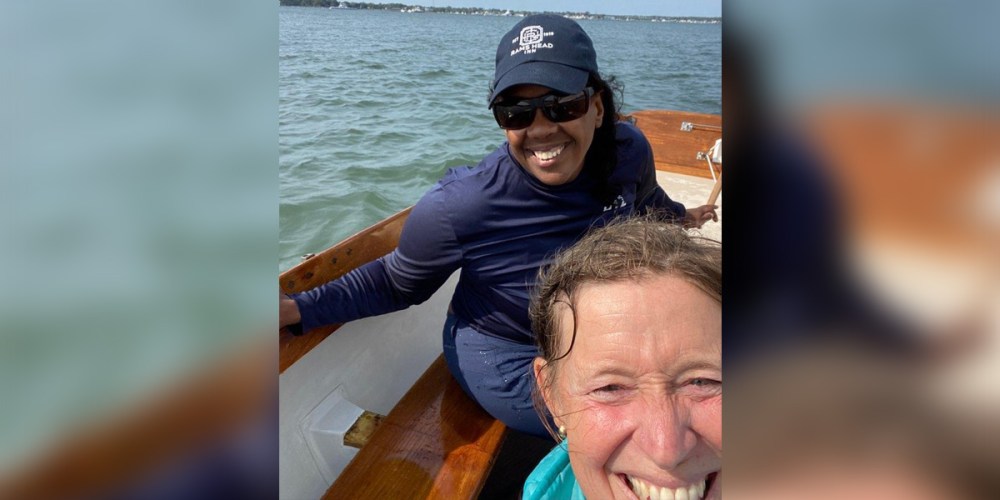
I love to sail. It helps me clear my head, relax and get away from the challenges of life on land. But when I recently headed out on the water with my sister-in-law and we ended up in rough waters, I got a lot more than that: I learned a valuable lesson about leadership.
The rough water — and my sister-in-law’s reaction to it — showed me that too often as well-intentioned leaders and as women, when we try to guide our colleagues through a storm we sometimes do a disservice by rescuing them too soon. I learned good leadership sometimes means letting them hang onto the tiller, which is used to steer the boat, and navigate the rough waters their own way.
And so, this one moment on the water has altered the way I think about leadership at work.

It happened a few weeks ago, during a women’s yachting race I entered with my sister-in-law Whitney. Now, you should know that while I’ve been sailing on and off throughout most of my adult life, I’m a neophyte compared to Whitney. She’s always at ease on the water, while I kind of feel I’m starting all over again every summer.
On that September day, though, I was fired up for the race. After all, it has been a challenging past two years, which included the unexpected death of my mother. In addition, my father-in-law passed away after a long illness. And of course, there’s been the stress of the pandemic. Sailing, however, forces me to be in the moment. You can’t think of all of life’s craziness when you have to pay close attention to where the wind is coming from and what your sails are doing.
Whitney and I entered the race on the Peconic Bay in New York with my boat, which I leased at the beginning of the year. But the weather on September 12 was rough. As the wind picked up and the water became more and more choppy, several teams opted to drop out of the race. But knowing that my days were numbered with the lease on the boat, there was no way we weren’t competing.
So, we hopped in our sailboat, got ready and eased off the mooring. I was at the tiller steering since it was my boat, still feeling confident despite the wind. We were chatting happily about our strategy to win. Whitney had a plan for a strong start — moving over to where you need to get, without being too far over, because if you’re over the right point when the race starts you have to turn around and begin again. It worked; we had a great start and got to the front.
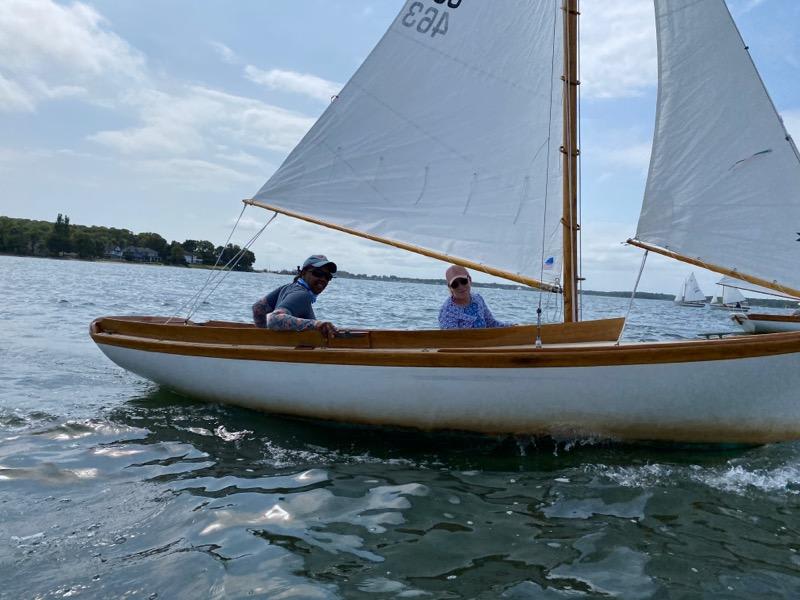
But then we went into the main body of water and approached one of the marks we needed to round: a big metal buoy that serves as a channel marker. The wind had picked up and so had the current. As we approached the mark, there was a big swirl — part current, part wind, part tide — and the water looked scary as we were coming up to it. It reminded me of “Where the Wild Things Are,” like the swirl could grab our boat and send us off to a faraway place.
At this point water was coming over the bow, and I was nervous. I looked around and saw the other boats were jibing, a rapid maneuver in which you turn your stern through the wind, bringing the boom with the main sail across the boat very aggressively. Jibing is one of my least favorite things to do. I’d done them before, but not in high wind like this.
I was just about ready for Whitney to take the tiller.
She didn’t.
Instead my sister-in-law said, “OK, here’s what we’re going to do. We won’t round the mark right here, we’ll go past it and tack.” And she stayed where she was.
I was surprised. Tacking is a slower maneuver that turns the bow into the direction of the wind. Everyone else was jibing and they were going along quickly. “We could win,” I thought. “Why isn’t Whitney taking the tiller and jibing?”
For whatever reason, she wasn’t doing it, so I dutifully began tacking. We slowly made our way through the waves and currents and approached the next marker, which thankfully was calmer without the churning swirl around it. We noticed the other boats, which had been fighting the tide for so long, were kind of slowing down. We decided to stay on the opposite side of the channel and then cut across to the finish line.
We ended up in third place … out of three boats. But we very nearly came in second! And I was so proud of us for finishing. I was still a little confused by what had happened. In the moment I was thinking, “Can’t you just take this? Come on. Obviously, you know how to do it, and I’m really uncomfortable, and now we aren’t going to win.” It wasn’t until I was driving home, back into the city, that it clicked for me. I was thinking about a conversation I needed to have with a colleague about culture and leadership, and I thought about Whitney and what she did. As well as what she didn’t do. During the race, my body language was clearly tense as I gripped the tiller. Whitney saw this and she could have said, “Just let me navigate this part.” And that would have been absolutely fine. But instead, she empowered me to stay on the tiller and lead us. She allowed me to take a different tack, literally. Whitney made space for me to get us there my own way, giving me ownership and agency. I realized many of us don’t do that as leaders. Especially as women, I think, we try to guide. We say, “Here, I’ll show you how to do it, and you’ll take over when the waters are calmer.” We mean to be supportive, but sometimes we just take control with the best of intentions. I’m not saying we should let people fail and drown in proverbial rough waters. Rather, it’s about pushing through the discomfort — yours and theirs — when you both know you could easily do it yourself, but you’re not going to. In the moment as the waves sloshed over the bow, I wanted Whitney to just take the tiller. Your mentees and colleagues may want you to as well. And sure, there will be times you need to do it. But often there is an opportunity to lead by stepping back, by creating space, by supporting without taking over. We can help those we lead to navigate their own way to the finish line — with the tiller firmly in their own hands. Alicin Reidy Williamson is a senior vice president and Chief Inclusion Officer at Endeavor. Prior to joining Endeavor, Reidy Williamson was with The Raben Group, a national public policy and communications strategy firm, where she led the firm’s New York office as well as its diversity, equity and inclusion practice as Managing Principal.
Alicin Reidy Williamson Recommended


