








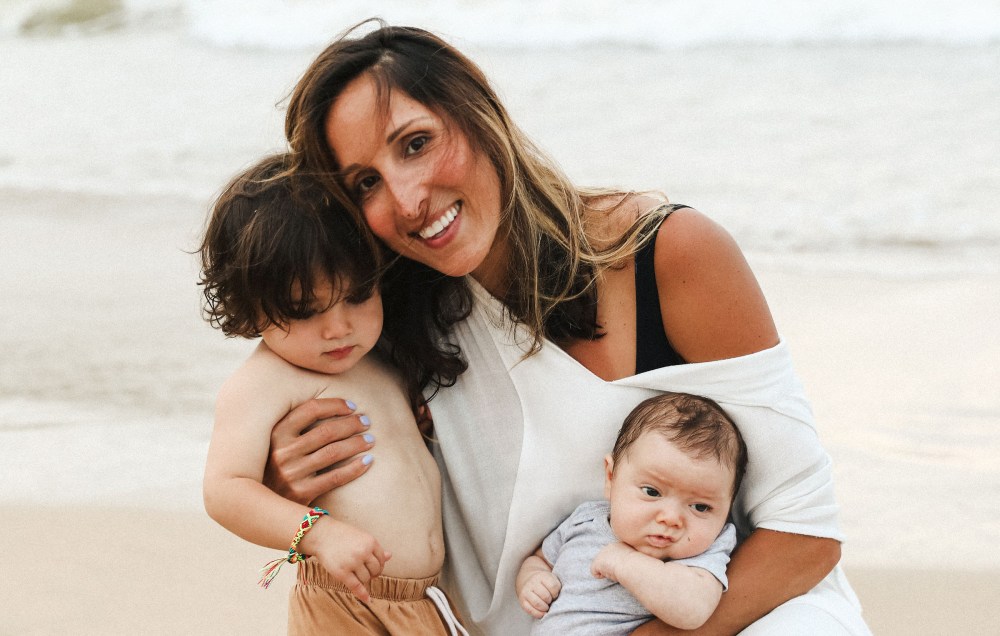
Asking for maternity leave should be the norm, but the reality is many women feel societal pressure that makes them nervous to broach the subject.
The good news is that attitudes, particularly in corporate America, are beginning to shift as “Morning Joe” co-host and Know Your Value founder Mika Brzezinski discussed with guests recently.
Yasmin Vossoughian, MSNBC anchor and Know Your Value contributor, discussed the importance of taking individual action: “It’s incredibly important to make an example of yourself and say: You know what, I’m not going to be insecure about the fact that I want to take this time, because I think it’s important to take this time and have it with my family.”

“It takes individuals to make that decision to lead and to move that needle forward,” the mother of two added.
On a national and legislative level, that needle has barely moved. A small handful of states have enacted versions of a paid leave law, there is no federal U.S. family leave. Now, paid maternity leave is guaranteed in every country except the United States and Papua New Guinea, according to a March report from the World Economic Forum.
As a result, asking for maternity leave can feel fraught.
“I call it the ‘big ask,’ because women are so stressed out to go in there and ask for what they need,” Brzezinski said. That means time off, period, or additional time off to deal with challenges like postpartum depression.

“If you don’t ask, if they don’t know what you need, then they can’t have that opportunity to retain you,” Brzezinski added. “We’ve got to change the equation around and change it from ‘big ask’ to requirement.”
Subha Barry, president of Working Mother Media, agreed with Brzezinski’s assessment that companies will generally do what they can to keep talented employees: “Companies are increasingly doing that,” she said.
She also noted an August announcement from Business Roundtable, in which CEOs of 181 companies signed a statement pledging to shift away from a shareholder-focused strategy to focusing on their responsibility to customers, communities, suppliers — and employees.
“That shift on Wall Street is phenomenal,” Barry said. “And what it says is that it’s really important for companies to learn to be human. And companies become human when their leaders and managers are human. I believe that is going to shift that attitude.” These attitudes are long entrenched. According to figures from the National Center for Health Statistics, from 2006 to 2008 about 70 percent of U.S. women who were employed during pregnancy took some leave — an average of 10 weeks. But that average belies a wide spectrum: a third of women took no formal time off at all, and 16 percent took only one to four weeks. The societal shift, while slow, is starting. Barry credited efforts by the younger generations, millennials and Gen Z, who say, “we not only want this, but we expect this.” It’s a win-win, she added, as workers show their gratitude for companies’ humanness through loyalty and hard work. The beginnings of this shift are also happening because men and women alike are asking for parental leave, with fathers sharing the parenting responsibilities more than ever. Older generations are learning from that, Barry said, noting that while they are no longer raising children they may have aging parents who require their care. Brzezinski concluded the conversation in part by noting that she came back from maternity leave too early and “paid a big price.” “That’s the bottom line: The ‘big ask’ shouldn’t be something you’re stressed about,” Brzezinski said. “It should be an opportunity for you to tell them why you have value, to show your commitment to the company and to show that you’re thinking of ways you can stay there for a long time.”
Julianne Pepitone
Julianne is the senior technology writer for NBC News Digital, covering large consumer tech companies' (Apple, Google, Facebook, etc.) news and trends, as well as cybersecurity. She also writes and appears in original videos for NBCNews.com, and speaks as an expert guest on live shows across the NBC and MSNBC networks.
She previously worked at CNNMoney.com where she covered large techs from a business angle, as well as the intersection of the tech and media industries.
In addition to NBC and CNN online properties, Julianne has written for several national magazines and online publications including Esquire, Self, Popular Mechanics and Cosmopolitan. Recommended


