Charlotte Moore expected to spend her 20s questioning her passions and career goals, a period she thought would be characterized by both growth and existential dread. That’s largely been true, up until a global pandemic was thrown into the mix. Now, after a year of stagnation, Charlotte is wondering how she can ensure that her career has value and meaning in her life.
Charlotte, 25, is a UX researcher at a financial tech company in New York. It’s a role she began in July of the pandemic, requiring her to work from home and spend most of the day online. She enjoys the projects and responsibilities her role entails, but the nature of remote work can often be monotonous and leaves her burnt out.
“I feel like it’s hard for me to fully detach from work since it all takes place at home,” she explained. “Sometimes work bleeds into my life more than I would like.”
But now, after a year plus of the pandemic, the country is finally reopening. States like California and New York have lifted virtually all Covid-era restrictions. Vaccinated Americans can brush up against a stranger’s shoulder on the street without fear. Companies are beginning to bring employees back to their offices. For many in Gen Zers, including Charlotte, the country’s reopening is imbued with hope and optimism, but also a tantalizing amount of anxiety surrounding their careers.
She’s watching many friends opt for major life changes: going to graduate school, moving cities, or pursuing a new career path. These are trends unfolding on the macro-level as well; a recent Microsoft survey found 41 percent of the entire global workforce is likely to consider leaving their jobs within the next year, with 46 percent planning a career pivot. Economists are even nicknaming the era “The Great Resignation.”
Charlotte’s fear that she, too, should embark on a fresh start — reopening FOMO, if you will — has proven difficult to tune out. “It makes me wonder if I should be thinking about what I want more long-term and what changes I can make now to accomplish those,” she said. “This period feels like an opportunity for a rebirth, and I don’t want to be somehow be left out of that.”
For many, the push-factor to start anew has been wrought with — or at least accelerated by — Covid-19 burnout. The stress of the pandemic, the toils of remote work, and the inability to easily separate work life from home life have all culminated into the ubiquitous sense that we’re no longer in control of our own lives. This is especially true among Gen Z employees. Microsoft’s polling revealed Gen Zers struggle at work more than any other generation when it comes to bringing new ideas to the table, getting a word in during virtual meetings, and feeling engaged or excited about work. More than half of 18 to 25 year olds in the workforce are considering quitting their jobs, according to the survey.
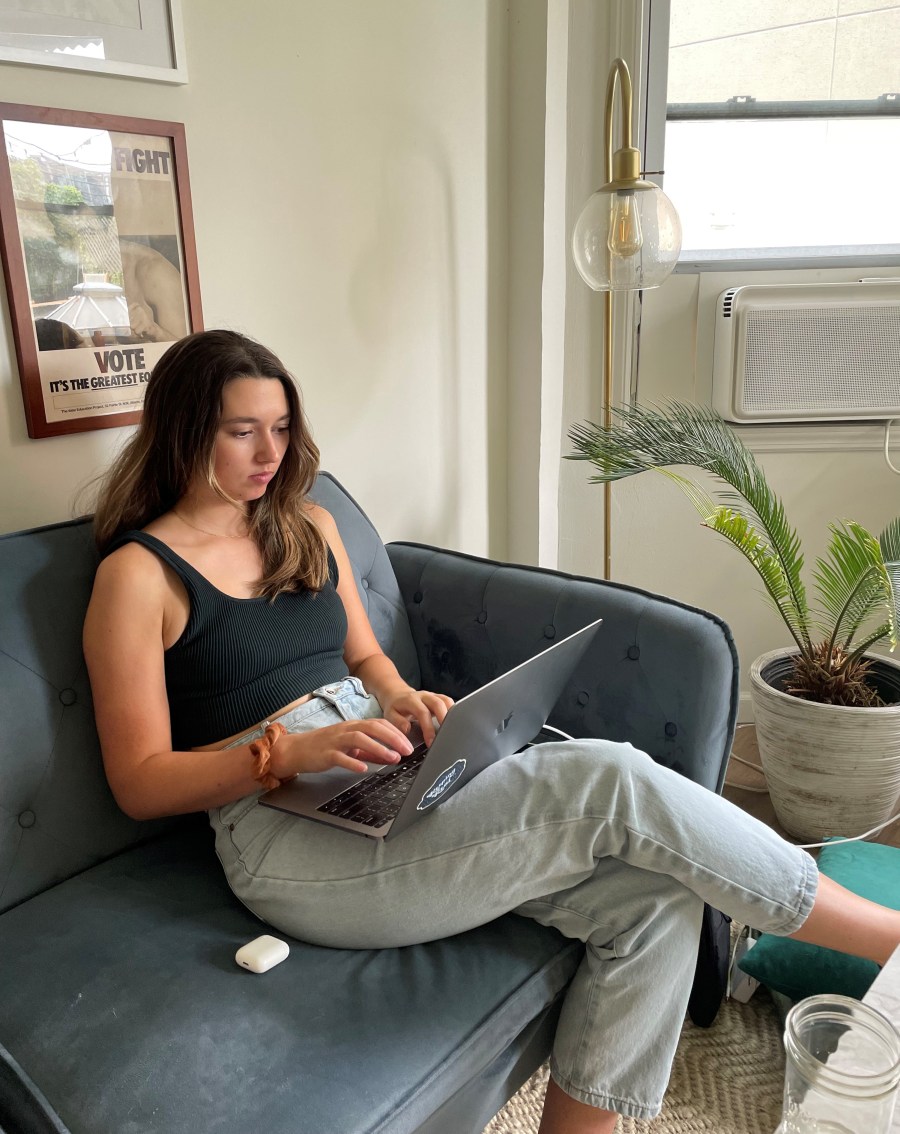
Such was the case for Megan Belden, a 25-year-old freelancer from San Francisco. Megan worked as an account executive at a wine PR agency she’d been with for three years. That is until she hit a wall at work in March.
She knew her role hadn’t been the best fit for a while, but she stayed because she enjoyed spending time with her coworkers. Then the pandemic moved her office space online, and she was left with her own thoughts and the reality of her job by herself all day, every day.
Her sense of fatigue was overwhelming. “I ended up going to a couple of doctors because I was wondering, ‘Is something wrong with me?’” she said.

Megan made the decision to leave her job in March and dedicated five weeks to not thinking about work or the future. It was a necessary pause, she explained, after which she transitioned to work as a freelance marketer — a period of experimentation away from a typical nine to five job, as she refers to it.
“I feel like a different human, honestly. I feel much more like myself. I feel energized and focused. I feel like the resting period is very much over and I’m ready to do things and take action.”
Dr. Dana Udall, trained psychologist and chief clinical officer at Ginger, said Gen Zers and Millenials, as well as all workers, are asking employers for more awareness of mental health issues in the form of stronger benefits, more paid time-off, and greater flexibility with their schedules. Ginger’s Third Annual Workforce Attitudes report found that 70 percent of employees in 2020 reported feeling more stressed in their professional careers than ever before due to the pandemic. At the same time, 96 percent of CEOs polled think they are doing enough for their employees’ mental health, yet only 69 percent of employees agree.
Celebrities and public figures coming forward addressing mental health issues have helped destigmatize it for employees, Dr. Udall told Know Your Value. Tennis champion Naomi Osaka, 23, for example, shocked many in her decision this month to pull out of the French Open in favor of her own well-being.

“I think people are more comfortable saying this environment isn’t working for me and I need something different,” Dr. Udall said. “Ideally they could partner with their employer and work something out. But there are times in which workplaces are just very toxic and they’re not very supportive, so I think people are making hard choices.”
Career empowerment coach Melanie Denny observed in her work that younger women are more ready to leave jobs than older generations of women. “I think there’s a certain level of healthiness to it because they’re not going to sit and suffer through something they’re uncomfortable with,” she told Know Your Value. But when it comes to trying to rectify the situation before deciding to leave, she thinks there’s room for improvement among younger women. Resigning from a job is a slippery issue in these times. It’s heralded as the ultimate form of self-care in some cases, but the ability to quit and fall back on a savings account is unquestionably a white-collar phenomenon. The feeling of burnout, however, is not. Hourly and service workers — the class of employees the country deeply relied upon during lockdown — have reported extreme fatigue throughout the year. And in a year when women’s participation in the workforce dropped to levels unseen since the 1980s — in large part due to many childcare options vanishing — stepping away from a job can feel like a betrayal for some younger women. “There’s some guilt there,” Charlotte conceded feeling. But women like Kohsheen Sharma are making significant career changes after watching the pandemic peel back the layers of the country’s inequality. Kohsheen, 25, decided to forgo her job as an analyst at a private equity firm in San Francisco when saw she millions of Americans lose access to health care last year. “I don’t know if I would have moved if it weren’t for the pandemic. I saw the world in a different way and my worries about what looks good on my resume flew out the window,” she explained. For the past two months, she’s worked in strategy and operations at a health care tech company. “I thought, I don’t want to look back 10 years later and say that I was just working a finance job after this huge event changed the way the world worked.” That moment of reflection is a key point of Melanie Denny’s career empowerment work with women, and one that the slowed pace of the pandemic actually fostered. “Pre-pandemic we never took the time to sit down and reflect on our careers,” she said. “We didn’t sit down and say, ‘Let me plan out what my career is going to look like. Let me see what I’ve done. Let me take inventory of my wins, my accomplishments.’” The last few generations of women have been filled with renegades in their own right. Baby Boomers, for example, came of age at the height of the women’s liberation movement and Vietnam-era protests, many of whom resisted the scripts set before them: marry, have children, and remain at home. Gen X was written off as the “mess” generation, but it featured women breaking boundaries in fashion and personal style, and outpacing men in master’s degrees for the first time. Among the characteristics that will set the young women today apart from previous generations is that they have come of age amid the disruption of a global pandemic, and their careers will inevitably reflect that. “People are more burned out of doing things that they’ve been doing for so long, just because they’ve been taught that this is what I have to do,” Denny said. “Now they’re putting things into perspective like, ‘my life is much more valuable now.’” Natalie Johnson is a segment producer for “Cross Connection” and “The Sunday Show” on MSNBC and an illustrator from Brooklyn, New York. Follow her on Twitter @nataliejohnsonm.
Natalie Johnson
Natalie Johnson is a segment producer for “AM Joy” on MSNBC and an illustrator from Brooklyn, NY. Follow her on Twitter @nataliejohnsonm. Recommended