








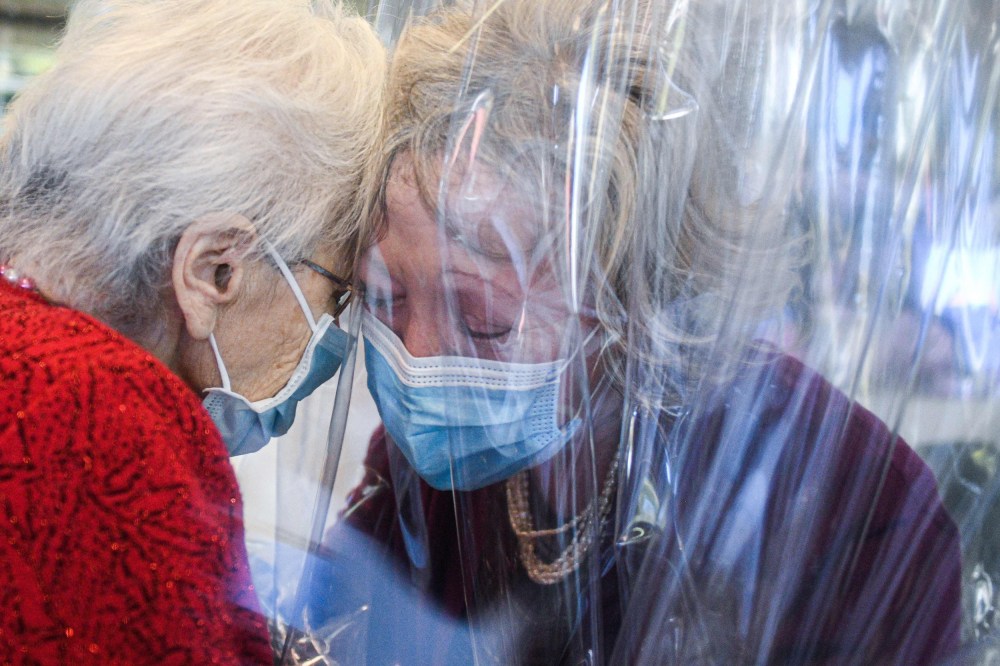
Those living in nursing homes have faced the shockingly disproportionate, very deadly affects of the Covid-19 pandemic. And a new report from AARP demonstrated that much of the devastation could have been prevented.
As of Dec. 4, at least 106,000 residents and staffers of nursing homes and other long term care facilities have died from the illness, according to the New York Times. The Covid Tracking Project counted almost 270,000 total Covid-19-related deaths in the U.S. by that date, which means that nursing home residents and staff have comprised over 39 percent of deaths.
The AARP report said there are several culprits to blame for this extremely high proportion, including poor government oversight and a lack of accountability in the nursing home industry.

“It escalated so rapidly, with little response,” said Elaine Ryan, vice president of state advocacy and strategic innovation at AARP in an interview with Know Your Value. “As early as March or April we were advocating for families to be able to even get information about the state of their loved ones. We were asking, ‘what’s happening? Do the staff have enough PPE? Is there any infection control?’ The lack of transparency by nursing homes early on was just extraordinary.”
The report, in this month’s AARP Bulletin, found that long-term care facility workers, who are underpaid, tend to work in multiple facilities to make ends meet. They inadvertently carry the virus to different institutions and throughout their communities. The older residents are often more vulnerable to the disease, and they live communally—often with roommates.
“When we have facilities where the virus is out of control, it’s going to come back into the community too,” said Bill Sweeney, senior vice president of government affairs at AARP. “I think there’s an out-of-sight, out-of-mind mentality about nursing homes. But this is a community problem and it’s not something you can wish away.”
Early in the pandemic, the federal Centers for Medicare and Medicaid Services pulled back regular government oversight of these facilities, according to the report, a decision which ratcheted up the risk factors.
The CMS also gave $21 billion in federal relief funds to nursing homes nationally, of which $2.5 billion was allotted toward infection control. The rest was granted with “no strings attached,” the report said. Seventy percent of long-term care facilities are for-profit, according to the report, which are linked to higher death rates.
“Where has this money gone?” asked Ryan. “It’s not going into wage increases for the people who are showing up every day to battle on that front line. We need answers about what’s going on in those facilities and what more can be done to save lives in the coming months.”
The report argued that, aided by government neglect, nursing homes have been able to deflect accountability. The American Health Care Association, which represents nonprofit and for-profit nursing homes, has pushed for federal and state legal immunity during the pandemic. This immunity has been granted in at least 20 states, the report said.
The American Health Care Association and National Center for Assisted Living (AHCA/NCAL) sent Know Your Value a statement that denies aspects of the AARP report, pointing to dissenting studies from universities and the CMS.
“The AARP report accurately describes the struggles the nursing home industry faced in not being prioritized in the country’s initial response to COVID and lack of support we received to secure vital PPE, reliable testing, and additional staffing,” the statement read. “However, as leading independent experts have repeatedly noted and CMS data has shown, the level of COVID cases in the surrounding community was the top factor in outbreaks in nursing homes given the asymptomatic and presymptomatic spread of the virus, not ownership structure or quality rating of a facility.” The statement also denied that nursing homes were rolling in cash. “As we testified before Congress last year, our industry has been facing a staffing shortage for years as providers are operating on razor-thin profit margins due to the chronic underfunding of Medicaid and challenges in recruiting additional staff from a high demand workforce,” it said. Dr. Stephen Crystal, director of the Center for Health Services Research at Rutgers University, who was not affiliated with the report, said the “whole thing has been shameful, frankly.” He added, “What I see is an industry that has cultivated tremendous clout in Congress…I’ve wondered over the years why there isn’t more outrage about a lot of things that go on in nursing homes. People think of it as their own personal problem, not as something that a civilized society provides to people.” Ryan is hopeful that the coronavirus will force sweeping changes in long-term care policy and in American attitudes toward its aging population. Ninety percent of people want to age in their own home and communities, according to a previous study from the AARP. Individuals are offered little government support for this choice, Ryan argued, when compared to grants given to private, high-risk facilities. When the coronavirus isn’t front-of-mind, other infectious diseases like the flu will continue to threaten the lives of nursing home staff and residents, she said. “We give unlimited funding to nursing homes and capped funding to care for people at home,” said Ryan. “I’m hoping not only for a wakeup call and action now, but I’m also hoping and will be advocating for fundamental reform of this system.”
Halley Bondy Recommended


