








Judge Clay Jenkins was out of town when a wave of protesters showed up outside his Dallas home.
At least two dozen demonstrators camped outside his front yard Saturday, waving signs reading “Deport Illegals. Save America” after Jenkins offered up three Dallas County buildings to temporarily shelter nearly 2,000 migrant children.
The irony of another sign — “Don’t Like Large Groups of Uninvited Strangers in the Neighborhood? Neither will Others!” — was lost on the group of mostly older, white Texans seen parked outside Jenkins’s home as they staged their protest along the sidewalk of an otherwise quiet suburban neighborhood. Police officers remained stationed outside Jenkins’s front door, while several enterprising kids in the community set up a lemonade stand a few houses down.

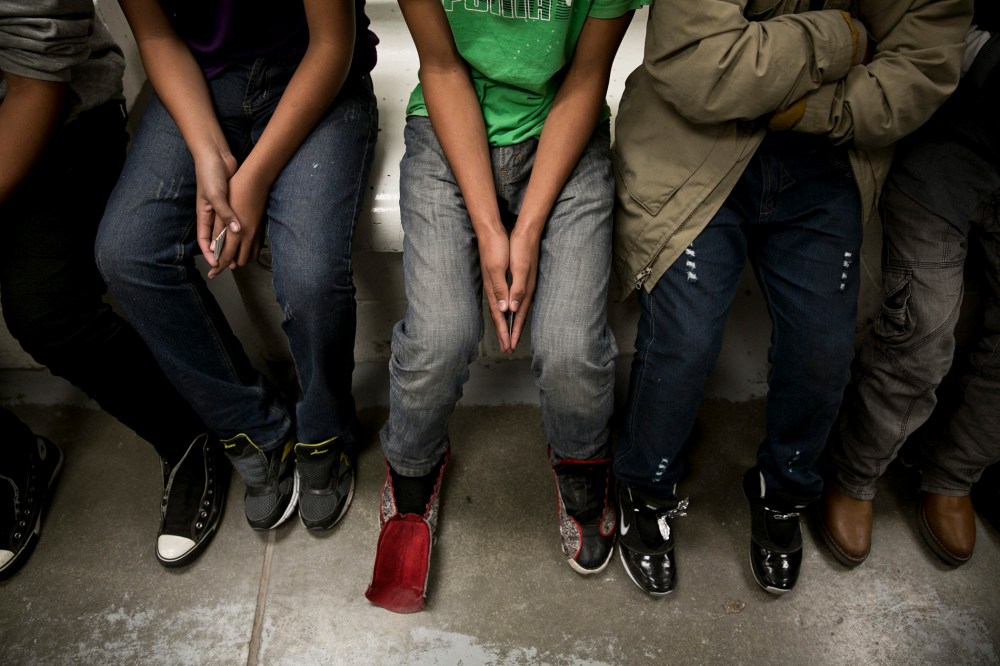
The “Not In My Backyard” resistance in local communities poses a conundrum for local officials who are being pressed to open shelters and house the thousands of unaccompanied minors that are overcrowding existing facilities along the southwestern border. Few cities have answered the call to shelter the children in the face of long-simmering discontent with illegal immigration that’s boiling over into the public space as the flood of migrant kids draws more attention by the day.
“The influx of unaccompanied child migrants is a growing humanitarian crisis that we can no longer ignore,” Chicago Mayor Rahm Emanuel said in a statement Saturday in unveiling the city’s plan to take on as many as 1,000 children by the end of the year.
So far, a number of major cities and urban areas have agreed to open shelters to take pressure off the border and help cope with the more than 57,000 migrant children who have crossed into the U.S since October. Chicago became the latest city to step up, joining Boston, Los Angeles, New York City and Syracuse, N.Y., in agreeing to offer a safe haven to the kids. The resulting anti-immigrant vitriol has spawned counter movements led by pro-immigration activists to challenge protests against the children and even press to bring licensed shelters to their communities.
Several other cities have tried and failed. In Maryland, Democratic governor and potential 2016 candidate Martin O’Malley has been an outspoken advocate on behalf of the migrant kids. But Maryland ultimately had to scuttle an offer to open a shelter in Westminster after anti-immigrant graffiti roiled the neighborhood.
%22The%20influx%20of%20unaccompanied%20child%20migrants%20is%20a%20growing%20humanitarian%20crisis%20that%20we%20can%20no%20longer%20ignore.%22′
In Lynn, Mass., protesters mobilized after the town’s mayor warned that sheltering the children would backfire on the community and drain civic resources. “[I]t’s gotten to the point where the school system is overwhelmed, our Health Department is overwhelmed, the city’s budget is being sustainably altered in order to accommodate all of these admissions in the School Department,” Lynn Mayor Judith Flanagan Kennedy told a Fox News affiliate earlier this month.
In Southern California, crowds of protesters that blocked busloads of migrants in Murrieta earlier this month set the tone for a wave of anti-immigration demonstrations that swelled over the weeks that followed. Protesters in Oracle, Ariz., gathered by the dozens in efforts to block roughly 40 migrant children from being transferred to new facilities. A crowd of agitators even took to the streets in Vassar, Mich., toting AR-15 rifles and handguns to contest plans to bring immigrant kids to their communities.
“Once these people come into these communities, it’s a local issue,” Douglas Gibbs, a local activist who helped lead the anti-immigrant protests in Murrieta, told msnbc earlier this month. “This is beyond immigration. It’s about whether or not the federal government can force its will and force illegal immigration on communities or not.”
Federal overreach is a common complaint in the regions resisting the housing of migrant children, but adds to a line of arguments that the service providers who actually run the shelters say are easily debunked. “The programs are self-contained,” Alexis Rodriguez said at the National Council at the La Raza conference last week. Rodriguez heads Southwest Key, a nonprofit that runs a network of shelters for unaccompanied minors throughout the country. “The federal government pays for us to get staffed up so that we can provide all of those services in house. The children do not go to schools in the community. We educate them on site.” The shelters are temporary rest stops for the kids, who on average remain in the facilities for less than a month. While there, children undergo a series of health screenings, therapy and obtain legal services before they’re eventually matched up with relatives or sponsors who are able to take them in as they wade through immigration proceedings. Children who do not have relatives in the U.S. move on to more long-term housing or foster homes. The Department of Health and Human Services, which contracts out the service providers that run the shelters, must approve all new facilities, which can delay the response time of how quickly new housing can be up and running in cities, Rodriguez said. Communities have been involved early on in the approval process, giving rise to resurgent — and sometimes ludicrous claims — that the children are spreading contagious diseases upon arriving in the U.S. “When these kids come in, they have to get medically cleared by a physician. If they have any medical issues, we attend to those immediately,” Rodriguez said. “Any sorts of rumors about the spreading of any sort of epidemics or diseases are clearly untrue.”
Amanda Sakuma Recommended


