









When Tammy Sun was 34 and working at the tech company Evernote, she sought out egg freezing services in case she wanted to start a family one day. At a doctor’s appointment, she found out she had “premature ovarian failure,” which meant that her ovaries were essentially getting older significantly faster than her biological age — and that she would go through early onset menopause.

Another consequence of the diagnosis was that each of her egg freezing cycles would be less successful than the norm. Sun underwent three cycles of egg freezing. And while doctors were able to retrieve a total of 10 eggs (most women her age would get about 10 to 20 eggs per cycle), it came with a hefty price tag: approximately $40,000, which Sun had to pay out of pocket because her employer at the time did not cover fertility treatments.
“There was an opportunity cost for me having to have spent that,” Sun told Know Your Value. “I wasn’t able to invest in a down payment. I wasn’t able to buy a house. I wasn’t able to use that money to buy a car… But the truth is that most Americans don’t have the luxury of going into a savings account and accessing thousands of dollars for care that they want or need.”

That’s why Sun six years ago founded Carrot Fertility, which works with companies to add fertility care to their health coverage. Carrot currently works with more than 800 companies, including Clif Bar, Instacart, Snap Inc., Zoom and Peloton, to support millions of employees and their families in 120 countries. Carrot has raised more than $200 million from top-tier investors since 2017. And this year, Carrot will process half a billion dollars in claims.
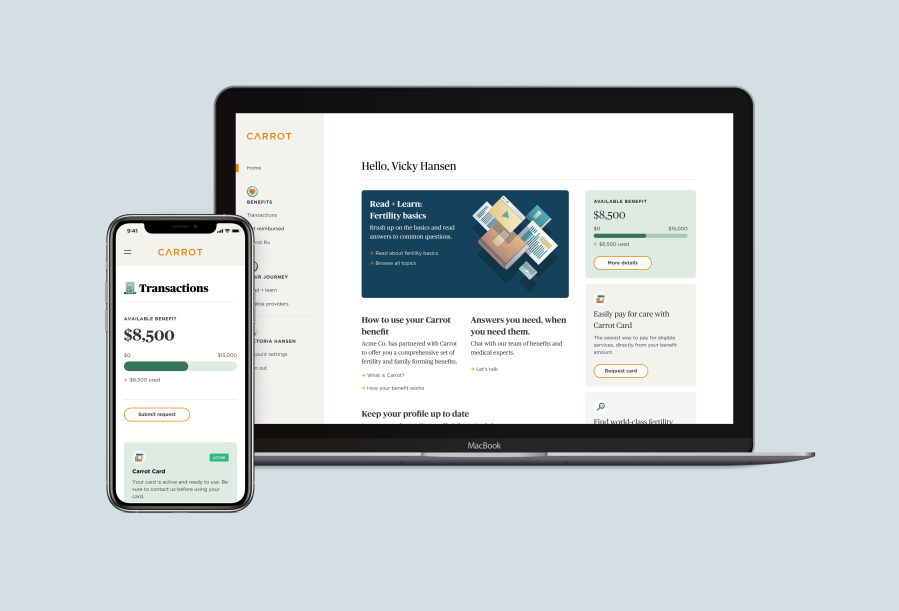
The way Carrot works is simple. After a company teams up with Carrot, employers put money into an employee’s health plan. Then, employees can use their Carrot Card – a debit-like card – to access doctors and pay for services like egg freezing, IVF, adoption, pregnancy, menopause treatments and more.
“The company was born out of a desire to make sure that every single person, regardless of their age, their sex, their sexual orientation, gender identity, marital status, race or geography would have equal access to high quality care,” said Sun, who noted that specialized care for menopause has been particularly popular. “A lot of women in their 40s and 50s are your most successful managers. They’re your most senior executive leaders. They’re your C-suite. So we’ve invested a lot in age inclusion.”
Sun said fertility care is not just about offering a nice-to-have perk, but that it’s also a way to increase gender diversity in the workforce and attract and retain workers, especially in the aftermath of the Great Resignation, which disproportionately affected more women than men.
Know Your Value recently chatted with Sun about the future of fertility benefits, how the pandemic affected her business, how you can broach your employer if your company doesn’t offer such benefits and more.
Below is the conversation, which has been edited for brevity and clarity:
Know Your Value: What does the fertility benefits landscape look like now? What’s the percentage of companies that offer such benefits?
Tammy Sun: We have upwards of 850 customers ourselves, but when you look across all of the employers in the entire country, a very small percentage of them … fewer than less than 5 percent of all employers are offering comprehensive fertility benefits. So, the opportunity is really, really big. And I think this particular time in the market is really exciting because even though there are some recessionary headwinds and the macroeconomic environment has new challenges to it, we see a huge appetite for this type of healthcare purchase from our customers in a way that I think outlasts whatever is happening right now.

Know Your Value: What is the breakdown between men and women who use Carrot?
Sun: Great question … More than 40 percent who engage are male. About 53 percent are female. And the rest do not identify [with a particular gender]. But, I think one of the unique things about fertility is that, you know, we’re just coming to understand as a society is it is absolutely about the health of women, but it is also about men. Half of all infertility is male factor. And so, it’s really about thinking of fertility health as a human health issue…
Know Your Value: I’m curious to know how the pandemic affected your business, especially with the Great Resignation. We saw so many women leave the workforce. Did you find that companies were reaching out to you because they wanted to provide better benefits to recruit more women, or to keep more women in the game?
Sun: Absolutely. During the pandemic, we saw a more than three times the increase in the utilization of our platform, particularly around issues of mental and emotional health. The pandemic caused a lot of stress, a lot of turmoil, specifically in the area of fertility. Adoption processes were, you know, interrupted. IVF cycles were interrupted. We were excited that we were able to provide a comprehensive solution… And since the pandemic, engagement and utilization of fertility benefits has actually exceeded pre-pandemic levels. But, you know, fertility benefits is something that five years ago, you would not think to ask for in a job interview or at work. There was still a ton of social stigma. Today, there still is too.
…But what we see is really stunning. Women in particular will ask for this benefit as part of the way that they negotiate a job. They will ask for this benefit at work through their employee resource group as a way to push their employer towards buying fertility benefits. … About 95 percent of people who use the Carrot product say that they are more willing to stay at that job because they are engaged with Carrot than without it … I think the expectation across the market, in in the culture, in the economy is that no, fertility is not a luxury good … It isn’t something that only a certain subset of people can have. This is now a core part of the healthcare stack at work with medical, with dental, with vision, with mental health. Know Your Value: What’s your advice to women who want to have kids later in life, especially as a CEO in your line of work? Sun: I think the takeaway is that every single person’s journey is personalized and is their own … There is no right answer. And what’s important is that all women have full access to all of the options that should be available to them as a normal part of healthcare. So this isn’t something that only a certain subset of people should have access to. Every single woman should have the opportunity to achieve their highest purpose and live to their full potential. For some women that will involve having kids, starting your family, you know, in your 20s. For other women that will, that will be a much different story. Women in their 40s are increasingly thinking about starting and expanding families. And so there should be options for every single woman to pursue their own path… Know Your Value: As you noted, so many companies don’t offer fertility benefits. What’s your advice to women who are at companies where there aren’t such benefits? How do you ask your employer or broach the subject? Sun: … As much progress as we’ve made, I can empathize and understand why some people would still feel stigma and, and caution and shame at work in talking about these issues. It’s deeply personal … Sometimes we see people, employees, friends at work banding together to have that conversation among themselves and then approaching their benefits leader or their HR leader as a group. So that’s one way to do it … The employee community aspect of this can be very supportive if you don’t want to be the single person that goes to your benefits leader at work and reveal too much of yourself. The other thing I would say is we see a lot of this as a “halo effect.” A lot of people themselves may not ever need access to a fertility benefit. But, oftentimes we see employees advocating for each other. So if you see somebody in your workplace who is struggling, who could use better access to pregnancy care, whether it’s through doula, if you see somebody who is struggling with infertility and they themselves are not comfortable speaking out about it, if you see a gay couple who is struggling through trying to understand how to navigate surrogacy, more and more we actually see those employees speaking out on behalf of others. And so that’s one thing that I hope we’ll see more of… Know Your Value: Last question. What do you think is the future of fertility benefits? Will this become the norm? And what will it take to get there? Sun: I think it is becoming a norm every day as we speak. The change from five years ago has been enormous. There is a very normalized expectation that fertility benefits is a standard part of compensation and benefits at work today, in a way that was not true five years ago. Five years from now, I’d like to see a world where everybody has access [to fertility benefits] as a normal part of work, no matter what industry you’re in… what kind of job you have, or what age you are, or what sex you are or what gender identity you are. [I hope everyone] will have access to a fertility benefit that helps people design a life that allows them to live their highest purpose.Recommended


