








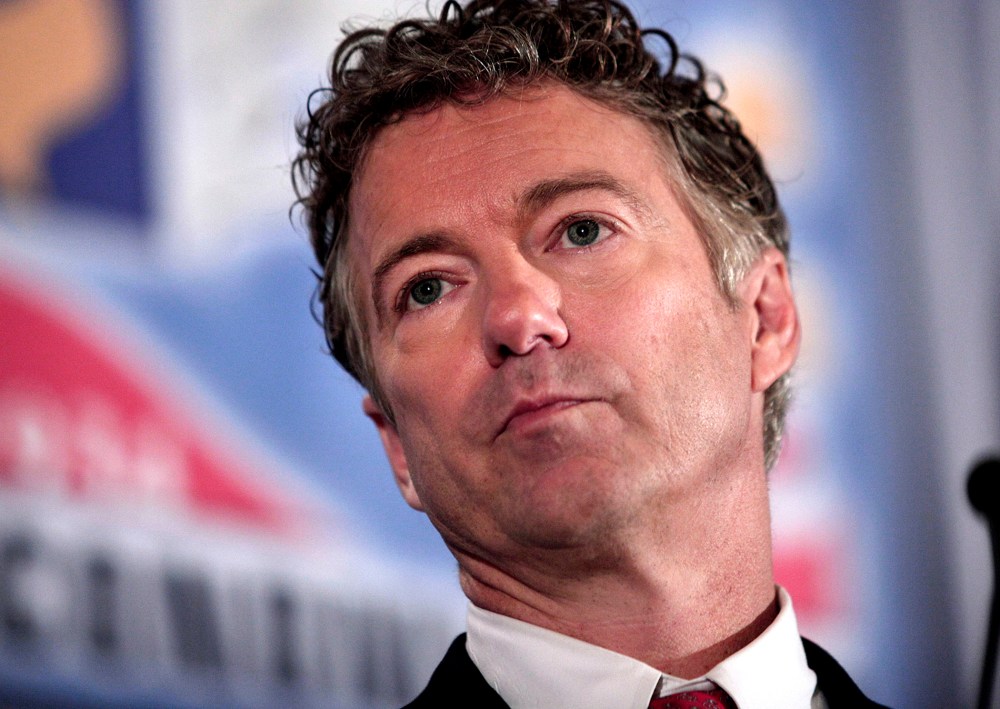
What is Rand Paul, a Republican Senator from Kentucky, doing giving speeches in uber-Democratic stronghold Detroit?
Running for president, of course, despite his public protestations.
“There’s two votes [about whether I should run] in my party, my wife has both of them, both are no votes right now,” Paul said in an appearance at the Detroit Economic Club on Friday.
But Paul’s visit to the Motor City dovetailed with two trends in vogue among national Republican leaders.
One is a fledgling attempt to reach out to minority voters, who are both growing in electoral strength and more committed than ever to the Democratic Party.
“If you look at it by race, John McCain got more of the Caucasian vote than Bush did and Romney got more of it than McCain got and lost,” Paul said. “We need to be a more diverse party.”
Before his speech, Paul attended the opening of a GOP office in Detroit, a symbolic signal by Republicans that they’ll try to listen to black voters’ concerns throughout the election cycle and not just a few weeks before they vote. Race aside, Paul’s Detroit tour is also an olive branch from a party that often vilifies big cities –small town resentment is at the core of Sarah Palin’s appeal, for example.
“Republicans as a party, myself included, need to do more in the cities,” Paul told reporters ahead of his trip.
The other trend Paul is riding is a new emphasis on poverty, especially among GOP presidential hopefuls. The party has always struggled to get past its fat cat stereotype, but it’s a higher priority this year after Mitt Romney’s “47%” monologue and his remark that he was “not concerned about the very poor” because they had an adequate safety net. Paul Ryan, despite being best known for his proposals to slash government benefits, has been a prime mover in this effort. Now Rand Paul is joining aboard, touting a “conservative war on poverty” in Detroit.
The meat of Paul’s speech was a proposal to create “economic freedom zones” in places with especially dire unemployment and poverty. Under his proposal, depressed areas like Detroit would receive major cuts to income, payroll, and capital gains taxes, aimed at spurring businesses to invest more.
“These freedom zones will dramatically reduce taxes and red tape so Detroit business can grow and thrive,” he said.
As Paul acknowledged in a speech, it’s a prescription borrowed from the ‘80s and ‘90s , when it was championed by Republican Jack Kemp. It came up again after Hurricane Katrina when President Bush suggested an “opportunity zone” to help rebuild the Gulf Coast. Economists are skeptical whether attempts to implement these policies reduced poverty or whether they merely shuffled some jobs directly outside the designated zone into its borders. In general, tax cuts for investors aren’t exactly a mindblowing break from Republican orthodoxy. But Paul’s second policy plank for reducing racial and wealth inequality is more controversial within both parties: scaling back the drug war, reducing jail time for nonviolent offenders, and returning voting rights to felons after they serve their time. “No one’s life should be ruined because of a youthful mistake,” Paul said. “No one should lose their voting rights because they spent time in prison.” Rhetorically at least, Paul has come a long way since he delivered an awkward and patronizing speech at historically black Howard University earlier this year. But while he may offer some compelling hints as to how the GOP might better appeal to young, minority, and urban voters, he’s an imperfect messenger. On race, he has a uniquely terrible blind spot that’s led him to attack the 1964 Civil Rights Act and defend a neo-Confederate aide and co-author who advocated for secession and white supremacy. These episodes would be bad enough for any politician, but the Senator’s father, Ron Paul, notoriously published years of racist, homophobic, and anti-Semitic newsletters. That means the younger Paul, who supported his dad’s presidential runs, faces heightened scrutiny when these kinds of blowups happen. As for poverty, Paul has to square his desire to help the poor with his draconian proposal to balance the budget in five years while cutting taxes for the rich. Tax credits for suffering cities sounds nice enough, but city voters might have some reservations about, say, abolishing the entire Department of Housing and Urban Development to increase defense spending. Still, Paul’s well-delivered Detroit speech stood out among Republicans. In stark contrast to many of his fellow Republicans, he’s focused on offering actual ideas rather than just attacking Democratic ones. Paul noticeably eschewed Obama-bashing for most of his speech, choosing instead to focus on his own legislative agenda. His drug and civil liberties positions, deployed correctly, might be a legitimate wedge issue against a Democratic candidate. A skilled candidate might be able to borrow Paul’s more innovative methods while leaving his radical baggage behind.
Benjy Sarlin Recommended


