








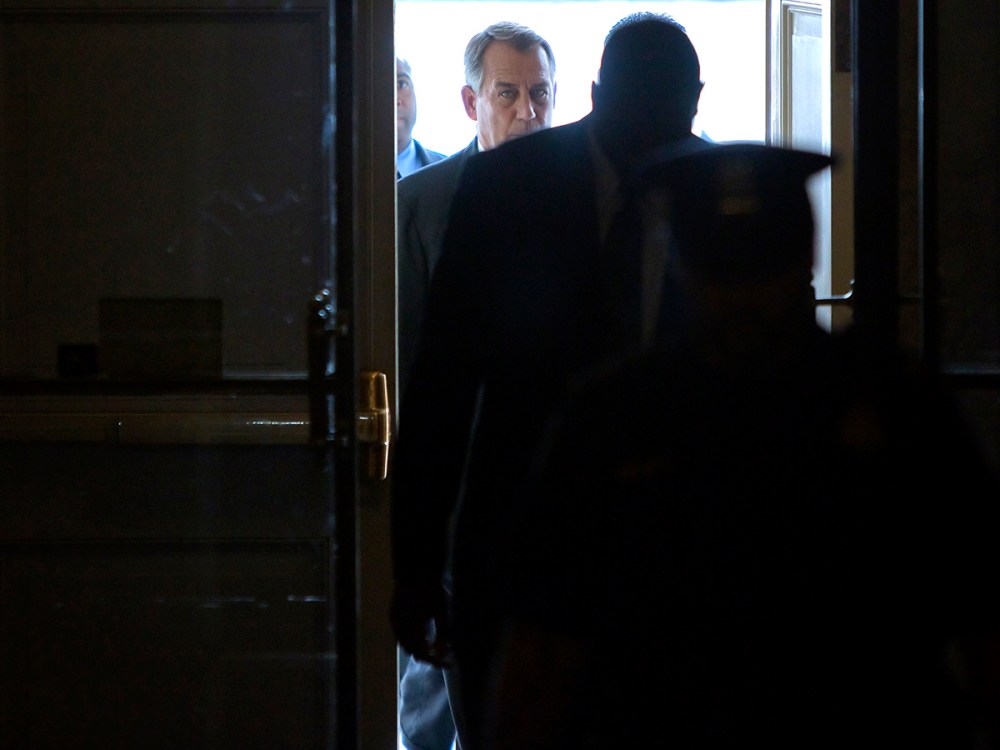
With a shutdown looming at midnight, the debate over funding the government is about to get louder and more chaotic.
The reason: this fight doesn’t just pit Democrats versus Republicans or House versus Senate. There’s also a GOP Civil War going on at the same time. So the normal rules of a fight just don’t apply.
To separate the signal from the noise, you’ll need to know which players matter and their various tells. Here’s a guide to the major factions in the shutdown fight. Keep your eye on these groups and you should have a good idea at any given moment whether we’re moving closer to a deal – or a shutdown.
The Leaders
Who they are: This group includes top officials in the House, Senate, and White House, who have to placate all the other groups.
On the Democratic side, President Obama has said he will not sign any changes to his health care law under threat of shutdown and is refusing to even negotiate over raising the debt ceiling, saying it’s a basic responsibility of Congress. Majority Leader Harry Reid has said he won’t enter talks with “tea party anarchists.” House Minority Leader Nancy Pelosi is carrying the same message. For now, there are no cracks between the White House and Democratic leaders.
It’s among the Republican leaders are where things gets more complicated. House Speaker John Boehner waved off talk of a shutdown for months, but now his party’s conservative wing is expecting him to hold the line — or else. In past standoffs, Minority Leader Mitch McConnell has worked with Democratic leaders when Boehner’s been pinned down by his members. He was the one who crafted the fiscal cliff deal with Vice President Joe Biden, for example. But now McConnell is facing a tea party primary opponent in 2014, making it difficult for him to play a conciliatory role.
One House leader bears special mention: Paul Ryan. The House budget chair and 2012 vice presidential nominee was a critical bellwether in the 2011 debt ceiling standoff, where he helped sell conservatives on a bipartisan compromise. So far he’s been strangely AWOL, but if he gets off the sidelines and strongly backs a new plan that might be a turning point.
What to watch: Any movement at all. Right now, all sides are entrenched in their respective positions and not talking. It will take a big development — either a concession from one side or a major shift in the political environment — to bring them back to the table together. The biggest tell to watch is if Boehner either starts talking to Pelosi or calls on Senate Republicans to find a deal instead of the House. That means he’s decided placating the tea party is a lost cause and wants to find a way out with Democratic votes, a last-ditch approach he resorted to in the fiscal cliff fight after failing to win True Believer (see below) support for his own plan.
True Believers
Who they are: For ultra-conservative True Believers like Congresswoman Michele Bachmann, the current standoff is what they’ve been demanding for years. “We’re very excited,” Bachmann told the Washington Post after the latest House bill targeting Obamacare was unveiled. “It’s exactly what we wanted, and we got it.”
On the Senate side, the most visible True Believer is Senator Ted Cruz, who delivered a 21 hour speech last week decrying the law. He’s joined there by allies Sens. Rand Paul, Mike Lee, and Marco Rubio. On the House side, members like Reps. Louie Gohmert of Texas, and Tim Huelskamp of Kansas, are good examples of a much larger and more influential True Believer caucus.
Outside the Capitol, the conservative Heritage Foundation is an important player, mobilizing True Believers to scuttle talk of compromise before it gets far.
What to watch for: At some point, the shutdown has to end. You’ll know negotiations between Democrats and Republicans are getting serious when these members start screaming about how the Republican leadership is stabbing them in the back. Already, Heritage is warning Boehner that anything short of defunding or delaying Obamacare — like, say, ending a tax on medical devices — is off-limits.
The Caution Caucus
Who they are: Plenty of Republicans, from Speaker John Boehner down, have warned that a shutdown is a bad idea. These members are often very conservative, but on tactical grounds they fear the GOP is likely to suffer the blame in a prolonged standoff and unlikely to achieve its goals of derailing the president’s health care law.
On the House side, Deputy Whip Tom Cole has repeatedly warned his members against throwing a “temper tantrum” to block Obamacare. Sen. John McCain is the most visible member on the Senate side, but he has plenty of company there. Sen. Richard Burr of North Carolina, for example, called an anti-Obamacare shutdown “the dumbest idea I’ve ever heard” in July.
What to watch: For now, the Caution Caucus is mostly keeping quiet while the House’s new proposal to delay Obamacare plays out. But at some point, they’re likely to start calling out the True Believers again and pursuing their own solutions to the standoff. That’s a dangerous dynamic for the GOP, because it undermines their current efforts to blame Democratic intransigence for causing a shutdown. Blue State Republicans Who they are: There aren’t many Republican representatives left in swing districts or senators in blue states, but they’re the ones who have the most to lose if a shutdown turns into a political anchor for the GOP. In the House, this group includes the only two Republicans to vote against the House’s latest effort to delay Obamacare were Reps. Chris Gibson and Richard Hanna of New York. Sens. like Kelly Ayotte of New Hampshire, Pat Toomey of Pennsylvania, and Ron Johnson of Wisconsin, who were all elected in the 2010 Republican wave could face tough re-election fights in 2016. There’s a lot of overlap with the Caution Caucus, but they’re a distinct group in that they actually could suffer at the ballot box personally from a prolonged crisis. What to watch: As the shutdown fight escalates, Blue State Republicans are likely to go out of their way to try and distance themselves from the True Believers. Senator Susan Collins of Maine, despite being considered relatively safe in her 2014 race, has already called the House GOP’s new proposal “a strategy that cannot possibly work.” Red State Democrats Who they are: Democrats are heading into a tough election cycle in 2014, especially in the Senate, where they have to defend the many seats they won in Obama’s 2008 blowout. Sens. Mark Pryor of Arkansas, Mary Landrieu of Louisiana, and Kay Hagan of North Carolina, can expect to face a number of tough votes over the next few weeks that their Republican opponents will look to use against them in attack ads. In the House, Democrats Jim Matheson of Utah and Mike McIntyre of North Carolina, were the only two members of their party to join Republicans in voting to delay the Affordable Care Act. What to watch: Among Republicans, the True Believers are convinced they can win over Red State Democrats in the Senate to the cause. So far they’ve resisted their entreaties, but if Democrats do end up caving to Republican demands, the first sign will be Red State Democrats publicly breaking ranks. Big Business Who they are: Led by groups like the Chamber of Commerce, these are the various trade associations and large corporations that stand to lose big money if a shutdown and default damage the economy. Not surprisingly, they’re strongly in favor of a deal — any deal — to keep the government running smoothly and the Treasury’s bill paid on time. What to watch: Up to now, they’ve mostly been content to assume the two parties will work out their differences. If a shutdown happens and there’s no progress on the debt ceiling, they may start freaking out. Recently, the Chamber of Commerce and 236 industry groups signed a letter calling on Congress to fund the government, raise the debt limit and then debate any policy changes. Democrats are hoping Big Business will get real loud real fast during a crisis, forcing Republicans to either back down or alienate a core constituency.
Benjy Sarlin Recommended


