John McCain knows about friendly contact with dictators.
That’s the best explanation for the Arizona senator’s attack on President Obama Tuesday for shaking hands with Cuban President Raul Castro at Nelson Mandela’s memorial service in South Africa.
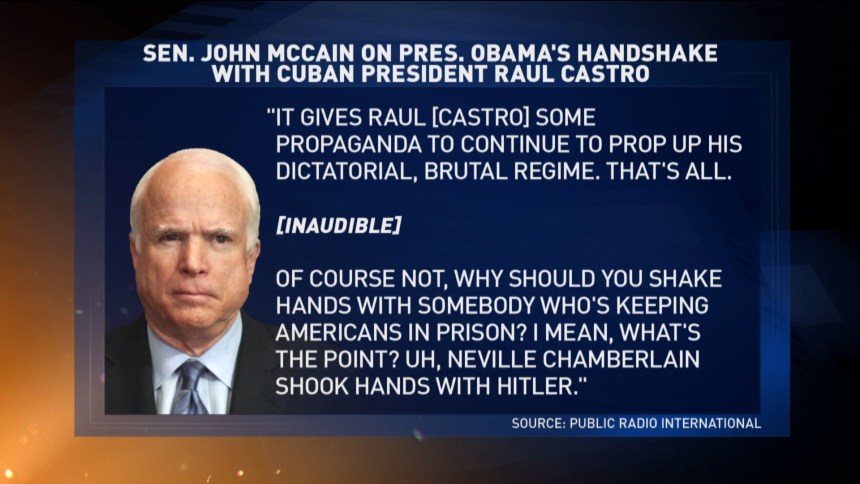
“It just gives Raul some propaganda to continue to prop up his dictatorial brutal regime,” McCain told Public Radio International. And then the money quote: “Neville Chamberlain shook hands with Hitler.”
It was inevitable Obama would take some heat for shaking hands with Castro. But the level of vitriol from McCain is genuinely surprising.
For one thing, McCain used the most loaded analogy in foreign policy — Chamberlain ceding the Sudetenland to Hitler–to discuss an event that didn’t involve negotiations of any kind. It was a handshake at a memorial service for a late world leader, not a handshake before a global summit aimed at lifting Cuban sanctions. Bill Clinton shook hands with Fidel Castro when they crossed paths at a United Nations event in 2000, yet somehow the U.S. embargo on Cuban goods survived intact and the Castros didn’t take it as a signal to invade Florida. The closest Obama came to addressing Castro’s policies during his trip was a jab in his eulogy at unnamed “leaders who claim solidarity with Madiba’s struggle for freedom, but do not tolerate dissent from their own people.”
But McCain knows better than anyone that diplomacy sometimes means shaking hands with repressive autocrats. Take, for example, former Libyan dictator Muammar Gadhafi.
McCain visited Gadhafi in Tripoli with other lawmakers on a diplomatic mission in 2009 for an interesting hangout he described on Twitter.
Late evening with Col. Qadhafi at his "ranch" in Libya – interesting meeting with an interesting man.
— John McCain (@SenJohnMcCain) August 15, 2009At the time, relations with Libya were on an upswing. Gadhafi was still as brutal a leader as ever, but after 9/11, he offered to abandon his nuclear and chemical weapons programs and cooperate in the war on terror, prompting President George W. Bush to reopen normal diplomatic relations.
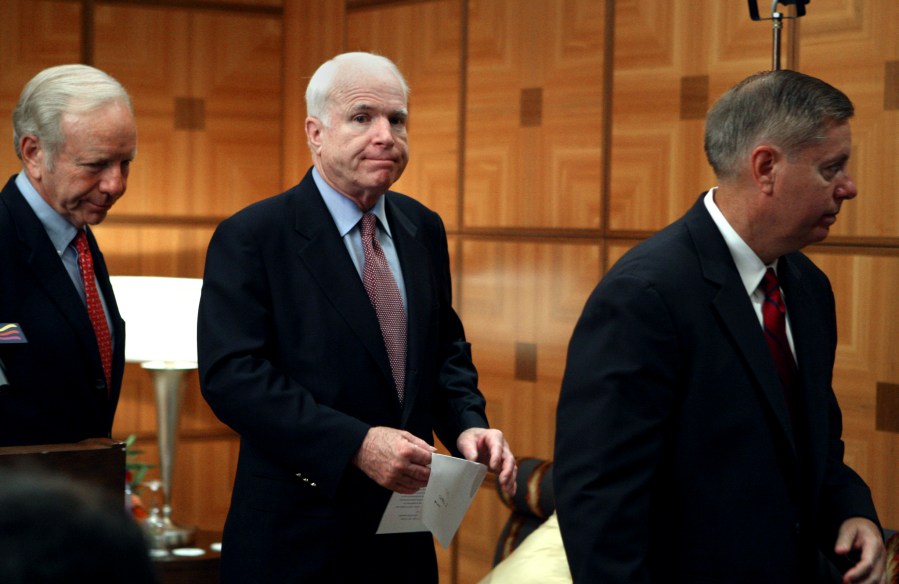
That tweet proved an embarassment later when a civil war broke out and America participated in a bombing campaign to prevent Gadhafi from murdering civilians, ultimately contributing to his ouster. McCain complained that the visit was overblown and that a subsequent leaked cable suggesting the senator tried to secure military transport planes for Gadhafi was inaccurate. It’s almost as if he felt it was unfair to judge an American political leader for shaking hands with a dictator (and giving them a shout out on Twitter from an overnight stay at their compound).
But if it’s specifically old communist regimes that he’s worried about, McCain knows a thing or two there as well.
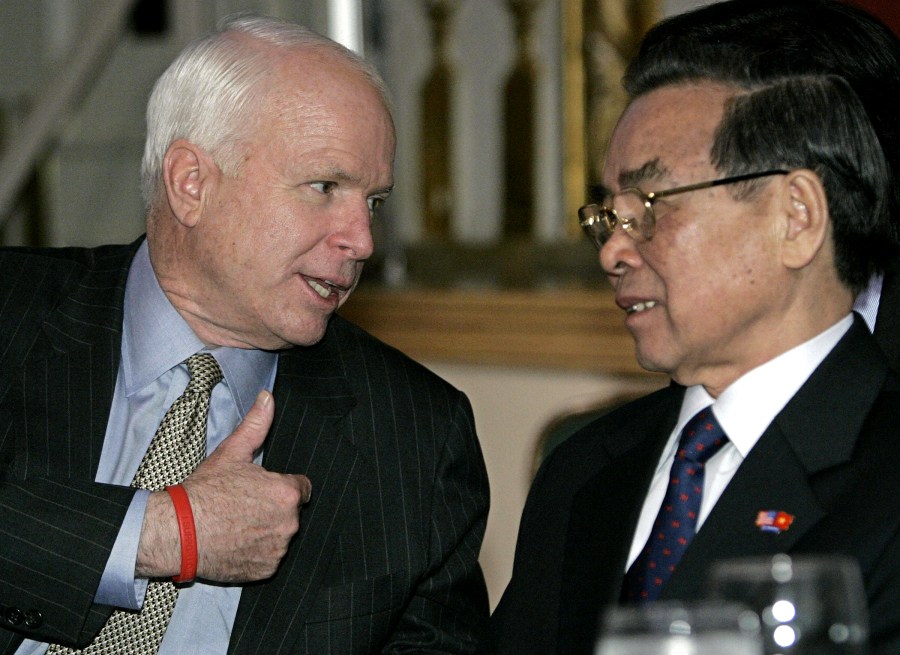
On the lower right is a 2005 photo of the senator with then-Prime Minister Phan Van Khai of Vietnam.
It was taken at a gala dinner honoring the world leader, who McCain introduced with a speech hailing the two nations’ improved relationship. He then shook his hand on stage.
Some context here: As a young fighter pilot, McCain was shot down and held captive in Vietnam for five-and-a-half years. But decades later, as a U.S. Senator, he joined several other veterans from both parties to advocate normalizing relations with Vietnam. In an incredible act of forgiveness, he met with his former captors, and Vietnamese officials handed over a helmet he had worn as a soldier as a gesture of goodwill.
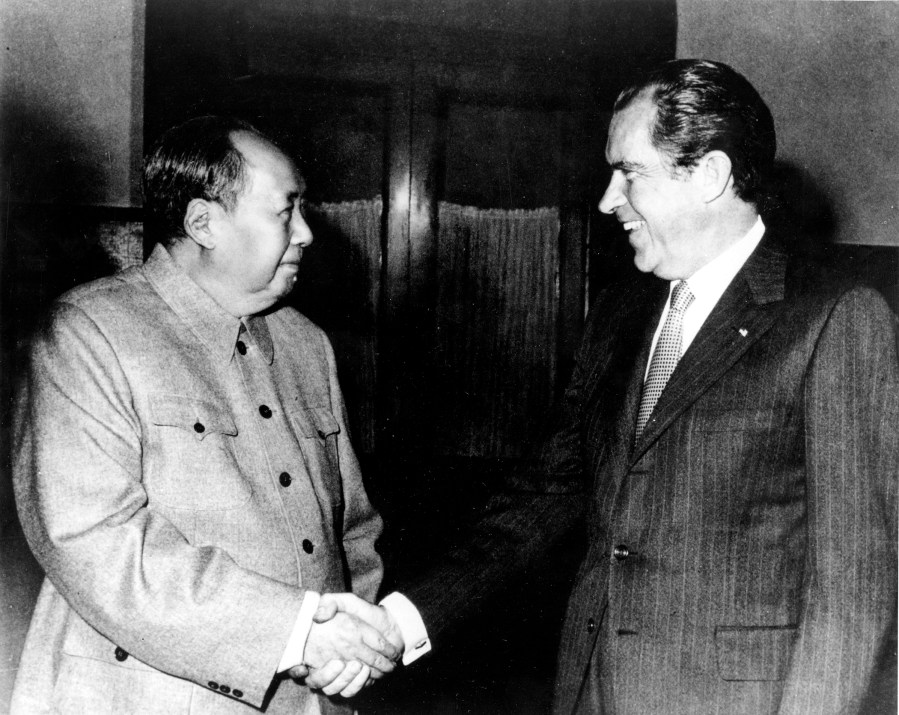
When President Bill Clinton finally announced a normalization policy, McCain stood by the president’s side at the speech and defended him from critics who accused the White House of buckling to a longtime Cold War enemy. In fact, critics made the same “propaganda” charge about Clinton’s actions that McCain made about Obama’s handshake. The below quotes are from a joint press conference he held with fellow veteran and then-Senator Bob Kerrey after the Clinton event. QUESTION: Senator, what do you say to some of the more radical elements on the Hill, who claim that the President is giving aid and comfort to the Vietnamese? MCCAIN: The only thing I can say is that, I believe the majority of the American people would strongly disagree with such a statement. And, I believe that, frankly, it’s uncalled for in American politics, and I don’t approve of such behavior. [Source: FDCH transcript, 07/11/1995] Vietnam is still a one-party communist state that silences dissent — and McCain has criticized their human rights record — but he’s steadfastly argued that both countries nonetheless benefit from their diplomatic ties. McCain was hardly the first Republican to shake hands with a communist leader. President Richard Nixon famously traveled to China to meet with Mao Zedong in pursuit of a deal restoring diplomatic ties. Obviously Cuba is Cuba, Vietnam is Vietnam, and China is China: each case had its unique circumstances that prompted McCain and other leaders to react the way they did. But of all people, a senator who has personally negotiated with anti-American dictators should see the absurdity in giving the Godwin’s Law treatment to a passing handshake in an unrelated foreign trip.
Benjy Sarlin Recommended