








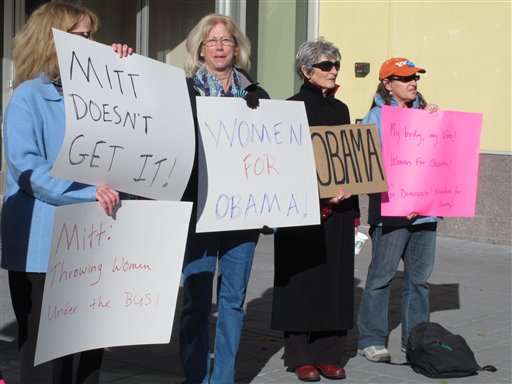
The Nov. 6 election was a historic one for female politicians–on the Democratic side anyway.
When lawmakers reconvene on Capitol Hill next year, there will be 20 women in the Senate and about 80 in the House. Never have those numbers been so high.
To top it off, American voters cast their ballots in November for the first openly lesbian senator (Wisconsin’s Tammy Baldwin), the first Asian-American woman in Senate (Hawaii’s Mazie Hirono), and the first Hindu-American in the House (Hawaii’s Tulsi Gabbard).
But with all those leaps forward, the Republican Party lags behind. Indeed, the bulk of gains for female lawmakers happened on the left side of the aisle. All three of the above women are Democrats.
Of the 20 female Senators in the 113th Congress, just four are Republicans. Of the five freshman women, just one—Deb Fischer—is a Republican. And of the approximate 80 women in the House next year, just 20 are GOPers.
But the GOP’s problem extends beyond the congressional gender imbalance.
“Their stances are just not modern,” ” said Jamie Chandler, Hunter College political science professor, of the Republican Party. “It’s 1950s Mad Men.”
Exit polls showed President Obama thumped Mitt Romney by double-digits among women (55% to 43%)—substantial as women make up the majority of the electorate.
Although Romney won a majority of white women’s votes (56%), there was still a gender gap among white voters. According to the Center for American Women and Politics at Rutgers University, 42% of white women, compared to 35% of white men voted for Obama.
Of course, some of it’s historical. By and large, women have long tended to favor Democratic candidates for their progressive views on social issues. Women, though, aren’t a monolithic voting bloc.
While much post-election analysis pointed to Republican candidates like Richard Mourdock in Indiana and Todd Akin of Missouri as ruining the party’s chances after lecturing the electorate about rape and pregnancy, it’s more than that.
“Instead of acknowledging [Mourdock and Akin] and trying to find a way to appeal women on healthcare, they dismissed it,” said Democratic strategist Maria Cardona. “The Republican Party didn’t do a whole lot to differentiate themselves from [Akin and Mourdock].”
Republican women leaders themselves are also acknowledging there’s a problem within their party. Former Secretary of State Condoleezza Rice said after the election that Republicans sent “mixed messages” on several issues, including ones pertaining to women. “And when you send mixed messages through the narrow funnel that is the media spotlight sometimes people hear only one side of that message,” she told CBS’ “This Morning.” Karen Hughes, a former George W. Bush adviser, went further, writing in an op-ed for Politico that “If any Republican man says anything about rape other than it is a horrific, violent crime, I want to personally cut out his tongue.” She noted “the college-age daughters of many of my friends voted for Obama because they were completely turned off by Neanderthal comments like the suggestion of ‘legitimate rape.” The GOP continues to hope to appeal to women on non-social issues. Republican strategist David Winston, who worked on Newt Gingrich’s 2012 presidential campaign, said boneheaded-comments on social issues cast a shadow over the No. 1 issue women really care about: the economy. “The focus is not where it should have been,” he said, adding that in the future Republicans must win the economic argument. Chandler said the GOP needs to phase out social conservatives as its core constituency. While it can’t go into 2014 with a completely different message, as it would be “too stark,” it needs to moderate its positions, and focus on issues like smaller government, personal libertie,s and giving everybody the chance to succeed.Recommended


