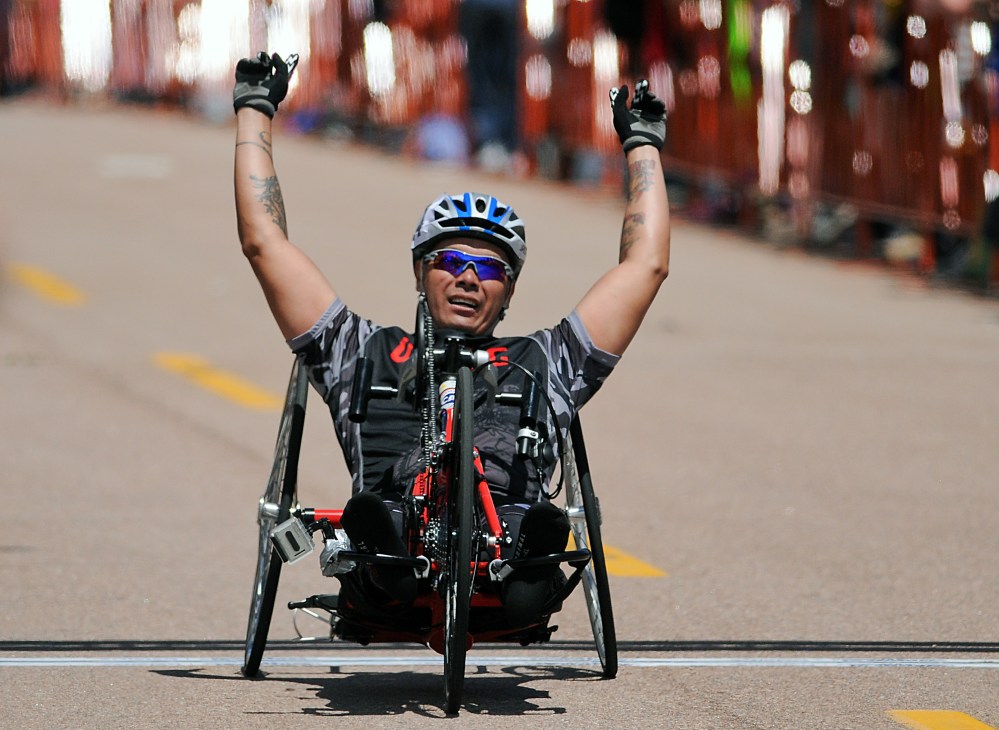
The runner sprints toward the finish line, on the last stretch of a 4×100 meter relay. He’s running for the Army in the Warrior Games, his team now neck-and-neck with the Marines in the last leg of the race. He surges towards the finish, crossing just two-hundredths of a second ahead of the Marine runner. The crowd cheers as the Army team takes the gold medal in a photo finish.
And in the midst of competition, a spectator might forget that most of these runners are missing limbs.
The 2013 Warrior Games gathers more than 260 injured service members from all over the world in Colorado Springs, Colo., to go head-to-head in various sports, including sitting volleyball, archery, swimming and competitive shooting.
“For some of these guys, maybe two years ago they were lying in a hospital bed, told they would never walk again or never be active and in a wheelchair the rest of their life and never do anything,” says Sgt. JR Salzman, who competed on the winning team in the 4×100 race this year. “And now they’re swimming laps in a pool or they’re on a cycle barreling down hills at forty miles-per-hour.”
Salzman is a retired Army sergeant who first heard of the Warrior Games when he covered them as a freelance journalist last year. He lost his right arm while on assignment in Iraq as an infantryman in 2006 when an improvised explosive device went off. But as a lifelong athlete, Salzman didn’t let his injury keep him from living an active life. He continues to compete as a professional lumberjack when he is not training for the Warrior Games in his spare time. In addition to his gold medal for the Army team in the 4×100 this year, Salzman also won a silver in cycling, and a silver in the 100 meter run.
For Major John Arbino, training for the Warrior Games has given him back a renewed sense of life since his illness has confined him to a wheelchair.
“I”m not one to sit around in a wheelchair and I was trying to find what I was going to do with my life,” says Maj. Arbino. “[Adaptive sports] gave me a whole new lifeline, gave me a whole new opportunity to do things I thought I could no longer do.”
Arbino was diagnosed with secondary progressive multiple sclerosis in January 2009, and had to begin relying on a wheelchair just nine months ago. But it was when he started training for the Warrior Games in December that something inside the major came back to life.
“I turned to them, the other 49 Army guys [on the team], as my inspiration, cause I see what they’re going through, and they’re fine with what their situation is,” says Arbino. “I look at my situation, and I’m just in a wheelchair. So I can do this.”
The major took home the gold medal in shooting this year, a proud accomplishment after spending three weeks a month over the last six months away from his wife and three sons.
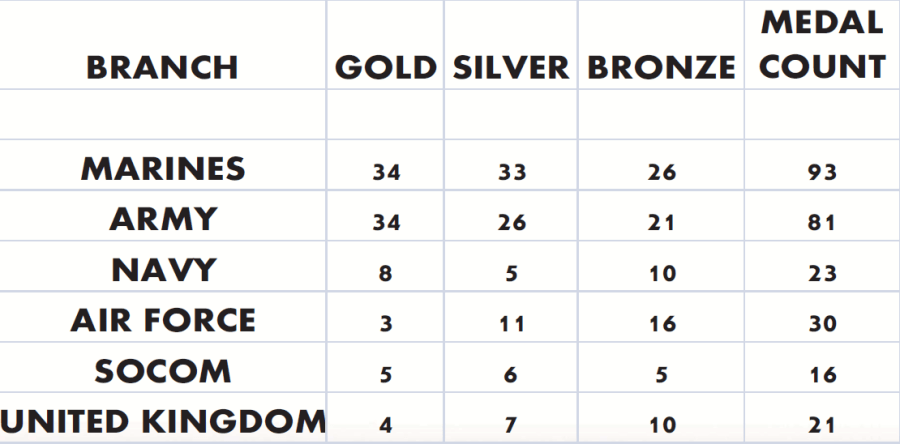
The Department of Defense and the U.S. Olympic Committee Paralympic Military Program have been teaming up since 2010 for the games. Service members from all branches of the military participate. “I think it sort of reaffirms where we all come from. We all have different stories,” says Sgt. Salzman. “You are surrounded by your own in that people know the sacrifice you’ve given and know where you’ve come from and what you’ve had to go through to get here.” The global competition this year received a royal visit from Britain’s Prince Harry. The prince teamed up with the British sitting volleyball team for practice Saturday, and also decided to compete with his fellow countrymen. Prince Harry returned to the games Monday to hand out three medals to the U.S. Army cycling team. The Army-Marine rivalry was as heated as ever. The two teams tied with 34 gold medals a piece, but the Marines edged out Army in the final medal count, 93 to 81. The Air Force came in third with 30 total medals. “I think we’re kind of all winners in that we’ve all managed to survive what we’ve all had to go through,” says Salzman. He pauses, then adds, “And a lot of other people did not.”
Lisa Crivelli Recommended