








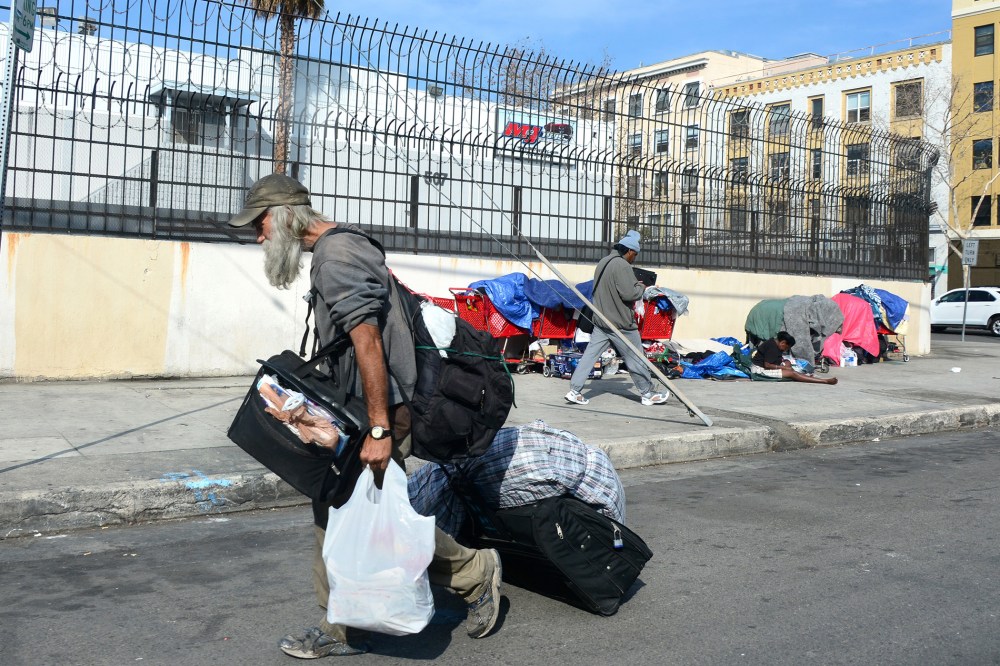
The criminalization of homelessness has been on the rise since early 2009 in a number of cities across the country.
A recent study by the National Law Center on Homelessness and Poverty examines the state of citywide bans targeting the homeless population in 187 cities across the country. These bans cover a number of public behaviors limiting the homeless’s capacity for daily survival. The report cites these legislative bans as punishing homeless individuals for “being in public even when they have no other alternatives”.
Citywide behavioral bans prohibit sleeping in public, begging in public, loitering, sitting or lying down in public spaces, food sharing, and sleeping in vehicles, among other behaviors.
“Many cities have chosen to criminally punish people living on the street for doing what any human being must do to survive,” the report states.
Initially, these bans sought to eradicate homelessness by addressing some of the underlying causes of poverty. However, the NLCHP report cites shortcomings in providing alternatives to the banned behaviors, rendering the criminalization laws ineffective. Additionally, these bans do not only affect the populations in specific areas of the cities; instead, they prohibit banned behaviors in entire communities city-wide, limiting the options for people trying to survive on the street.
The NLCHP study insists on changes to the homelessness support system on all levels of the government as a more effective solution instead of criminalizing the homeless. Perhaps the most significant change that can be made, the report suggests, is widening the scale of affordable housing in order to make necessary resources more accessible to homeless populations in cities across the U.S.
%22Despite%20a%20lack%20of%20any%20available%20alternatives%2C%20more%20cities%20are%20choosing%20to%20turn%20the%20necessary%20conduct%20of%20homeless%20people%20into%20criminal%20activity…%20Such%20laws%20threaten%20the%20human%20and%20constitutional%20rights%20of%20homeless%20people%2C%20impose%20unnecessary%20costs%20on%20cities%2C%20and%20do%20nothing%20to%20solve%20the%20problems%20they%20purport%20to%20address.%22′ The U.S. Department of Housing and Urban Development’s most recent headcount of the homeless revealed “significant and measurable progress” in homelessness rates across the country. Continuum of Care, the local planning organization for homelessness counts, counted 610,042 homeless people on a single night in January 2013. That figure represents an 8.2% decrease since the count in January 2008, when Continuum of Care counted 664,414 homeless individuals. However, the NLCHP notes that these numbers fail to take into account a number of factors including the number of jailed homeless people on the night of the count. Tristia Bauman, Senior Attorney at NLCHP sums up the problem in the criminalization report’s press release. “Instead of wasting limited public resources on strategies that do nothing to address the underlying causes of homelessness, and are often illegal, cities would be much better served by pursuing sensible, cost-effective, and humane constructive alternatives to criminalization.” What can lawmakers do to combat homelessness, without criminalizing it? Find out in our new #NoSafePlace report! http://t.co/srJhbKOrkq
Lauren Spurr Recommended


