








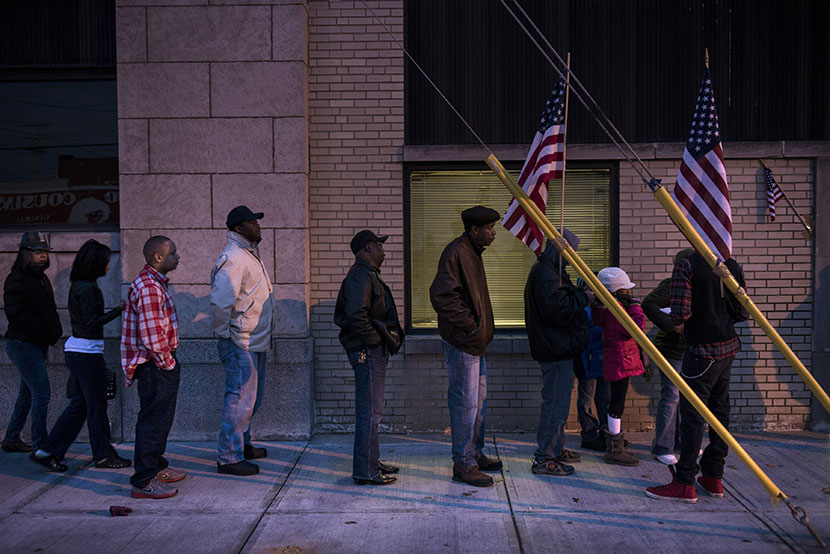
In theory, the Supreme Court didn’t strike down the meat of the 1965 Voting Rights Act in Tuesday’s 5-4 ruling, which requires states with a history of racial oppression to clear new voting laws with the federal government. In practice, the court did the closest thing: they asked Congress to fix it.
The Supreme Court ruling, written by Chief Justice John Roberts, concluded that Section 5 of the Voting Rights Act, which requires federal pre-clearance of state voting laws, was constitutional. But Roberts determined that Section 4, which sets the formula for which states are affected, had become unconstitutional—mostly because minority registration and turnout in the South had improved so much since 1965. Congress, he claimed, had violated these states’ rights by reauthorizing the VRA in 2006 using the same formula as it did in the 1975 version. However, he left the door open for Congress to modernize its standards and hope the new rule passes Supreme Court muster.
President Obama and voting rights advocates responded to the decision by immediately calling on Congress to do just that and draft new Section 4 standards. But legal experts, and even Obama’s own aides, have little hope that Republicans will actually approve a formula that preserves Section 5 in practice.
“[T]here is a theoretical path for Congress to update the statute in ways that would make it constitutional,” a senior White House official told NBC News, but “as a practical matter, that may be difficult to do given political dynamics.”
Democratic Senator Patrick Leahy, chair of the Judiciary Committee, said the decision “effectively guts the ability of Section 5 to protect voters from discriminatory practices” even as he pledged to do his best to repair the damage.
Why are Leahy and the White House so down on Congress? First of all, there’s a general sense that the legislature has grown too dysfunctional and partisan to come together on major policy bills in general, whatever the topic. But, since 2006, the GOP has also become more hostile to the Voting Rights Act, in ways that make it hard to imagine an easy fix.
In recent years, Republican state legislatures around the country have passed—or tried to pass—laws requiring citizens to show identification when they vote. Claims of out-of-control voter fraud have become an article of faith on the right—the 2012 GOP platform includes a plank supporting state voter ID laws and polls show as many as half of Republican voters believe Obama stole the 2008 and 2012 elections.
There is precious little evidence the type of fraud ID laws aim to prevent, in which one voter impersonates another in person at their local polling place, is an actual problem. A comprehensive study by News21, an independent news project funded by the Carnegie-Knight foundation, found only 10 valid claims out of more than 2,000 alleged cases of fraud. They concluded the practice was “virtually non-existent.”
But while the threat of voter-ID fraud may be a myth, it’s a fact that large swaths of the voting population, especially poorer residents, minorities, and college students, lack an ID card, which often requires a fee to obtain. Civil rights groups have accused GOP state legislators of using voter ID laws to depress turnout among these mostly Democratic-leaning demographics. And one of the biggest allies minority groups have on their side is Section 5 of the VRA.
In Texas, to name one example, state lawmakers passed new ID requirements in 2011 that would have left an estimated 4% to 6% of the population unable to vote. The Justice Department successfully blocked from taking effect. The DOJ has effectively stopped eight other election changes approved by Texas since 2008. With a federal government sign-off no longer needed, Texas and other Southern states’ laws face a much better chance of surviving judicial scrutiny. In fact, Texas Attorney General Greg Abbott announced just after the Supreme Court’s decision on Tuesday that he’d move to implement the state’s voter ID law “immediately.” Republican voters and legislators alike will almost certainly view any widespread reauthorization of the Voting Rights Act as a Democratic push to block these types of bills. Thus the discussion should quickly turn from racial discrimination to claims that the law is a partisan power grab. Even if Republicans softened their stance on voting restrictions—and they won’t—there’s a reason that Congress was so content to adopt 1975 standards up until now. The alternative was the awkward debate they face now over what should replace it. “What they did in 2006 was easier than saying ‘Let’s figure out which states are racist and which ones aren’t,’” Adam Winkler, a professor of law at UCLA, told msnbc. “If we look at history we can probably determine it…but today it’s not a comfortable question to ask. I think that it’s just too fraught an issue and too incendiary for Congress to take up again.” Here Justice Roberts has a point, though not the one he probably intended. Voter ID laws and efforts to curtail voting hours are major fights not just in the South, but in states like Ohio and Pennsylvania that host large African-American populations. One could make the case that the old Section 4 standards should be updated to take this into account, but there’s no way Congress is going to open that can of worms. Barring a huge shift in the political climate, Section 5 is likely to remain dormant.
Benjy Sarlin Recommended


