








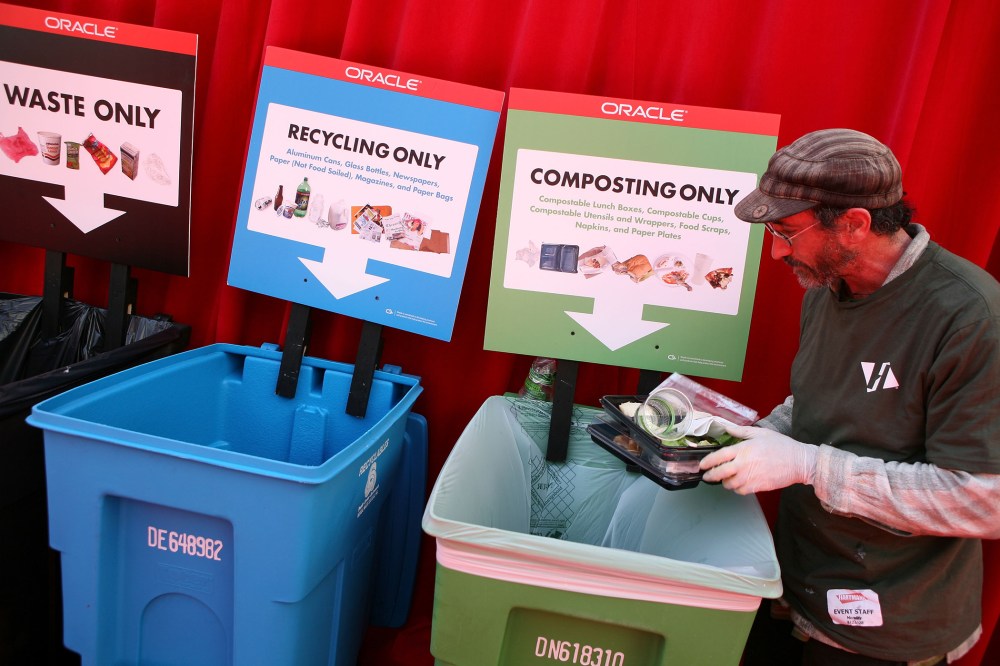
In 2009, San Francisco implemented a policy mandating that residents compost their food waste. That year, the EPA estimated that over 97% of municipalities’ discarded food was ending up in either landfills or incinerators. Besides being an undeniably shameful amount of food to waste (tens of millions of tons) in a country where millions go hungry, this staggering amount of organic refuse was burned and left to decay, needlessly releasing various greenhouse gases into the atmosphere. San Francisco may have only addressed a small portion of the United States’ enormous food waste problem; however, it and other forward-looking cities could be serving up significant solutions for the nation to follow.
Since the introduction of the Integrated Waste Management Act of 1989, California state legislation has established financial penalties for local governments that do not meet certain landfill waste diversion goals. By the mid-2000’s, San Francisco was exceeding the state’s goals, but was falling behind those it had set for itself (75% landfill diversion by 2010 and zero waste to landfills or incineration by 2020). After the city’s diversion rate began to slow down, the city felt its voluntary recycling and composting policy effective enough.
At the same time, the city would soon be approaching the maximum capacity of solid waste disposal agreed upon in its contract with the Altamont Landfill in Alameda County. Any new contract would undoubtedly result in much higher trash collection rates for the city. Spurred by both environmental and economic concerns, the San Francisco Board of Supervisors passed the Mandatory Recycling and Composting Ordinance of 2009, requiring all San Franciscans to “separate recyclables, compostables and landfilled trash and participate in recycling and composting programs.”
San Francisco’s residents continued to subscribe to the city’s long-time garbage collection monopoly, Recology (which had recently changed its name from Norcal Waste Systems, Inc.). The Board of Supervisors provided a framework for how Recology would manage street-level enforcement of the new recycling and composting policy. According to the ordinance, collectors are to leave explanatory tags on bins containing misplaced waste. If a resident repeatedly fails to separate the refuse, the collectors would continue to leave tags and could stop collection upon sending a written notice. The city could fine these residents a maximum of $100 for their first violation of the new rules.
Five years in, the city has yet to issue any fines to residents. The city contends that its collection service rate structure (which charges much less for the weekly pickup of recyclables and compostables than it does for other refuse) provides enough of a financial incentive to avoid necessitating residential fines; however, the Department of the Environment has asserted that it would be willing to explore utilizing fines in the future, if residents’ compliance with the ordinance became unsatisfactory.
San Francisco’s composting program affects more than just the city’s residents. Recology sells compost as a nutrient-rich organic fertilizer, of which vineyards in Napa Valley and Sonoma County are some of the highest consumers. Besides providing nutrients, the compost keeps soil moist, helping to prevent soil erosion and other deleterious effects of California’s extreme drought.
On October 5, 2012, San Francisco Mayor Edwin M. Lee announced that the city had reached an 80%landfill diversion rate, the highest of any major city in North America. However, it’s important to recognize that California’s legal definition of “diversion rate” is not what some San Franciscans might think it is. California permits cities to count some heavy construction debris and compostable material as “diversion” even though it ends up in a landfill. San Francisco’s Department of the Environment asserts that it supports recent state legislation that disallows landfilled compost from being credited in diversion rates. That law goes into effect in 2020. The Department of the Environment also contends that its current policies minimize the amount of compostables that can be used in a landfill. In spite of all this, San Francisco is recognized and often esteems itself as a role model in sustainability for the rest of the country.
Portland
In 2012, months before San Francisco proclaimed its 80% diversion rate, the city of Portland, Oregon had already professed a goal of becoming the best city in the nation at promoting sustainability and reducing environmental harms via effective solid waste and recycling collection. That summer, the City Council passed an ordinance strengthening the city’s curbside compost collection program which had recently begun to include food scraps instead of just yard waste. While San Francisco mandated that compostables, recyclables and trash must be separated, Portland simply prohibits the trash contaminating recycling or compost bins.
As of yet, Portland has refrained from issuing any fines to residents. When residents incorrectly separate their waste, they’ll simply receive tags on their containers explaining the proper method. This reflects the City Council’s original intentions for the ordinance that public education and outreach should remain the primary method for encouraging refuse source separation.
Portland’s Bureau of Planning and Sustainability orchestrated a large media campaign in the lead-up to the new food scrap collection service. The BPS also delivered to each resident a gallon pail intended for collecting food scraps in their kitchens, in addition to multiple information packets explaining the changes. Every six months, residential subscribers continue to receive the BPS newsletter Curbsider, which provides more information and examples on how the community can increase food scrap collection and promote overall sustainability.
Prior to the new policy’s implementation, Portland residents received garbage collection every week but compostables collection only every-other week. With the inclusion of food scraps in compostable bins, city planners thought it pertinent (partly for olfactory concerns) to flip those frequencies by collecting compostables on a weekly basis and collecting ordinary garbage every-other week. The city also now incentivizes residential subscribers to opt for smaller garbage bins and even less frequent (every-four weeks) garbage pickups by offering discounts on their collection service rates.
The BPS considers these collection frequency changes to be very important to the successes of its new service. During the first year of curbside food scrap collection, over 85,000 tons of residential compost was collected, which is almost triple the amount of compost that was collected the year before. Also, a 2012 study indicated that at least 78% of residential subscribers were including food scraps in their compostables containers.
According to the BPS, since these service changes were introduced, Portland’s landfill diversion rate has increased from 50% to around 70%, which is close to double the nation’s average. The BPS also touts that the major reduction in overall garbage collection has allowed for the city to lower waste collection services rates in both 2013 and 2014. It appears that Portland is experiencing both environmental and financial benefits by encouraging curbside food waste collection.
Seattle The city of Seattle, Washington has been offering similar curbside food waste collection since 2005. Last year, the City Council passed an ordinance mandating that food be completely excluded from residential garbage. The city expects this prohibition to divert an additional 38,000 tons of food scraps from landfills, significantly aiding Seattle in reaching its 60% total waste recovery goal by the end of this year. Mandatory food waste separation started for residents on January 1st of this year; however, in accordance with the ordinance, the city will not be issuing fines ($1 per collection) to residents with misplaced trash until July 1st, 2015. In the meantime, Seattle is placing educational tags on containers with improperly separated waste. It was widely reported (NPR, The Atlantic) that the bright red design of the tag was meant to socially embarrass their recipients, as a scarlet letter of sorts; however, Seattle Public Utilities has denied these claims. SPU response to our inquiry regarding whether embarrassment was the goal of the educational tags: “Not at all. We owe all of the city’s recycling and composting success to our customers and would not want to put any of them in that position. The notices were brilliantly colored to be visible to the customer. In January, many of our customers come home from work and retrieve their garbage cans from the curb when it is dark. We have not heard any complaints from our customers about the color of the notices.” –Timothy Croll, SPU Director of Solid Waste By March 15th, garbage collectors had left 6,100 educational tags (on both recyclables and compostables containers), amounting to around 0.7% of the total collections. During the last fifteen days of that period, the percentage of collections tagged was only 0.27, possibly signaling the tags’ effectiveness at informing recipients of the new mandate. The city has been utilizing direct mail, web advertising, and social media to further educate Seattle residents. SPU market research shows that, by March 15th, 71% of garbage collection service subscribers were aware of the new food waste rule. For years now, nearly all Seattleites have had access to compost bins where they could dispose of both food and yard waste, and over the past decade, the total tonnage of compostables collected per year has more than doubled. SPU estimated that in 2014, already 60% of residents’ food waste was being composted. Now that it’s mandatory, the city expects that number to rise fairly quickly without much pushback. Ultimately, residential composting is merely a minor tool in combating our massive food waste problem. Yet, municipalities seeking ways to support sustainability should pay attention to these cities’ experiences. The results of their policies and their respective balances of educational outreach and incentives may provide great insight into what works best for different types of communities. Currently, New York City is experimenting with food waste collection pilot programs, and the state of Vermont is proactively banning food scraps from landfills after 2020. We won’t be able to keep burying either food scraps or our heads in the sand; food waste landfill diversion is increasingly becoming a serious public policy concern.
James Long Recommended


