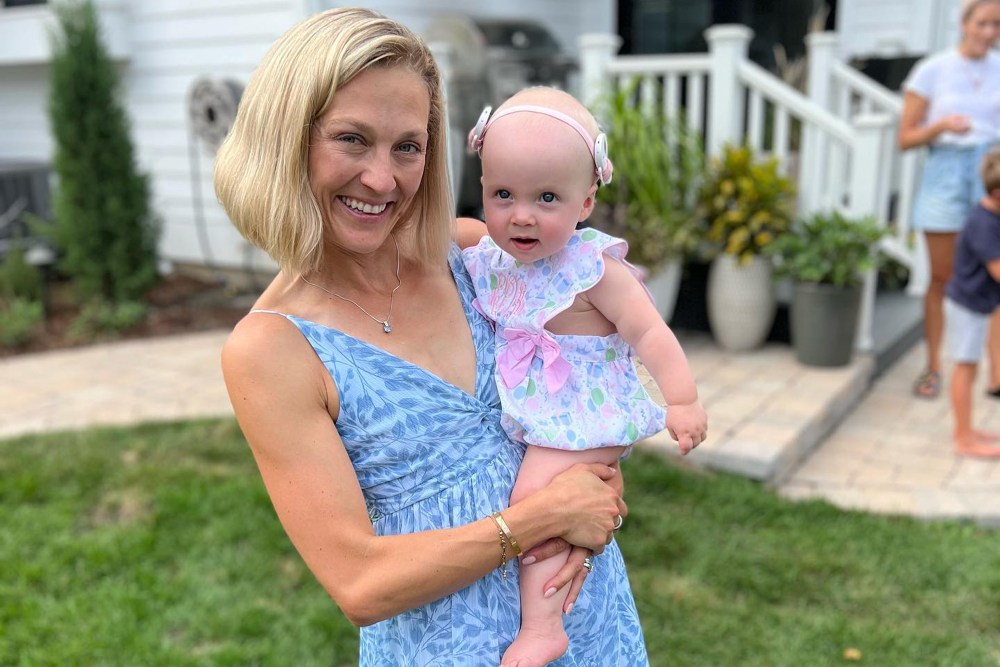
Editor’s note: In 2021, Leslie Danford launched her business when she was pregnant with her fourth child. After failing her newborn hearing screen, Danford’s infant was later diagnosed with Usher Syndrome, Type 1B, a rare genetic condition that impairs hearing, balance and will likely cause vision loss in childhood. While there is no cure for Usher Syndrome, many promising therapy treatment studies have emerged.
If there’s one thing I’ve learned about life at 40, it’s that you have no idea what’s coming around the corner. It could be something that will change your life forever.

In early 2020, I lost my dream job in the hospitality industry due to the global pandemic and it felt like I had lost my identity. A few months later, I found out I was pregnant with my fourth child – right in the middle of getting my newborn business, Vitaminis, off the ground.
As it happened, I had no idea what was coming next. My pregnancy had been normal and my daughter was born healthy. We even got to leave the hospital a day early so that she could meet her three brothers at home who were excited to see her!
An unexpected diagnosis
The only surprise was that she failed her newborn hearing screen at the hospital, but since we had three hearing children and no family history of hearing loss, we thought nothing of it.
The nurse confidently told me my daughter probably just had some fluid in her ears. I did notice that she was an excellent sleeper, not perturbed at all by the noise in our full house, but I simply counted myself lucky.
When we finally completed the follow-up testing about two months later, we learned that our beautiful baby girl had bilateral, severe-to-profound sensory-neural hearing loss. In other words, she was deaf. My husband and I simply couldn’t believe it.
The diagnosis was so unexpected, with no connection to our history or experience, that we could not understand how it could be true. We ordered a second test, with the same results. As part of the routine follow-up testing for hearing loss, we submitted our daughter’s blood for further genetic testing.
While of course many people live full and happy lives with hearing loss, our family was plunged into a period of grief. Our daughter would never hear the joyous laughter in our house, the sounds of her brothers playing or her parents’ voices.
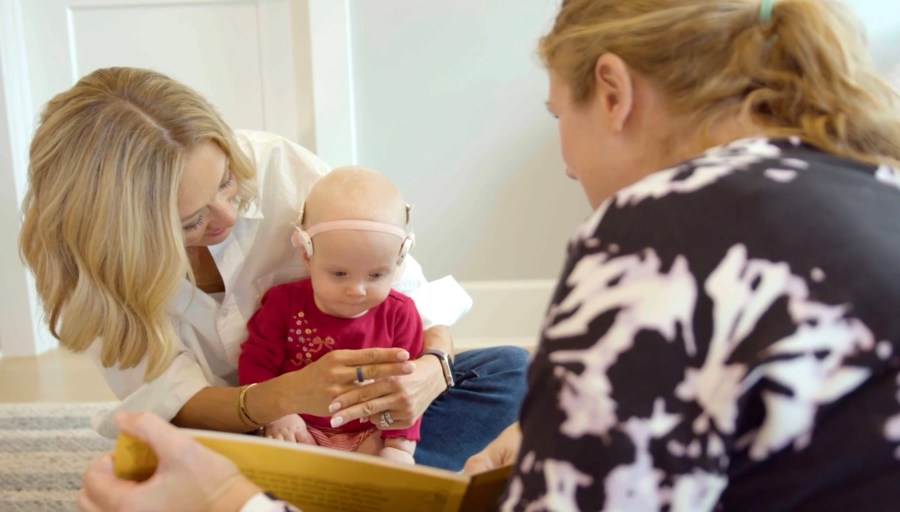
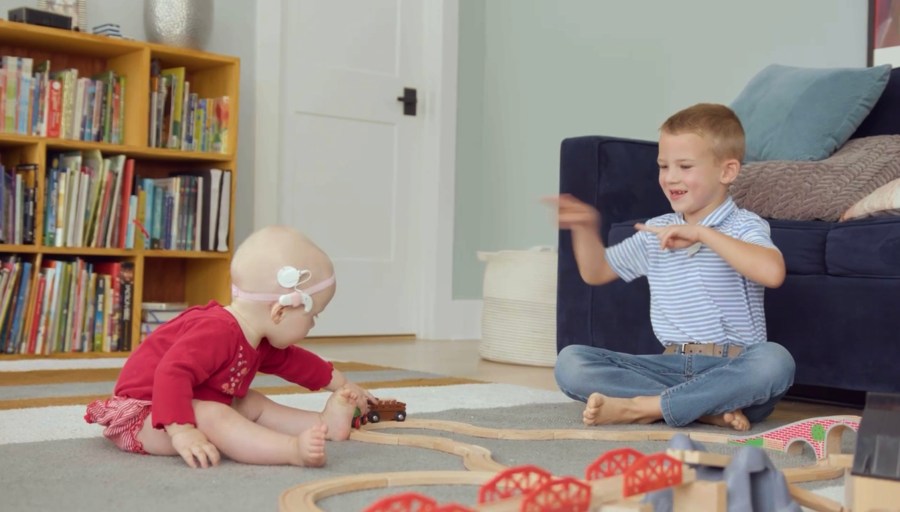
Then we learned about cochlear implant technology, which gives access to sound via a medical implant. For a hearing family of five with one deaf child, this technology was a godsend. Our daughter could participate in the sound world of our family life after all. We also pledged to learn sign language as a family, so that we would have a way of communicating with our daughter in the event she was without her cochlear implants.
After two months of processing the hearing loss diagnosis, we were finally comfortable with our new way of life. Our youngest would be embraced and included by our family, with all of the tools and support she would need.
‘The worst thing that could happen to a deaf child’
Then the genetic test results came in (after nearly three months of processing). There was an explanation for our daughter’s hearing loss: She had Usher Syndrome, Type 1B.
Those with this condition are born with hearing loss, and sometimes vestibular (balance) issues. Worst of all, they will lose their vision over time, starting at the periphery and narrowing down more and more, until there is nothing left, typically by the age of 10.
It turns out my husband and I both carried the autosomal recessive gene for this condition, meaning that there was a 1 out of 4 chance that our offspring would have it. Here was our fourth child, with the syndrome.
If you had asked me what’s the worst thing that could happen to a deaf child, I would have said it’s taking away her vision. We simply could not imagine a world that was both silent and dark.
Would she have friends, grow up and have a family, be able to pursue any occupation she desired? Just after we had emerged from the grief and acceptance cycle of the hearing loss diagnosis, we were plunged back into it again.
There was a period of time where my husband and I would cry ourselves to sleep, then wake up and remember, and cry all over again. We told our other children – ages 5, 6 and 8 at the time – but they were too young to really understand. Friends were sympathetic, but they couldn’t relate to what we were going through.
Seeing the light
Like many of us do when faced with uncertainty, we scoured the internet. I read all about Usher Syndrome and searched for stories of people living with it.

I soon discovered NBC News Chief White House correspondent Peter Alexander has a sister – Rebecca Alexander – not just living but thriving, despite having the condition.
Her strength and positivity inspired me to hope, finally. I devoured her book and started to see that having Usher syndrome was not a death sentence. There was so much possibility despite the challenges of the condition.
We found other families on the same path as ours. The Porcanos – whose daughter was also born with Usher Syndrome Type 1B – established Save Sight Now, a group that raises funds for researching a cure. We also partnered with the Foundation Fighting Blindness. We learned about the promising research being done to halt and even reverse the vision loss and retinal degeneration associated with Ushers. There is so much hope with technologies like CRISPR and gene editing, particularly when thinking about a decade-long time horizon. We started to see the light. Throughout all this, there was a worry in the back of my mind. Of course, my daughter’s health and our family’s plan for dealing with her condition was top priority, but what about Vitaminis? The business was finally getting off the ground, after all of the hard work and investment I’d put into its launch. If I abandoned it, all of that would be wasted. As I realized my daughter would need extensive therapy to learn to use her cochlear implants, address her vestibular disfunction and manage her vision loss, not to mention learning sign language, I began to feel hopeless. How could I possibly run my own business on top of all that? If I were to spend time on this venture, was I just being selfish when my daughter and family needed me? I took my foot off the gas for a while to think it all through. Eventually, we found therapists, a sign-language teacher and Deaf culture mentor. We began setting up our support network and regular childcare. As our routines became more established, I could feel the constraints on my time loosen up. I thought through the scenarios: If I abandoned Vitaminis, how would I feel about it years from now? If I was able to continue working on it, is that something I would regret? I came back to one of the driving motivations that I’ve leaned on as a working mom throughout my career. Spending time on something outside of family does not mean you are selfish or taking something away from them. It also means you are a role model and setting an example for what hard work can do, when you invest in your future. Given my daughter’s diagnosis, this became all the more meaningful to me. I did not want her to see me give up in the face of challenges. I wanted her to see that with the right support, plus hard work and perseverance, she could pursue her dreams, even in the face of what might seem like impossible odds. I decided that as long as my family’s needs were being met, I would continue to build my business. I arrived at that realization nine months ago – and it’s incredible how far we’ve come. Our family has a basic working knowledge of American sign language, and our daughter – now 15 months – expresses a few signs. Her cochlear implants are active, and she is processing and reacting to sound. We’ve fundraised to support critical research toward several promising milestones in the mission to save this community’s vision. At the same time, Vitaminis just launched its second product, with more growth planned in 2023. While we have a formidable journey in front of us, I like to think that on the difficult days we focus on gratitude, the progress we’ve made so far and the horizon ahead. I want my daughter to know that no matter what challenges life has in store, she can dream big, chase those dreams and build her life with those she loves cheering her on.
Leslie Danford Recommended


Back to business