








For Mindy Kaufman, the threat of a government shutdown isn’t about Democrats or Republicans. It’s about her livelihood.
More than 2,500 miles west of Washington, Kaufman runs Spin and Margie’s Desert Hideaway, a five-room bed-and-breakfast near Joshua Tree National Park. If Congress can’t pass a budget before September 30, “we would lose reservations within days,” she says—right at the beginning of the park’s high season.
If the shutdown continues for weeks, she adds, “we would go out of business—absolutely.”
A shutdown would affect federal workers, military service members, and government contractors directly, and, downstream, would also hit millions of American families and businesses that rely on government services. Washington’s dysfunction could significantly damage the U.S. economy.
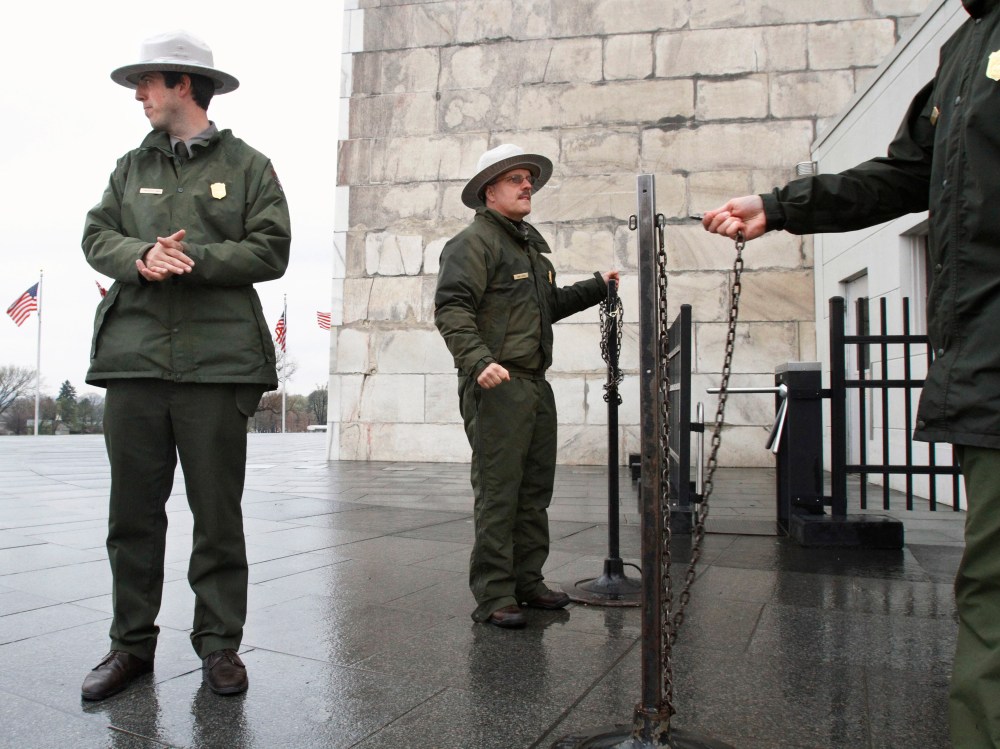
Under a shutdown, the government would continue to provide essential services to protect the public’s health and safety, including air traffic control, national security, and mandatory payments like Social Security. But huge swaths of government activities would come to a standstill: paychecks to military service members would be delayed, passport offices and national parks would be closed, and mortgage servicing by the Federal Housing Administration would be suspended.
A brief shutdown—say, three to five days—would have minimal economic impact. “Although terribly irresponsible, and certainly disruptive and inefficient, it is not a major crisis,” says Isabel Sawhill, a senior fellow at the Brookings Institute and a former Clinton budget official. “A few days would be more of a nuisance than an economic problem,” says Mark Zandi, chief economist at Moody’s Analytics.
If the shutdown continued for weeks, however, it would deal a much bigger blow to the entire economy. Zandi estimates that a month-long shutdown could completely wipe out any economic growth this quarter: He expects the economy to grow only 1.5% this quarter, and a lengthy shutdown would depress growth by 1 to 1.5 percentage points, according to his estimates.
“It starts out being a non-factor, then it builds exponentially and really starts to hurt growth,” says Ethan Harris, head of North America economics at Bank of America Merrill Lynch, who believes there’s a 30% chance of a shutdown or debt-ceiling breach. Economists are particularly concerned about the drag on the housing market, as the federal government would be unable to insure mortgages.
The far bigger threat is the debt ceiling, which the US is scheduled to hit some time between October 18 and November 5. If enough Republicans refuse to raise it, as they have threatened to do, the government would default on payments it’s already promised to make.
Washington could prioritize certain payments over others—say, to Medicare and defense—but the government would be force to default on a staggering 32% of all payments, according to the Bipartisan Policy Center. Entire agencies would be shuttered, and financial markets would tank. “Like most people, I think it just can’t happen because it’s just unreal—it would be so incredibly stupid,” says Sawhill. But given how serious the consequences would be, the mere threat of breaching the debt ceiling could also chill the economy. If there’s a shutdown, for instance, investors and businesses “will worry they won’t agree on the debt limit,” says Zandi, which could begin to spook the markets and overall confidence in the economy. For now, there’s still the expectation that Congress and the White House will come to a last-minute deal. “Unless they go over the deadline, going up to the brink probably won’t create too much reaction—they’ve cried wolf too many times here,” says Harris. He warns, however, that even the best-case scenario could hurt us in the long run. “The cumulative effect of one act of brinksmanship after the other drives a deep distrust on the reliability of the federal government,” says Harris, who believes these budget battles have already held back job creation, business investment, and capital spending. Kaufman simply hopes that Congress can pass a budget before September 30, as they need to “if they’re really concerned about job growth and continuing prosperity,” she says. “The small businesses here would be devastated for the sake of this bull—t battle.”
Suzy Khimm Recommended


