








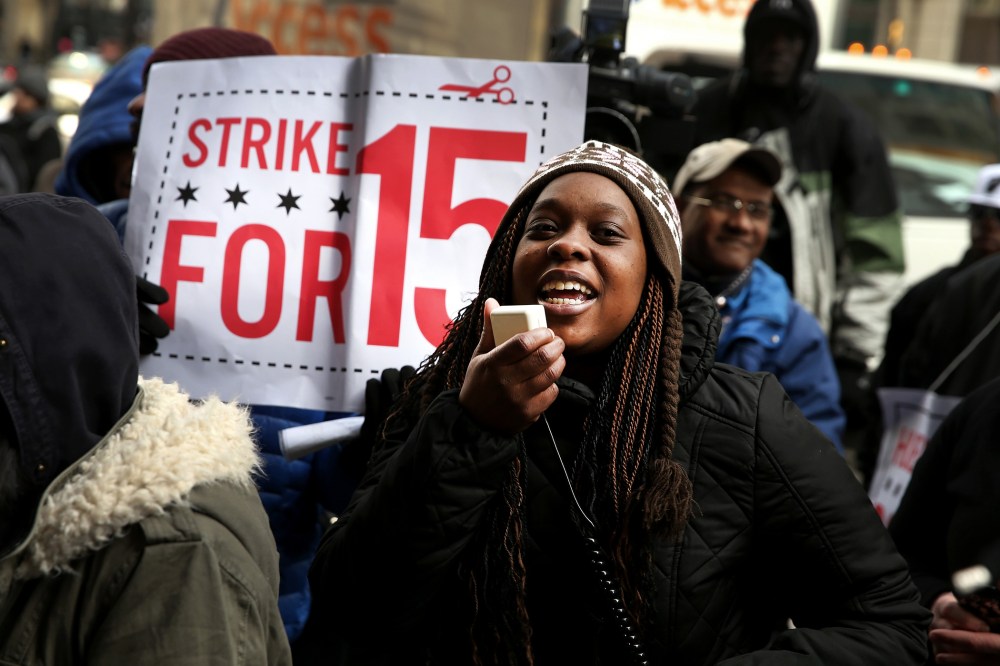
Just a little over one year ago, about 200 fast food workers held a surprise work stoppage in New York City. At the time, it was the biggest strike to hit restaurant chains like McDonald’s, Wendy’s and KFC. But it was miniscule compared to what happened this week.
After a year of grassroots organizing and community networking around the country, the burgeoning fast food workers’ movement held its biggest strike yet on Thursday. Organizers say the strike encompassed fast food locations in one hundred cities across the United States. The last most recent national action, which occurred in late September, affected 58 cities.
“We’re going to do whatever it takes to get this $15 wage and a union,” said Latoia Caldwell, a striking Wendy’s employee in Kansas City, Mo.
Like many of the striking workers, Caldwell was driven by desperate circumstances. A mother of four, she has spent six years working at Wendy’s full-time. Yet she and her four children spent an entire year living in a homeless shelter, and have only recently found housing elsewhere. Following two years of employment at one Wendy’s in particular, Caldwell still makes $7.35, Missouri’s legal minimum wage.
“These are starvation wages,” said Caldwell. The median hourly wage for fast food and counter workers is under $9, according to the Bureau of Labor Statistics, making it one of the lowest-paying jobs in the United States.
Inequality has been receiving greater attention from political elites over the past several months. On Wednesday, the day before the strikes, President Obama referred to income inequality as the “defining challenge of our time.” The administration also supports a bill that would raise the federal minimum wage from $7.25 to $10.10 and tie it to inflation. But workers are demanding more: a $15 per hour wage floor and union representation.
At least some of those workers could have their wages lifted by way of a unilateral executive order from the president. In Washington, D.C., the strikers included federally contracted workers at workplaces such as the McDonald’s within the National Air and Space Museum. Because that particular McDonald’s has a contract with the federal government, workers and their allies are calling on the president to sign an order requiring that all federal contractors pay their workers a living wage.
McDonald’s acknowledged the nationwide protests in a statement, but denied that workers were actually striking.
“Outside groups are traveling to McDonald’s and other outlets to stage rallies,” according to the statement. “Our restaurants remain open today–and every day–thanks to our dedicated employees serving our customers.”
While labor unions, religious organizations and other activist groups have protested alongside the workers, organizers insisted that workers themselves were at the center of the campaign.
“In the final analysis, it is their direction, their strategy, and their effort that will move this demand,” said Rev. Martin Rafanan, community director of the St. Louis based organization STL Can’t Survive on $7.35. It’s not just corporate spokespeople who are skeptical about the movement. In early November, In These Times published an article reporting that many organizers and activists involved with the campaign were concerned about the role which the Service Employees International Union (SEIU) plays in supporting the campaign. “[M]any questioned whether Fight for 15 is fundamentally a worker organizing campaign or a “march on the media,” and many believe the endgame will be determined by an SEIU leadership that is not in contact with the daily realities of the campaign,” according to the article. “Here in Missouri, that’s not our experience,” said Rafanan. The movement has only grown in that state, he said, because of worker leadership. An SEIU spokesperson passed along a statement from union president Mary Kay Henry supporting the strikes, but did not respond to a request for comment on the In These Times article.
Ned Resnikoff is an urban policy analyst, researcher, writer, and editor. His byline has appeared in a variety of publications, including the New York Times, San Francisco Chronicle, Dissent, and The Nation. He writes the newsletter Public Comment, which can be found at publiccomment.blog. Recommended


