








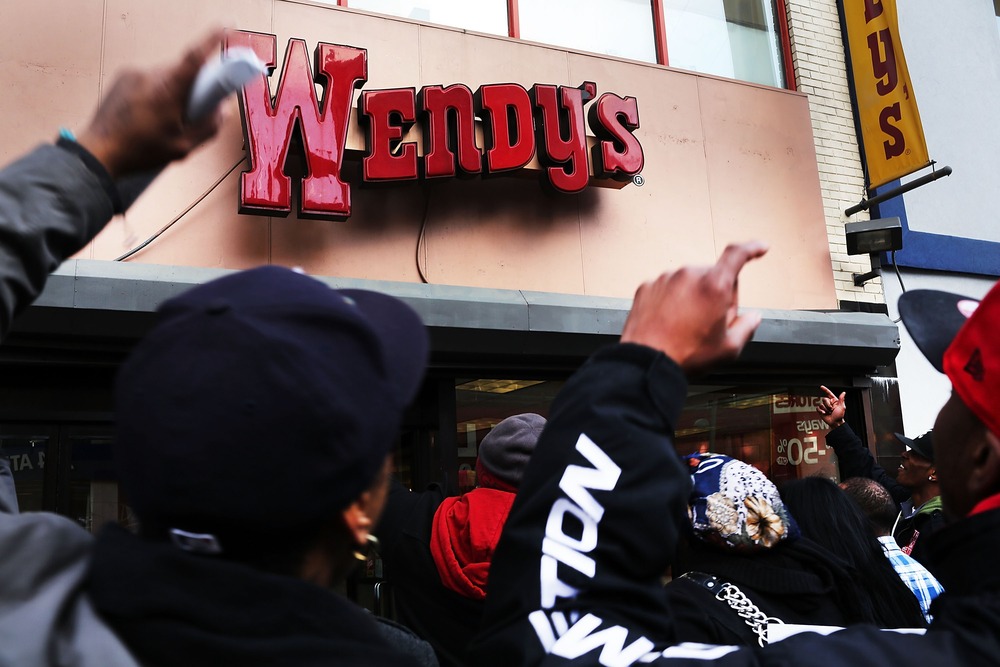
Hundreds of workers from fast food outlets across New York City went on strike Wednesday morning, demanding higher wages and recognition for a new union called the Fast Food Workers Committee. This strike is only the latest in a spate of labor actions within service and retail sectors over the past few years, the most recent of which was the Black Friday Walmart strike.
Low-wage service and retail organizing “really seems to be exploding now,” said Columbia professor Liza Featherstone, a frequent reporter and commentator on labor issues. In addition to Walmart and New York fast food chains, a number of other service and retail employers have also seen recent labor action: The SEIU’s Justice for Janitors campaign has organized tens of thousands of janitors since 1990s; young restaurant workers have become increasingly militant, and just this week, bakers at New York’s Hot and Crusty signed their first union contract.
What all of these workplaces have in common is that they use low-wage labor in what have become linchpin industries for the U.S. economy. “With the substantial number of people employed in the retail industry, I think it’s very analogous to what manufacturing used to be,” said Featherstone.
Indeed, as the number of American workers employed in manufacturing has steadily declined since the mid-1970s, the service sector’s population has exploded. However, most of the recent growth has been in precarious labor: jobs with low pay, very high turnover and few benefits. The fast food industry offers some of the worst of these jobs, hence the “McJobs” monicker often applied to low-wage service or retail work. According to the Bureau of Labor Statistics, fast food work is the lowest-paying occupation in America, and the median salary for a fast food worker in 2010 was $18,130 a year—meaning that the average fast food worker in 2010 was at exactly the federal poverty line for a family of three.
According to labor journalist Sarah Jaffe, organizers for the fast food strike found poverty-level conditions when they began speaking to workers. “They’ve found that overwhelmingly, those workers can’t afford basics like food, rent, or a Metrocard to get to work,” wrote Jaffe.
Featherstone said that the recession may have laid the groundwork for the recent wave of strikes. “There’s been a leaner and leaner corporate response to economic hard times,” she said. Companies have grappled with the downturn by looking for areas to cut costs, and one of the major ways they’ve done that is by trying to extract more labor from their employees in exchange for less pay.
Exhibit A would be Walmart, where same-store sales dropped 1.8% between 2009 and 2010. “Walmart hasn’t been able to grow in recent years as it once was, and its sales have been sort of disappointing to its shareholders,” said Featherstone. “Walmart has been taking out its troubles, as companies are wont to do, on its workers.”
The fast food industry has weathered the economic downturn more successfully than Walmart; McDonald’s sales actually increased in the year after the collapse. As profits increased, so did employment: other industries continued to stagnate post-collapse, while the fast food industry surpassed its previous employment peak. The fact that so much of recent job creation has been concentrated in low-wage service and retail sector jobs has led some to label the current economic climate as “the McJobs economy.” The number of new workers who felt they had no other choice but to work in the fast food industry may have contributed to overall worker dissatisfaction with their labor conditions—and, therefore, set the stage for a strike.
But that’s not the only thing that’s different about service and retail workers now, compared with 20 years ago. Featherstone said unions and labor organizations are also getting smarter and more flexible in how they organize. In the case of the fast food strike, the organizers didn’t even come from a traditional union—40 organizers from the community group New York Communities for Change spent months building a network of workers and laying down the infrastructure for the strike. “In some ways this is something new,” said Featherstone. “This idea of organizing through community organizations, through worker organizations, that are more flexible and reflect the contemporary workplace, and the fact that people don’t necessarily have the same job for their whole lives.” The United Food and Commercial Workers (UFCW), which had been making sporadic attempts to organize Walmart workers since the 80’s, also found more success recently when they adopted a decentralized, worker-driven model for organizing. However, there is as much that’s old as new in the service and retail organizing wave. In some ways, it harkens back to the wave of labor militancy which swept American manufacturers in the 1920’s and 30’s. In an interview with In These Times, labor historian Nelson Lichtenstein explained: ” OUR Walmart [Organization United for Respect at Walmart] is a kind of return to labor formations of the 1930s. It’s an association–they aren’t looking for legal certification, they don’t claim to represent everyone. They’re a minority that is willing to stick their necks out.” Featherstone said the precedent goes back even earlier. “Republicans—and Democrats, honestly—and much of the corporate class has been trying for some time to return us to the 19th century in terms economic relations,” she said. “And if you’re going to do that, [workers] are going to return to the same tactics.” Such tactics, she said, include rolling waves of low-level, highly militant, decentralized labor actions.
Ned Resnikoff is an urban policy analyst, researcher, writer, and editor. His byline has appeared in a variety of publications, including the New York Times, San Francisco Chronicle, Dissent, and The Nation. He writes the newsletter Public Comment, which can be found at publiccomment.blog. Recommended


