








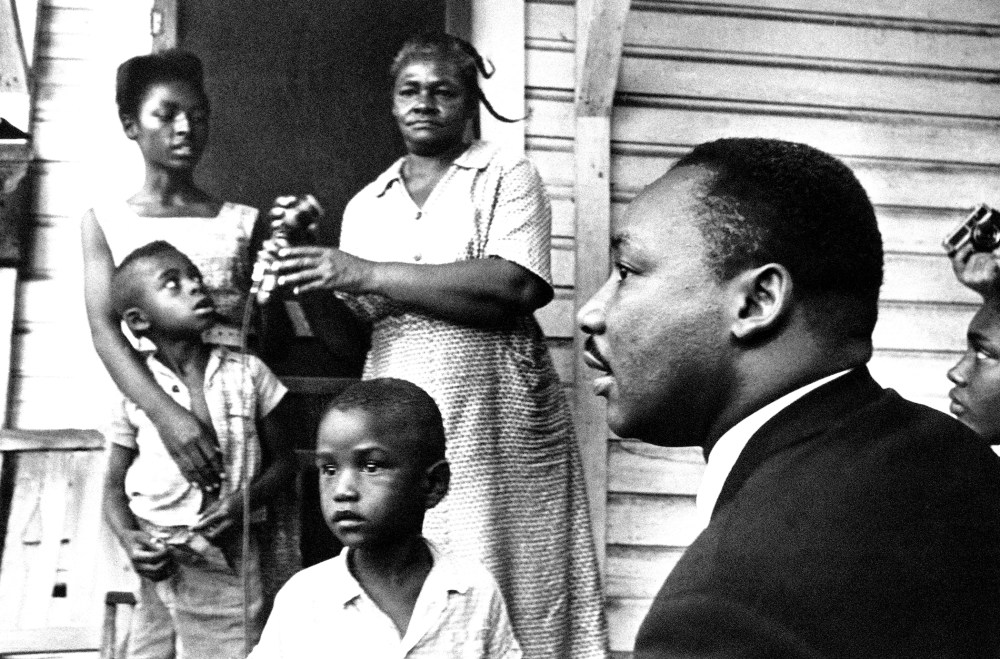
Today, Dr. Martin Luther King Jr. is most often remembered as a crusader for racial equality, not economic justice. But those struggles were inextricably intertwined for the civil rights leader, whose 85th birthday is being honored this weekend. Even during his upbringing, as he wrote in 1958 [PDF], he knew “that the inseparable twin of racial injustice was economic injustice.”
Much of King’s career reflects this belief. The famed 1963 March on Washington’s full name was actually the March on Washington for Jobs and Freedom. And in the last year of his life, King poured most of his energy into launching the Poor People’s Campaign, an organization dedicated to advocating for economic justice.
While Jim Crow laws are long gone, economic inequality—and especially racially stratified inequality—has intensified in recent years. President Barack Obama has even referred to inequality as “the defining challenge of our time.”
Here are some of King’s proposals, many of which seemed radical at the time.
1. Ratify an economic bill of rights
In 1968, members of King’s premier civil rights group, the Southern Christian Leadership Council (SCLC), drafted a letter demanding “an economic and social bill of Rights” that would promise all citizens the right to a job, the right to an adequate education, and the right to a decent house, among others.
“It cannot take more than two centuries for it to occur to this country that there is no real right to life, liberty and the pursuit of happiness for people condemned by the accident of their birth to an existence of hereditary economic and social misery,” wrote the letter’s drafters. While the SCLC was specifically concerned with the ways in which economic inequality perpetuates racial inequality, they made clear that the rights they proposed would apply to all citizens. It sounded radical at the time.
In fact, the effort echoed a proposal made by President Franklin Delano Roosevelt during his 1944 State of the Union Address, when he called for a “second Bill of Rights,” to guarantee all citizens a “useful and remunerative job” and “adequate medical care.
2. Guarantee everyone a basic income, no strings attached
King believed that every person was entitled to a livable income, whether they worked or not. In the 1968 book Where Do We Go from Here: Chaos or Community? he called for unconditional cash transfers to every American citizen. These cash transfers wouldn’t just be enough to scrape by on, either; instead, King thought that a guaranteed income “must be pegged to the median income of society, not at the lowest levels of income.”
At the time that King pitched the idea, a guaranteed income didn’t sound quite as utopian as it does now. Even President Richard Nixon had a basic income proposal called the Family Assistance Plan, which he unveiled to the nation in 1969. Nixon’s plan failed in part because some on the left thought his offer of $1,600 per year for each family of four was not ambitious enough.
Other countries have since experimented with a guaranteed income closer to the kind King advocated. The people of Switzerland will soon be voting on a referendum to guarantee every Swiss citizen a monthly check worth $2,800 USD.
3. Build a powerful labor movement
King spent much of his career working with labor unions, while also working to push them in a more radical direction. At the time of his assassination, he was campaigning in Memphis, Tenn., on behalf of the city’s striking sanitation workers. He delivered his final address, the famous “I’ve Been to the Mountaintop” speech, to a crowd of predominantly black sanitation workers and supporters of their right to form a union.
The 1968 Memphis strike was not the first time King had reached out directly to the labor movement. He had been delivering speeches before crowds of union members for years, calling for greater cooperation between the civil rights movement and the labor movement.
“The labor movement was the principal force that transformed misery and despair into hope and progress,” he told the Illinois State AFL-CIO in 1965. “Out of its bold struggles, economic and social reform gave birth to unemployment insurance, old-age pensions, government relief for the destitute, and, above all, new wage levels that meant not mere survival but a tolerable life.” But that same year, King also chided the labor movement of his time for failing to wholly embrace the civil rights movement and racial equality. “Its sporadic and limited support has been welcome, but in relation to its essential strength, labor has made inconsequential contributions to civil rights,” he told AFL-CIO New York City District 65. “As the struggle unfolds in the north where labor is particularly strong, its omissions will become more evident and embarrassing.” King’s answer to dealing with labor’s “apathy” wasn’t to abandon unions, but instead to nudge them towards greater social activism and militancy. “The labor movement, if it is to remain vital, needs to raise the standard of living of all workers, not merely those under its contracts,” he said. “As the relative number of workers in unions drops, the strength of labor will fail if it does not become a social force pressing for greater dimensions of wealth for all those who labor.” 4. Guarantee a job to anyone who can work The very first right to be enumerated in the SCLC’s economic bill of rights was “[t]he Right of every employable citizen to a decent job.” In addition to a guaranteed income for everyone, those who were willing and able to work would be guaranteed a job. “I hope that a specific number of jobs is set forth, that a program will emerge to abolish unemployment, and that there will be another program to supplement the income of those whose earnings are below the poverty level,” King wrote shortly before his death. In recent years, some academics have taken up this call again. Most notably, economists at University of Missouri-Kansas City and Bard College, as well as Duke University public policy professor William Darity Jr., have argued in favor of a government program that would create public sector jobs for anyone who isn’t already employed. A recent poll found that 47% of respondents were at least somewhat sympathetic to the idea.
Ned Resnikoff is an urban policy analyst, researcher, writer, and editor. His byline has appeared in a variety of publications, including the New York Times, San Francisco Chronicle, Dissent, and The Nation. He writes the newsletter Public Comment, which can be found at publiccomment.blog. Recommended


