








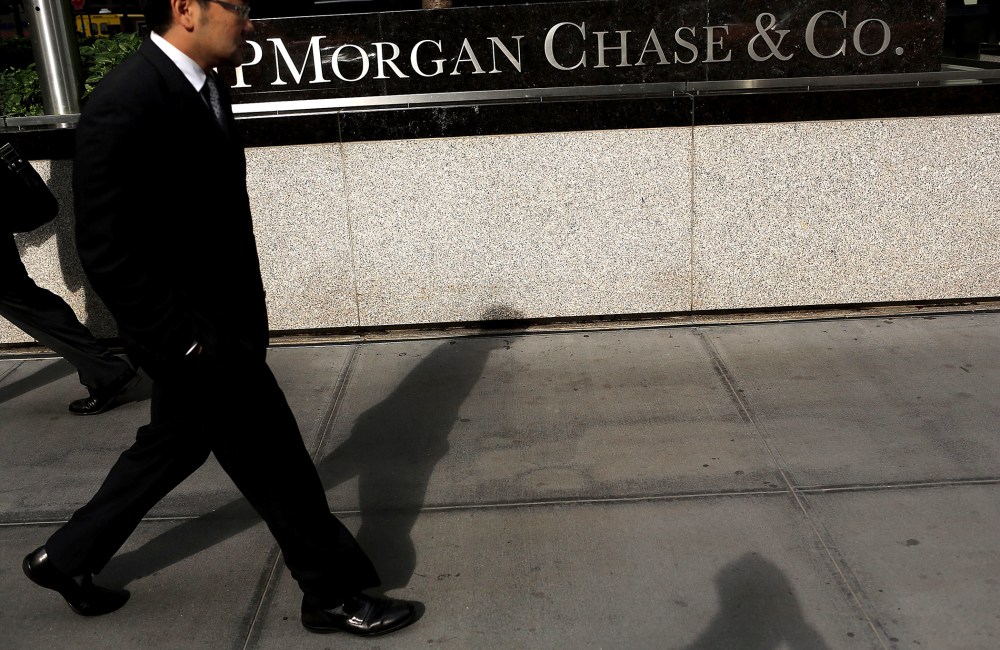
Wall Street colossus JPMorgan Chase & Co. will have to pay a record $13 billion legal settlement, thanks to an agreement the banking institution reached with the Department of Justice on Monday. The settlement is the result of a Justice Department investigation into JPMorgan’s mortgage-backed securities business.
A mortgage-backed security is a type of financial instrument backed up by a pool of home mortgages. In the run-up to the financial crisis, JPMorgan and other banks made billions by trading in securities backed in part by “subprime,” or high-risk, mortgage loans. The collapse in value of toxic mortgage-backed securities was one of the major incidents which precipitated the financial crisis, and major banks like JPMorgan soon came under legal scrutiny for their role in fueling that securities market.
“Without a doubt, the conduct uncovered in this investigation helped sow the seeds of the mortgage meltdown,” said Attorney General Eric Holder in a statement. “JPMorgan was not the only financial institution during this period to knowingly bundle toxic loans and sell them to unsuspecting investors, but that is no excuse for the firm’s behavior. The size and scope of this resolution should send a clear signal that the Justice Department’s financial fraud investigations are far from over. “
Out of the $13 billion settlement, $4 billion is supposed to go toward aiding struggling homeowners, though the terms of how that relief is to be distributed are already prompting skepticism. JPMorgan will reportedly hire its own “independent monitor” to oversee the process, leading financial reform activist Alexis Goldstein to tweet the following:
Did #IFR teach you NOTHING, @thejusticedept? A monitor chosen BY THE BANK is not "independent" @ddayen @retheauditors http://t.co/NGqqrA5uPD
— alexis goldstein (@alexisgoldstein) November 19, 2013Wall Street has already provided billions of dollars in so-called homeowner relief, but the bulk of that relief has come in the form of short sales, “where banks allow borrowers to sell their house for less than the amount owed,” and which “might have happened without the settlement because banks generally lose less money on those than they do on foreclosures,” according to a 2012 Wall Street Journal report.
The JPMorgan settlement could even end up hurting underwater homeowners more than helping, according to journalist David Dayen.
“While JPMorgan could be allowed to write off the penalty as a tax deduction, ordinary people who receive mortgage relief as part of the settlement could get hit with a giant tax bill, making the debt relief benefit irrelevant, if not actively harmful,” he wrote in The New Republic last month. “This is because Congress, through their sheer inaction, will soon allow this type of mortgage relief to be taxed as income.” The $13 billion settlement was the result of a civil case, but JPMorgan remains subject to an ongoing criminal investigation regarding its mortgage-backed securities business. The bank has faced other legal troubles as well in recent years. In September, JPMorgan admitted wrongdoing in the “London Whale” scandal and agreed to pay an $800 million fine. The bank has also been implicated in the LIBOR scandal. In part due to these scandals, the bank has been subject to widespread public vituperation, culminating in a recent barrage of insults and criticism over Twitter under the hashtag #AskJPM. This post has been updated.
Ned Resnikoff is an urban policy analyst, researcher, writer, and editor. His byline has appeared in a variety of publications, including the New York Times, San Francisco Chronicle, Dissent, and The Nation. He writes the newsletter Public Comment, which can be found at publiccomment.blog. Recommended


