








California may soon have the highest minimum wage out of any state, thanks to a law approved by the state legislature on Thursday. Assembly Bill 10, which Gov. Jerry Brown has endorsed, would raise the state’s minimum wage to $10 per hour by January 2016. After that, the wage would continue to automatically increase every year based on inflation.
The Economic Policy Institute (EPI) has studied the effect of a new minimum wage between $9.80 and $10.10 on the California economy, and estimates that it would directly affect between 2.1 million and 2.4 million workers. An additional one million workers would be indirectly affected by the hike, said EPI’s Doug Hall.
“The indirectly affected include those workers whose wages would be slightly above the new minimum, whose wages would also be slightly increased,” said Hall.
But many full-time workers will likely continue to struggle even after that modest boost goes into effect, in part because California is one of the states with the highest cost of living. The MIT living wage calculator, which “is designed to provide a minimum estimate of the cost of living for low wage families,” finds that a single adult in California needs to earn at least $11.20 per hour in order to be self-sufficient. By 2016, when the state minimum wage rises to $10, the cost of living in California will likely be even higher.
House minority leader Nancy Pelosi, a Democrat from California, took the bill’s passage as an opportunity to call for a federal minimum wage hike.
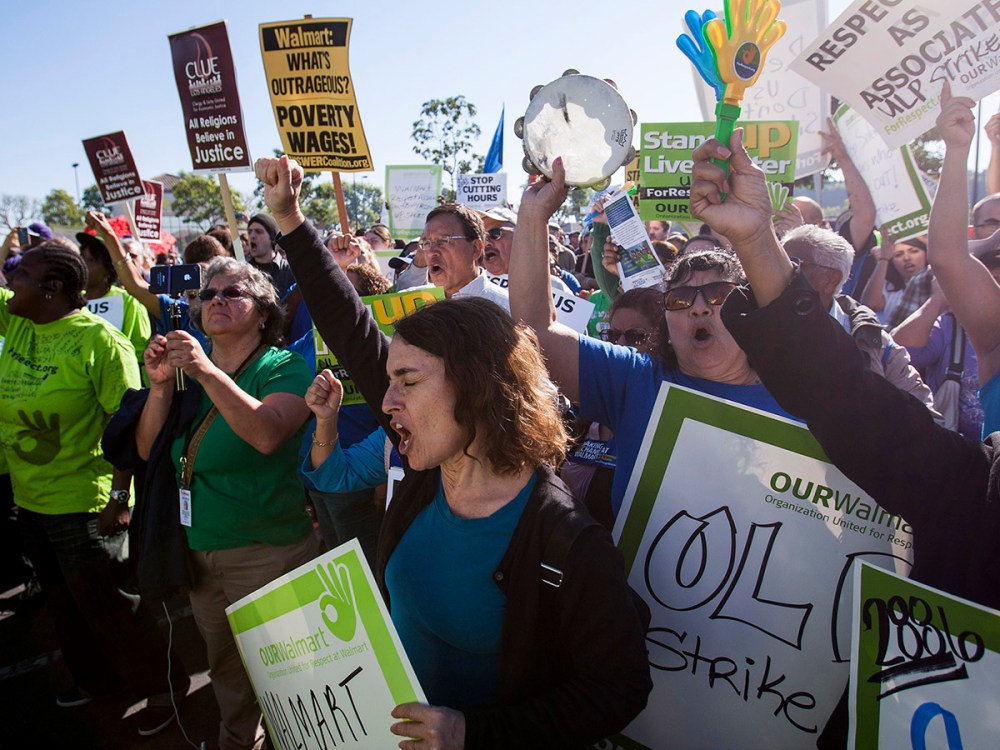
“We must pass the Fair Minimum Wage Act to follow California’s lead and ensure all American workers know the security, certainty, and dignity of a living wage,” she said in a statement. The Fair Minimum Wage Act, which Democrats introduced in both the House and the Senate several months ago, would raise the federal minimum wage to $10.10, outstripping all current state minimum wages. A coalition of striking workers, labor unions, and progressive community groups have set their sites even higher. Since December, thousands of fast food workers across the country have engaged in short-term work stoppages and demanded a new industry wage floor of $15 per hour, though they have not always specified whether that base wage should become law. Columbia University professor Dorian Warren has suggested that pushing for state minimum wage hikes may be an effective strategy for the movement, and could even lead to an eventual federal wage increase. Washington state currently has the highest state minimum wage in the nation, at $9.19 per hour. However, the city of San Francisco, in California, beats out all 50 states with a minimum wage of $10.55 per hour.
Ned Resnikoff is an urban policy analyst, researcher, writer, and editor. His byline has appeared in a variety of publications, including the New York Times, San Francisco Chronicle, Dissent, and The Nation. He writes the newsletter Public Comment, which can be found at publiccomment.blog. Recommended


