








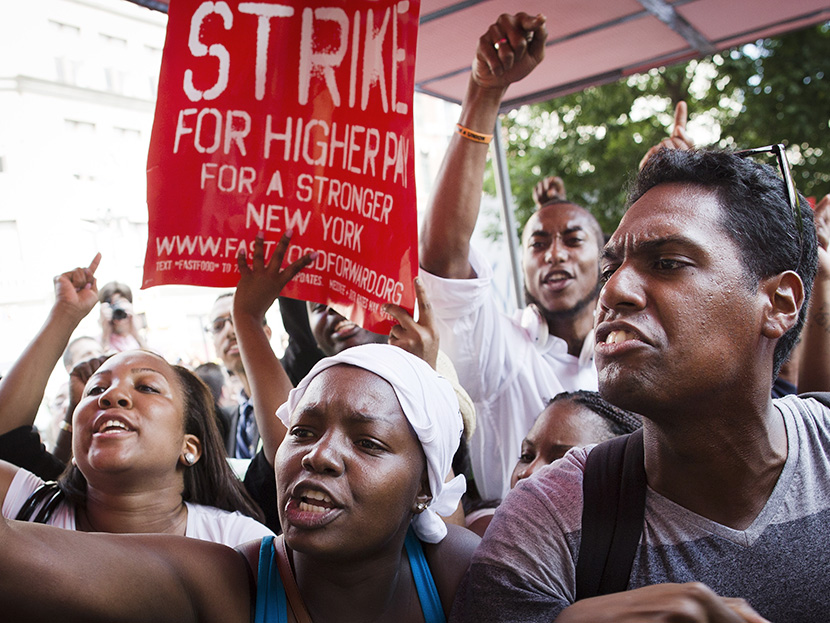
For the fast food workers’ movement, this week is a coming out party. Fast food employees are striking in unprecedented numbers and their campaign has attracted national media coverage. But now comes the real challenge: translating that momentum into an actual wage increase.
The hundreds, possibly thousands of fast food workers on strike this week are demanding a base wage of $15 per hour, as well as the right to form a union. While union recognition can be won only workplace by workplace, there are multiple possible routes to a wage increase.
“I think what we’re seeing is a bit of experimentation across the country about how to get there,” said Dorian Warren, a professor of political science at Columbia University.
Federal legislation has the potential to raise the wage for all low-wage workers in one fell swoop. There is currently legislation pending in both the House and Senate that would raise the minimum wage to $10.10 per hour. That is well below fast food workers’ asking price but is nonetheless significantly higher than the current federal minimum wage of $7.25. It’s even higher than the most generous state-level minimum wage, Washington state’s $9.19 per hour.
But the legislation, known as the Fair Minimum Wage Act of 2013, has little chance of passing a Republican-controlled House. As a result, members of the House Progressive Caucus are seeking other avenues for an increase, such as attaching a wage-hiking amendment to a more Republican-friendly bill.
“We’re right now looking for vehicles where we’re looking for amendments to increase the federal minimum wage,” Minnesota Rep. Keith Ellison told msnbc. He said he had personally urged the president to sign an executive order which would increase wages for employees of federal contractors.
While President Obama has not committed to signing any such executive orders, he has voiced his support for some kind of minimum wage hike. In his 2013 State of the Union, he proposed that the federal minimum wage be raised to $9 per hour and pegged to the Consumer Price Index. But it is unclear whether his proposal has a better shot in Congress than the Fair Minimum Wage Act, and low-wage workers in Seattle say their state’s relatively generous $9.19 minimum wage is still not enough.
“There’s fast food workers that have two kids, three kids, one car, and some of them don’t even pay insurance,” Taco Del Mar employee Alfonso Arellano told msnbc during a Seattle fast food strike in late May. “Because the fact is, they don’t even have the money. It’s just not fair.”
In recent months, the White House has dropped hints that it is willing to go higher than its $9 bid, or even the $10.10 proposed by congressional progressives. At a Labor Department event held to commemorate the 75th birthday of the 1938 Fair Labor Standards Act, Vice President Biden said that workers are only asking that employers “pay me for minimum wage what you paid in 1968,” when the minimum wage was $10.58 in 2012 dollars. In his major economic address last week, the president again emphasized the importance of a wage hike, though he did not name a specific dollar value.
Still, Warren said that he did not see federal legislation as a near-term fix for the fast food workers’ movement.
“There’s not the political will or possibility in the House right now, because of the way the Republican party is structured,” he told msnbc. Instead, he advocates “progressive federalism”: building the political power to change minimum wage laws on the state and federal level. Doing so “builds up the range of victories that the movement can share and be proud of,” which may eventually lead to a federal minimum wage. While the federal path to a wage increase may be closed for now, Warren said there was still value to the Congressional Progressives Caucus’ “Raise up America” campaign and similar efforts. “It means the world to these workers to have a member of Congress standing with you,” he said, in part because influential friends can help protect against employer retaliation. Ellison, who co-chairs the Caucus, said that raising the minimum wage must be part of a “comprehensive strategy” for dealing with inequality. “We have startling inequality in this country, and if you look at the components of that inequality, the components of it are low-wage work, the limit on the right to collectively bargain, bad trade deals, and a few other factors,” he said. He urged striking workers to “understand that the fight is at the counters and the kitchens where they work, but it is also at the ballot box.” “We’re hoping that these workers will see themselves as not just employees, but citizens who have prerogatives in this society we live in,” he said. The result would be a movement that looks beyond wages to issues as diverse as health care and education.
Ned Resnikoff is an urban policy analyst, researcher, writer, and editor. His byline has appeared in a variety of publications, including the New York Times, San Francisco Chronicle, Dissent, and The Nation. He writes the newsletter Public Comment, which can be found at publiccomment.blog. Recommended


