








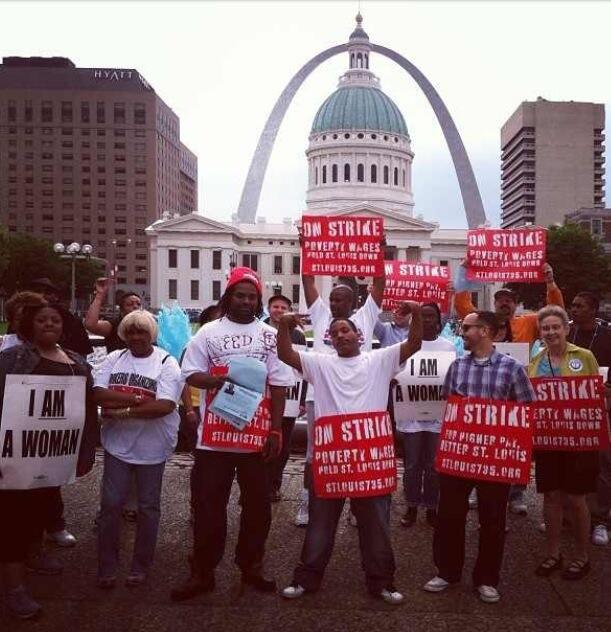
First New York, then central Pennsylvania, and then Chicago. Now St. Louis is the latest American city to be hit with a strike by non-union fast food workers demanding higher wages and the right to form a union. Over the course of Wednesday and Thursday, over 100 employees at approximately 30 different St. Louis-based restaurants walked off the job, demanding the right to form a union and a raise from Missouri’s $7.35 hourly minimum wage to $15 per hour. The strike was organized by an alternative workers’ group called the St. Louis Organizing Committee as part of a campaign called STL Can’t Survive on $7.35.
“Increasingly, fast food jobs are the only options for St. Louisans, but these workers can’t even afford to pay for rent, food, or carfare,” said Rev. Martin Rafanan, director of STL Can’t Survive on $7.35, in a statement. “If the workers earned more, fast food workers would spend that money at local businesses here in St. Louis and help lift our economy.”
The strike—which hit restaurants such as McDonald’s, Jimmy John’s, Wendy’s and Domino’s—was only a quarter a size of New York’s second fast food strike, still the largest walkout to occur in the industry. Still, the recent events in St. Louis indicate that labor unrest within the industry is not going away, and that the nationwide momentum shows no sign of abating.
“It’s clearly getting national traction,” CUNY labor studies lecturer Ed Ott told Salon’s Josh Eidelson. “This is potentially the largest organizing drive in decades.”
Both national labor organizations and disaffected fast food workers in other parts of the country are clearly paying attention. On the day the walkout began, New York’s Fast Food Forward campaign released a statement supporting the strike. The national offices of SEIU, one of the largest labor unions in the country, also endorsed the strike.
“The 2.1 million SEIU members stand in solidarity with these workers and support their fight for higher wages,” said SEIU president Mary Kay Henry in a statement.
The St. Louis walkout was conducted with the support of a sprawling coalition which included the local chapters of SEIU, Teamsters, AFSCME, UFCW, and AFL-CIO. Several non-union labor groups and churches of various denominations also lent their support to the coalition.
This model of organizing—roping together unions, alternative labor organizations and community groups for a campaign that goes far beyond collective bargaining—seems to be on the rise, and may signal an historic shift in organized labor’s approach to organizing. In addition to supporting the fast food workers campaign, AFL-CIO recently announced plans to expand it’s non-union, alternative labor group Working America. “The labor movement that emerges from these reforms might resemble a latter-day version of the Knights of Labor, the workers’ organization of the 1880s that was a cross between a union federation, a working-class political vehicle (it championed the eight-hour workday) and a fraternal lodge,” wrote Washington Post columnist Harold Meyerson on Thursday. The Knights of Labor famously played an instrumental role in the campaign for an eight-hour work day. But these strikes and community-based coalitions also bear a crucial resemblance to the organizations which sprung up around the manufacturing and auto worker strikes of the 30s. That’s because low-wage service and retail jobs, such as fast food work (one of the lowest-paying jobs in the whole country), are coming to occupy the central role in the American economy once occupied by the manufacturing sector. A significant chunk of the jobs being gained during America’s economic recovery are concentrated in the service and retail sectors; in fact, the fast food industry is growing at twice the rate as the rest of the economy, according to The Nation’s Annie Shields. As a result, St. Louis is highly unlikely to be the last American city to be hit with a fast food strike.
Ned Resnikoff is an urban policy analyst, researcher, writer, and editor. His byline has appeared in a variety of publications, including the New York Times, San Francisco Chronicle, Dissent, and The Nation. He writes the newsletter Public Comment, which can be found at publiccomment.blog. Recommended


