








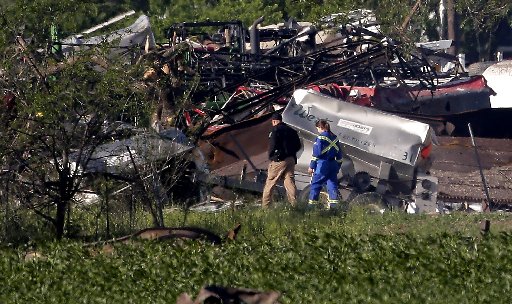
In the past month, two major industrial accidents have changed the landscape of entire American towns. In late March, an ExxonMobil pipeline carrying tar sands oil ruptured in the small town of Mayflower, Ark., dumping tens of thousands of gallons of corrosive fossil fuel into a residential area. And last week, a fertilizer plant in West, Texas, detonated, killing 14 people and destroying several buildings in the surrounding area.
In both cases, the emergency response was swift. Since shortly after the pipeline burst, Exxon has been working with state and federal authorities to contain the damage in Mayflower and clean up the oil. And President Obama has dispatched FEMA to the small town of West, where the National Guard was already assisting state and local authorities in assessing the damage.
However, both of these towns are likely to bear lasting scars. And federal authorities are doing little to prevent similar catastrophes from occurring in the future.
The spill in Arkansas seems to have temporarily dampened Beltway enthusiasm for the Keystone XL pipeline, but only for as long as Mayflower’s oil-soaked city streets remained in the national spotlight. Exxon itself seems unlikely to face serious legal repercussions for the spill. Residents of Mayflower have filed a class-action lawsuit against the energy company, seeking over $5 million in damages, but even an unfavorable verdict would not put a significant dent in Exxon’s $44.8 billion in profits.
In the meantime, Exxon has paid for the cleanup, covered the cost of housing for displaced residents, and offered those most affected $10,000 each for their trouble. Last Friday, the company reported that the Unified Command in charge of coordinating the cleanup “is beginning to transition from emergency response to remediation and restoration activities.”
The disaster in Texas was much more recent, and the cleanup is not quite so far along. Only recently have authorities completed a thorough survey of the damage: 14 dead, over 200 injured, at least 50 homes damaged. On Saturday, displaced residents began to return to their homes, though only in the areas on the outskirts of the blast.
The cause of the explosion is still unclear, but it is now known that the West Fertilizer Co. lacked some basic security precautions, including a functioning sprinkler system. The operators of the fertilizer plant had previously been fined a paltry $2,300 by the Environmental Protection Agency, and told state and local authorities who investigated a “strong ammonia smell” in the area that there was no risk of a fire or explosion on-site. Years later, a small fire [PDF] at the plant forced the local middle school to evacuate. But while state and federal environmental agencies demanded self-inspections from the plant and doled out slaps on the wrist for misbehavior, labor regulatory agencies stayed away entirely. The Occupational Health and Safety Administration had not inspected the plant since 1985. The federal Chemical Safety Board (CSB) has announced that it will investigate the cause of the explosion, but their investigation is unlikely to yield results. A recent Center for Public Integrity report found that 13 of the board’s prior investigations are incomplete, including one over five years old. The fertilizer plant explosion is also unlikely to lead to greater oversight of the fertilizer production industry. In fact, if anything, environmental and labor regulatory enforcement is declining, thanks in part to across-the-board sequester cuts.
Ned Resnikoff is an urban policy analyst, researcher, writer, and editor. His byline has appeared in a variety of publications, including the New York Times, San Francisco Chronicle, Dissent, and The Nation. He writes the newsletter Public Comment, which can be found at publiccomment.blog. Recommended


