








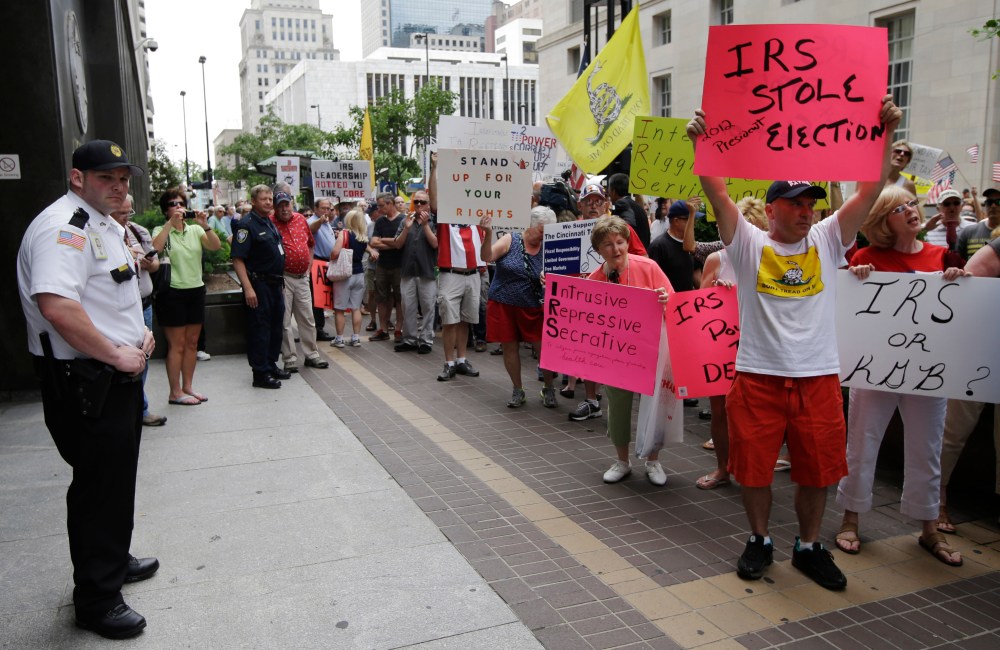
Demonstrators organized by the Tea Party Patriots groups rallied in front of IRS offices across the country Tuesday to protest the recent revelations of improper targeting of the party and other conservative groups.
In Cincinnati, not far from the federal building where the targeting plan originated, activists chanted “IRS has got to go” and called the agency the “internal revenge service” and “illegal research system” on rally signs. Another sign claimed the IRS “stole the election” with its targeting practices. In Washington, DC, a few dozen protesters gathered outside IRS headquarters with similar signs, calling for the IRS to be audited and even abolished, and in Boston protesters complained of Nixonian tactics, according to AP reports.
Protests were planned for dozens of other cities across the nation.
The group’s co-founder, Jenny Beth Martin, has argued that the IRS holding conservative groups up to greater scrutiny in applications for nonprofit and tax-exempt status reveals that the Tea Party’s concerns over government overreach are justified. She and protesters also contend that that IRS’s targeting policy had a “chilling effect” that discouraged would-be coordinators in other states from seeking the tax-exempt status after they learned of the intense screening process their cohorts faced.
As Tea Party members protested against the IRS, the agency’s former and outgoing chiefs testified in a senate committee hearing on the targeting scandal.
Former commissioner Douglas Shulman said he regretted and was “deeply saddened” that the incident happened under his watch, but refused to directly take responsibility for it.
Shulman, a Bush Administration appointee who oversaw the agency during the targeting, told the committee “I agree this is an issue that when someone spotted it, they should have brought it up the chain. And they didn’t. I don’t know why.”
Utah Republican Orrin Hatch admonished outgoing commissioner Steven Miller, accusing him of committing a “lie by omission” for failing to reveal that it had targeted conservative groups back when Republicans sent them letters asking as much last year.
Miller rejected Hatch’s claim, arguing that he did not mislead anyone.
“The concept of political motivation here,” Miller said. “I did not agree with that in May. I do not agree with that now. We were not politically motivated in targeting conservative groups.”
Treasury Inspector General Russell George reiterated in the hearing that he has yet to find any evidence that the scrutiny was politically motivated, as many tea party groups have argued The Tea Party movement has seen an uptick in support following the unfolding scandal—reaching a 37% favorability rating in a recent poll, that’s up from polling in the low 20’s earlier this year. Despite the uptick, a majority of Americans still disapprove of Tea Party actions and message. A Northern California Tea Party chapter filed a lawsuit against the IRS in a federal court in Cincinnati in conjunction with the protests, the first such suit against the agency in wake of the controversy. The case filed Monday by the NorCal Tea Party Patriots claims that the scrutiny it received at the hands of the IRS violated both its right to privacy and freedom of speech. “The result was a muffling and muzzling of free expression,” the lawsuit claims. “Hundreds of other citizen groups who met the IRS’ criteria—at first, groups with ‘tea party’ —sounding words in their names, but later, groups whose members shared purposes and beliefs similar to NorCal’s—suffered the same fate.” At the hearing, several senators took issue with the idea that many groups may be abusing the rules surrounding the 501(c)4 non-profit groups, specifically the 1959 rule change that allowed tax-exempt groups to be “primarily” rather than “exclusively” focused on “social welfare.” “Clearly a mack truck is being driven through the 501c4 loophole,” Finance Committee Chair Max Baucus complained.
Morgan Whitaker Recommended


