








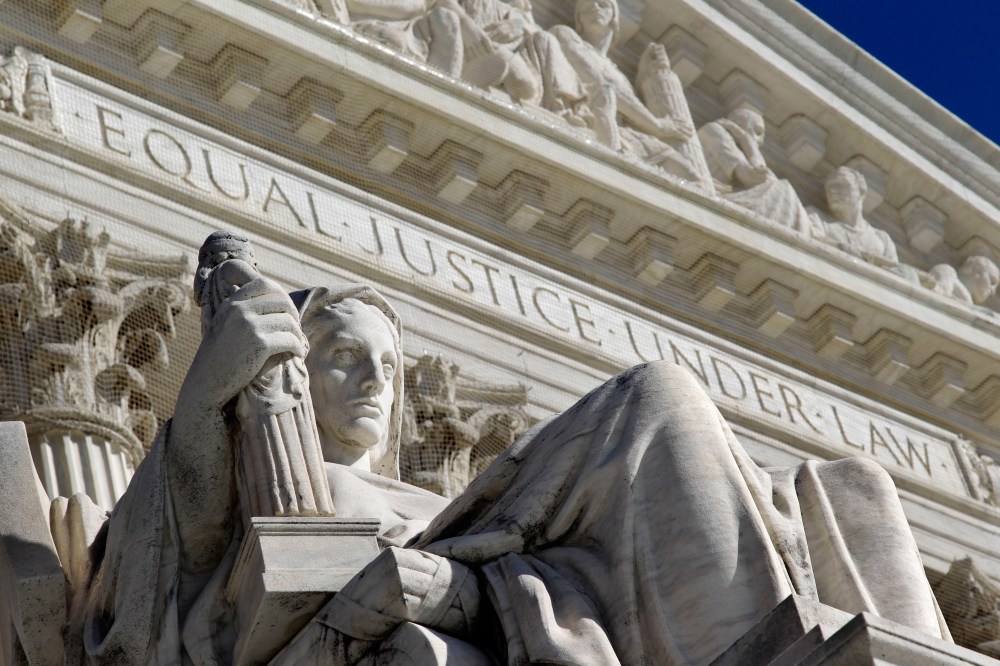
Can a company own a patent on the genes in the human body–including yours? The U.S. Supreme Court takes up that question Monday, diving into an issue that could help determine the future of life-saving genetic medicine.
The case involves a test that has helped guide more than a million women in their medical decisions. It can determine whether the composition of their genes makes them more likely to get breast or ovarian cancer.
A Utah company, Myriad Genetics, owns patents on two parts of human genes known as BRCA 1 and BRCA 2, named for the first two letters of the words breast and cancer. Women with mutations in those genes face up to an 85 percent risk of getting breast cancer and up to a 50 percent risk of ovarian cancer. Because of the patents, Myriad has a monopoly on performing all diagnostic tests related to BRCA 1 and BRCA 2.
“Countless companies and investors have risked billions of dollars to research and develop advances under this promise of stable patent protection,” according to Gregory Castanias, a Washington, D.C, lawyer who will argue the case for Myriad.
The idea of patenting DNA material has provoked a strong debate among scientists, and many have lined up on opposite sides of the case.
“Human genes should not be patented,” says James Watson, the Nobel prize winner and co-discoverer of the double helix structure of DNA.
“Life’s instructions ought not be controlled by legal monopolies created at the whim of Congress or the courts,” he says.
But a group of researchers at the University of Maryland is among those arguing just the opposite. “The costs are outweighed by the benefits stemming from the fruits of increased inventive activity,” they say in their friend-of-court brief.
In the 220 years since Thomas Jefferson wrote the cornerstone of U.S. patent law, the courts have agreed on a general principle: patents protect inventions, not products of nature. A central issue in this case is whether Myriad has obtained a patent on something already in the body or has created something new.
The ACLU, representing a group of scientists, doctors, and cancer patients, claims that Myriad has merely removed from the body something that was already there — the DNA sequence making up the BRAC 1 and BRAC 2 genes. Because it is a creation of nature, the ACLU says, it cannot be protected by a patent, even though Myriad claims that removing it is what makes it useful.
“Gold does not become patentable once taken out of a stream because it can be used in jewelry. Kidneys do not become patentable once taken out of a body because they can be transplanted,” says the ACLU’s Christopher Hansen.
Myriad’s exclusive patent, says the ACLU, creates a monopoly that denies women the ability to seek a second opinion, based on another test of the genetic material, and dissuades other laboratories from pursuing research on the patented genes.
“Myriad has given women false negative results while also barring other laboratories from testing genes to verify the accuracy of Myriad’s results,” says Hansen. But Myriad argues that removing the gene sequence from the body requires breaking chemical bonds that lock it into place, thereby creating a new chemical entity. The resulting genetic materials, the company says, “were never available to the world until Myriad’s scientists applied their inventive faculties to a previously undistinguished mass of genetic matter.” Myriad cites a line of cases finding patent eligibility for naturally occurring substances that were isolated and purified, including aspirin, vitamin B12, and adrenaline derived from cows. As for availability, the company says the cost of the test is covered by private insurance, Medicare and Medicaid. It also says many other labs provide second opinions regarding the company’s test results and that thousands of researchers have done studies on the gene sequence involved, unimpeded by the patent. The Obama administration urges the court to be deeply skeptical of Myriad’s broad claim of what can be patented. The Justice Department’s brief in the case says the public interest has consistently been given precedence by the Supreme Court “in avoiding undue restrictions imposed by patents that effectively preempt natural laws and substances.” The case requires the justices to decide whether the human genetic material patented by Myriad fits the broad definition set out by Thomas Jefferson in 1791, of a “new and useful art, machine or composition of matter or any new or useful improvement.” This article first appeared on NBCNews.com here.
Pete Williams Recommended


