








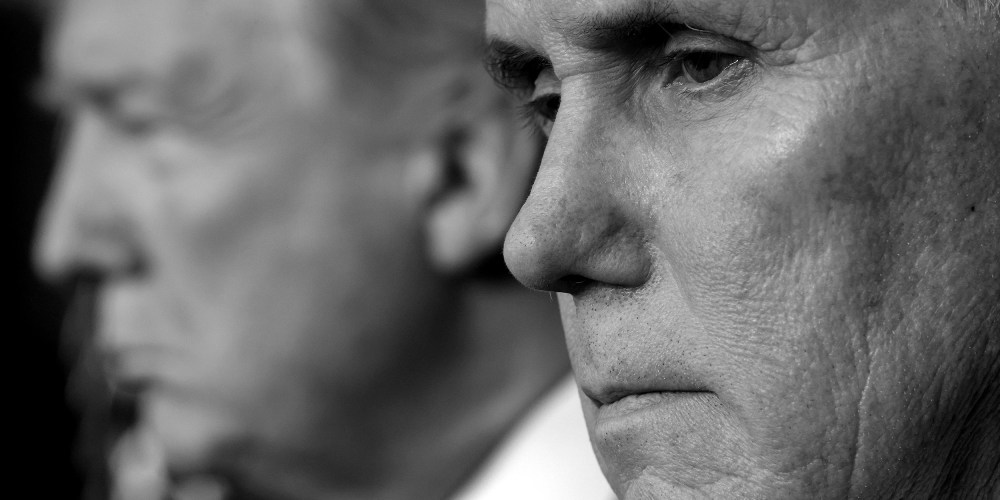
Former Vice President Mike Pence has made moves over the last few months to distance himself from former President Donald Trump and position himself for a possible run for the presidency. But history reminds us how hard a task winning the White House can be for a current or former vice president. On top of that, the current state of the Republican Party suggests the chances are even slimmer for Pence.
Vice presidents may be “a heartbeat away from the presidency,” but they’re often far away from the operations of the Oval Office.
The vice presidency is an infamously frustrating office. John Nance Garner, who held the office during President Franklin D. Roosevelt’s first two terms, complained that the position wasn’t “worth a pitcher of warm piss.” (Almost as an illustration of his point, reporters felt completely free to clean up that vice president’s words on their own, changing it to “a pitcher of warm spit.”)
Vice presidents may be “a heartbeat away from the presidency,” but they’re often far away from the operations of the Oval Office. Their role as understudies limits and lowers their profile, which can prove problematic if they later run for the top spot.
When Vice President Richard Nixon ran for president in 1960, a reporter asked President Dwight D. Eisenhower to provide an example of a “major idea” that his vice president had proposed and Eisenhower’s administration had actually implemented over the previous eight years. “If you give me a week, I might think of one,” the president chuckled. “I don’t remember.”
Nixon lost.
While vice presidents find it difficult to get credit for the positive accomplishments of an administration, they find it just as difficult to shrug off an administration’s failures.
As the Vietnam War dragged down the poll numbers of President Lyndon B. Johnson, his vice president, Hubert Humphrey, sought to distance himself from Johnson during his 1968 presidential campaign. Humphrey tried to stake out a slightly different stance on the war, but the most significant changes were merely stylistic. He had the vice presidential seal removed from his lectern. The vice presidential flag likewise disappeared at his public events. The campaign stopped introducing him as the sitting vice president of the United States and just called him the Democratic nominee for president. Not only were critics of the war unswayed by the changes, but LBJ saw Humphrey’s maneuvering as a betrayal.
Humphrey lost.
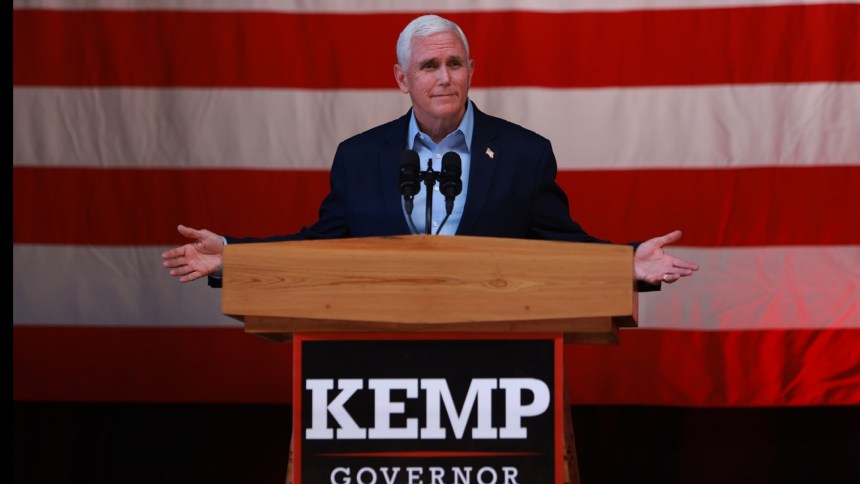
It’s hard for vice presidents to claim credit for an administration’s accomplishments, and it’s hard for them to distance themselves from an administration’s shortcomings, but it’s almost impossible to do both.
But that’s precisely what Pence seems to be trying to do. He’s rolling out what New York Times reporter Jonathan Martin has termed “a sort of Trump-without-the-chaos strategy, a bet that Republican primary voters crave the policy record of the last administration but without the impulsiveness, norm-breaking and naked demagogy.”
At one level, Pence’s effort to separate himself from Trump is laughable. He spent Cabinet meetings lavishing compliments on Trump to an uncomfortable degree and fixated on Trump’s “broad shoulders” so frequently it became a running joke among journalists. More than any other vice president in recent memory, Pence proudly presented himself as a loyal lickspittle to his president. More than any other vice president in recent memory, Pence proudly presented himself as a loyal lickspittle to his president. In fairness, Pence did break with Trump when it mattered most. During the Jan. 6, 2021, insurrection attempt, he forthrightly refused to go along with the president’s scheme to subvert the 2020 presidential election, even when so many in his party were cravenly willing to do so. And in recent months, Pence has become more outspoken in his criticism of Trump, pushing back not just on Trump’s “big lie” that the 2020 election was stolen but also on the former president’s praise of Russian dictator Vladimir Putin. The problem for Pence, of course, is that a majority of Republicans believe the lie that the 2020 election was somehow stolen from Trump. Even if Pence were able to become the candidate of choice for anti-insurrection Republicans — a big “if” — there seems to be little chance of his running to victory in the GOP primaries from that lane. Of course, if Trump decides to run again in 2024 himself, it’ll be even harder for Pence to claim credit for the accomplishments of what he’s now touting as the “Trump-Pence administration” because Trump will claim all the credit himself. The former president will mock him as a lightweight who did nothing in office and, worse, did nothing to help the Republicans’ attempted coup succeed. Pence will most likely argue that he put principle above politics and put his country before his party. And in today’s GOP, such a stance all but guarantees that Pence will lose.
Kevin M. Kruse
Kevin M. Kruse is a professor of history at Princeton University. A specialist in modern American political, social and urban/suburban history, he is the author and editor of several books, including "White Flight" (2005), "One Nation Under God" (2015) and "Fault Lines: A History of the United States since 1974" (2019). He grew up in Nashville, Tennessee, and earned his bachelor's degree from the University of North Carolina at Chapel Hill and his master's and doctoral degrees from Cornell University. 

