








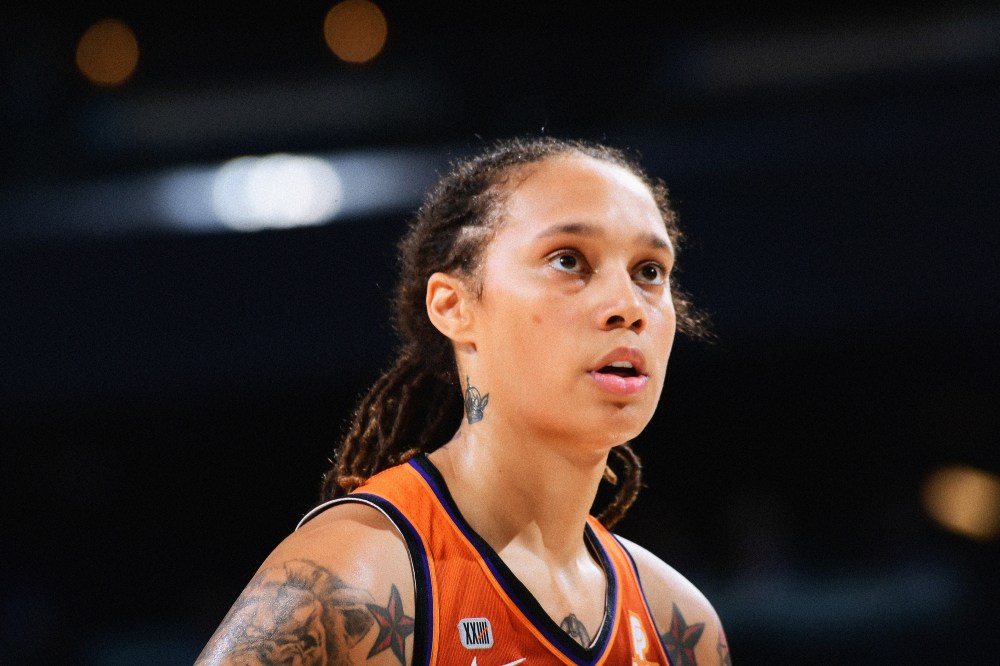
UPDATE (Dec. 8, 2022, 9:50 a.m. ET): Brittney Griner was freed from Russian imprisonment Thursday after U.S. and Russian officials successfully negotiated a prisoner swap. Griner spent 294 days in captivity, following her February arrest.
Seven-time WNBA All-Star Brittney Griner’s detention by Russian authorities has been extended until May 19, according to the Russian state news agency TASS.
Griner was detained at an airport near Moscow reportedly in mid-February for the alleged possession of vape cartridges containing oil derived from cannabis. Aside from a mugshot that circulated in early March, she hasn’t been seen since, and reports on her status have been sparse. A drug offense could get her up to 10 years in a Russian prison.
ALSO NEW: A source close to Griner says “we know she’s OK” because of the updates her family and representatives are getting from her team of Russian attorneys, who visit her frequently. “I wouldn’t say she’s ‘good,’ but she’s OK,” the source said. https://t.co/eiCFBeZTCz
— T.J. Quinn (@TJQuinnESPN) March 17, 2022
While Griner’s detention has received a measure of media attention, the fact that she was in Russia in the first place demands its own examination. Besides playing for the Phoenix Mercury, the 6’9” Griner is a basketball titan overseas, where she plays for the Russian league UMMC Ekaterinburg in the WNBA offseason. In 2021, she helped the Russian team win its fifth EuroLeague Women’s championship. Like most professional women’s players, who make a microcosmic fraction of what the men make in the NBA, this kind of international play is essential for supplementing their income.
While Griner’s detention has received a measure of media attention, the fact that she was in Russia in the first place demands its own examination.
Sue Hovey, former ESPN executive editor and co-author of Brittney Griner’s 2015 memoir “In My Skin: My Life On and Off the Basketball Court” sent me this note via email:
“Brittney’s detainment in Russia also once again shines the spotlight on an unfortunate truth: that the vast majority of WNBA players earn their living overseas. A lot of casual sports fans still don’t know this, which kind of blows my mind. But that just shows you how much more work needs to be done when it comes to raising awareness around equity issues in women’s sports.”
Other WNBA stars like Diana Taurasi, Breanna Stewart, and Jonquel Jones also play overseas, often in autocratic societies such as Russia, Turkey and China, where the love for women’s basketball can hold a fevered — and profitable — intensity. But it’s not just the stars. As The Associated Press reported, “Almost half of the WNBA’s 144 players were overseas this offseason.” And it’s understandable why. While the WNBA pays $130,000 on average, the minimum salary is $60,000 a year.

Meanwhile, players could earn upward of $1 million by taking their talents outside the United States. Russia’s professional basketball landscape is a wide open playing field. Unlike the WNBA, there is no salary cap or collective bargaining. Teams (not unlike the United States) are often owned by oligarchs who can afford to spring for the best talent because bragging rights between the mega-rich can mean more than profit margins. The great Taurasi missed the entire 2015 WNBA season to honor a contract with a Russian league.
These opportunities to play far from the United States come with other benefits, too. In years past, before players such as Griner, Taurasi and Sue Bird felt like they could publicly come out as members of the LGBTQ community, many players who were closeted in the United States saw the chance to go overseas as an opportunity to live their lives in peace and truth, to move more freely without cameras or prying eyes of the public. I had a player say to me in 2005, “Overseas I am free in a way that I just am not in the United States.” That being said, when you talk to players in 2022 and ask if they had the choice to leave the United States or make enough money in the WNBA to stay home, they will almost certainly choose the latter. Yes, playing overseas pays, but not without also exacting a price. The situation for WNBA players is a reflection of our own perilous state in regards to our economy. The situation for WNBA players is a reflection of our own perilous state in regards to our economy. The players will be safer and happier and better rested if they could stay home, but that would require a robust investment and a supercharged marketing scheme to appeal more to consumers, from WNBA franchise owners and the NBA which oversees the product. Tickets and game-day experience, currently an incredible bargain on the sports landscape, would cost more, as the owners would invariably pass salary hikes onto fans. This would also limit the diverse audience that currently attends WNBA games. Whether we are talking about oil or women’s basketball, the question comes down to what we, a country of 300 million people, are willing to support and what we are willing to sacrifice. Prior to Russia’s invasion of Ukraine, the U.S. had been happy to get cheap Russian oil as much as the WNBA was fine with seeing the comparatively meager salaries of their players subsidized by traveling overseas. Now that the global climate has changed, it’s time to restructure our economic decisions and investments. It’s time for the league to step up for the safety and security of its players, without simply passing the costs onto fans. Let franchise owners, our own homegrown oligarchs, sacrifice for once and make being in the WNBA a year-round job.
Dave Zirin
Dave Zirin is sports editor of The Nation. He is the author of 11 books on the politics of sports, including "The Kaepernick Effect." He is also the host of the "Edge of Sports" podcast. 

