








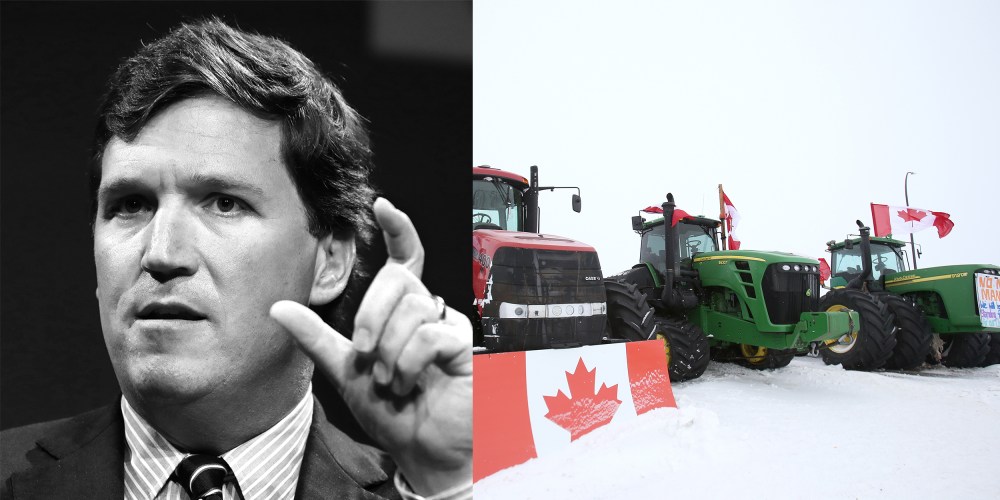
American right-wing pundits have taken great interest in the Canadian “freedom convoy” of truckers who have protested Covid-19 restrictions in Canada by occupying parts of the country’s capital and blockading U.S.-Canadian border crossings. But Fox News host Tucker Carlson is downright giddy about the possibility of a counterpart to the Canadian protest movement rising in the United States, and has been using his platform to try to boost the likelihood of that happening.
Last week on his show, Carlson effusively praised the convoy as the premier human rights movement of our era:
We want freedom, the truckers are saying, freedom from mandates. It’s a very straightforward ask, but so far, the truckers don’t have that freedom, and so their blockade continues. So far, that blockade has forced the Ford motor company to shut down one of its manufacturing plants and to operate another plant with a skeleton crew. … [T]his protest is less than a week old and already is causing deep pain to at least one global industry. It’s hard to overstate the historical significance of what we’re watching right here. The Canadian trucker convoy is the single most successful human rights protest in a generation. If nothing else, it has been a very useful reminder to our entitled ruling class, the working class man can be pushed, but only so far.
He sees the trucker protests as a useful vehicle for advancing right-wing populism — and in the process, he’s helping reveal why its claim to anti-elitism is specious.
Nowhere in Carlson’s analysis is there a reckoning with the reality that unrestrained Covid is most dangerous to the working class.
The convoy was initially sparked by a small group of Canadian cross-border truckers angry over losing their exemption to vaccine mandates in January. Since then, their protests have been joined by others, and evolved into a broader protest against any kind of Covid restriction at all in Canada — one of the protesters in Carlson’s segment says, “We want freedom, freedom of all mandates.” (It’s also attracted far-right white supremacist activity.)
Some context: Around 90 percent of Canadian truckers are vaccinated — which is to say, this isn’t a matter of the entire industry feeling unacceptably oppressed. And as Vox’s Zack Beauchamp has pointed out, polling shows Canadians have not only been widely supportive of their country’s current Covid restrictions, but also according to at least one poll, the January edition of the Covid-19 Monitor, most favor a stricter protocol: 70 percent support to some degree a vaccine mandate for all eligible adults in Canada, a more sweeping mandate than what any province requires. Moreover, the trucker protests are unpopular in Canada, and becoming even less so over time. None of these data points in and of themselves signify that these protests are illegitimate, but they do complicate Carlson’s simplistic depiction of a movement on behalf of the downtrodden everyman.

More relevant as Carlson tries to usher a trucker convoy into existence in the U.S. is the fact that Canada has significantly stricter Covid protocols than the U.S., such as vaccine passports for domestic and international travel and far more aggressive lockdowns, including curfews, in response to surges. By contrast, the U.S. has not only been more relaxed about Covid restrictions — including through the omicron surge — but it’s also trending toward dropping basic mask mandates even in liberal states. While the U.S. is still debating policies like mask mandates in schools, the country is open for business, doesn’t restrict travel, and the Supreme Court has struck down the Biden administration’s large employer vaccine mandate. In other words, the U.S. is not trending toward Covid-mitigating tyranny but rather swiftly toward normalcy — more quickly in fact than federal public health experts and President Joe Biden would prefer.
Despite this trend, Carlson, who is selling “I heart truckers” T-shirts that encourage solidarity with the truckers, is desperate to encourage Canada to export its pro-Covid movement to the U.S., with segments like his interview with an American trucker interested in participating in an American convoy.
Part of this is because, as Eric Levitz points out in New York Magazine, these truckers allow right-wing populist thought leaders to do what they do best: launch vague, nihilistic attacks on “elites” without discussing the origins of inequality or the kind of programs — like wealth redistribution — that might actually meaningfully contest their power. There may be no real crisis in the U.S. for these protesters to respond to, but figures like Carlson know that a trucker convoy can activate and mobilize activists whose energy can then be subsumed into ongoing right-wing populist projects. The trucker movement typifies the radical vision of conservative freedom that has emerged over the course of the pandemic. The convoy is also exciting for Carlson because the trucker movement typifies the radical vision of conservative freedom that has emerged over the course of the pandemic: the liberty to do harm to others in the name of hyperindividualism and to frame a serious, highly infectious illness as a purely personal matter, rather than a societal one. Nowhere in Carlson’s analysis is there a reckoning with the reality that unrestrained Covid is most dangerous to the working class he claims to champion. Lower-income people working, for example, in the retail industry or at restaurants often don’t have the privilege of being able to work from home, and are more exposed to the risks of Covid regardless of their personal risk threshold. People from poor and marginalized communities are disproportionately likely to die from Covid. And taking precautions against Covid with masks and vaccines are precisely the kind of measures that will allow commerce to continue — Covid is more likely to render businesses dysfunctional among a workforce that refuses to take commonsense measures to slow its spread and severity. The socioeconomic factors that have caused disproportionately lower-income people to mistrust credentialed experts and government authorities on vaccines and masks need to be taken seriously and dealt with. But Carlson is merely looking to take advantage of mistrust.
Zeeshan Aleem is a writer for MS NOW. Sign up for his newsletter. 

