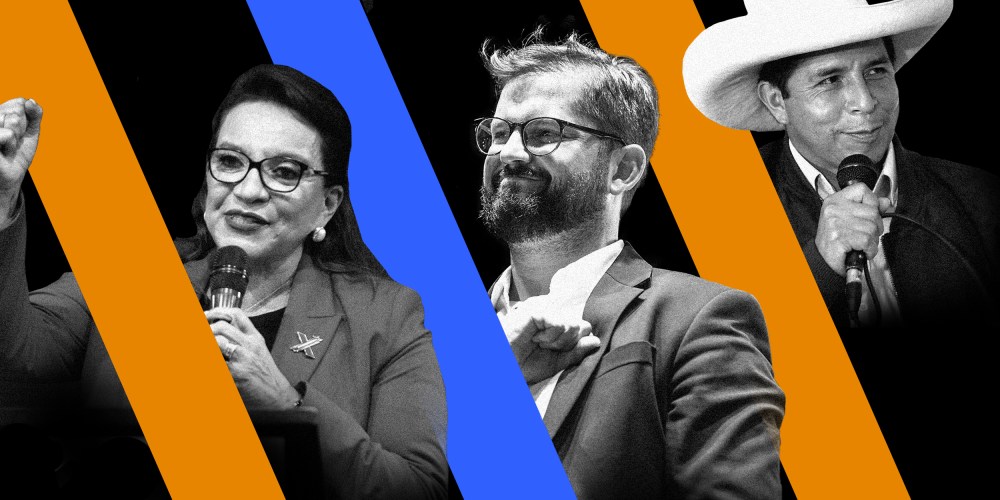
Gabriel Boric, whom The Associated Press described as a “leftist millennial,” was elected president of Chile last month, a development that should have grabbed everybody’s attention. Boric, a 35-year-old former student movement protester, defeated a Donald Trump-like extreme neofascist right-winger to become the country’s youngest leader.
Boric, a 35-year-old former student movement protester, defeated a Donald Trump-like extreme neofascist right-winger.
His victory is another big one for the Latin American left, coming weeks after Honduras elected Xiomara Castro, another leftist candidate, as the Central American country’s first female president.
These two victories followed rural teacher Pedro Castillo’s summer win in Peru, which followed a 2020 win by Luis Arce in Bolivia that marked the return of Evo Morales’ party. Argentina and Panama moved back to the left in 2019.
Although countries like Uruguay, El Salvador and Ecuador recently moved to the right, Latin America’s leftward trend — which began with Mexico’s Andrés Manuel López Obrador’s victory in 2018 — is more notable. Unlike we did with previous shifts, we shouldn’t easily conclude that the so-called leftist comeback is simply a part of a historical pattern. In fact, what is happening in Latin America is a combination of many factors, including extreme inequality and economic stagnation during the Covid-19 pandemic.

As Marcela García of the Boston Globe noted in a column about the elections in Chile and Honduras, “something different must be done to treat crippling income inequality.” What better way than to usher in new candidates and more progressive policies?
“Progressive” in this context doesn’t mean a nostalgic return to the Latin American left’s glory days when anti-imperialism was all the rage. The wins in Chile and Honduras should never be equated to the recent election farce in Daniel Ortega’s Nicaragua, which resulted in a fourth term for the former guerrilla leader. Instead, what is likely happening in Latin America is more a slight nudge to the center-left.
Boric’s win is just the latest example. In a Thursday interview with Latino Rebels Radio (the podcast I have hosted since 2014), Chilean political theorist Camila Vergara said Boric, even with the support of a leftist coalition that includes the country’s Communist Party, is not a true leftist and hasn’t been for a while. Comparing him more to Barack Obama of 2008, Vergara said Boric had to quickly move to the center during the runoff election and earn the support of centrist and right-center interests who push the “neoliberalism” in Chile that he has said he wants to end. As Vergara put it, a Boric vote was more a vote against stopping fascism and sympathizers of the Augusto Pinochet dictatorship than it was a choice for Boric. In addition, as has already been reported, the process to rewrite Chile’s constitution from the Pinochet era could make Boric’s term a short one, since a constitutional convention, if a new constitution is ratified in 2023, could call for new elections.
Boric might wind up being what Americans would think of as a left-leaning yet moderate Democrat.
In the end, Boric might wind up just being what Americans would think of as a left-leaning yet moderate Democrat, similar to Mexico’s López Obrador — who toned down his past rhetoric as he obtained presidential power; skirted around positions including abortion and the environment; and enjoyed a bizarrely cordial relationship with Trump when he was president, so much so that the wall Trump couldn’t build on the U.S. side of the border with Mexico was essentially moved south to the Mexico-Guatemala border in the form of more Mexican troops placed there by the López Obrador administration.
Still, the Latin American left as a more moderate movement will be tested twice more this year. Presidential elections are scheduled for May in Colombia and October in Brazil. There are already indications that by shifting more to the center and not fully embracing his leftist past, Gustavo Petro is following a Boric model for victory in Colombia. As for Brazil, in the latest poll, right-wing President Jair Bolsonaro is trailing former leftist President Luiz Inácio Lula da Silva by 22 points. Remarkably, this is the same Lula who was convicted of corruption in 2017, but Bolsonaro’s Covid-19 denial tour has led to approval ratings around 19 percent. All this is playing out while a Human Rights Watch report released Thursday described the “alarming reversal” of basic freedoms in Latin America, where “even democratically elected leaders attacked independent civil society, the free press, and judicial independence.” The reality in Latin America is that democracy continues to be an experiment not yet fully fleshed out. Structural and institutional problems are still rampant, while demonstrations against the power structure — such as in Chile or Colombia — have led to deeper attempts to transform society. The region’s new leftist wave, although not as revolutionary as previous generations, is at least trying to offer a new way to change it to forge ahead. Hopefully, the reactionary pendulum, which history has proven will eventually return, will not be so intense that it stunts the little progress Latin America has witnessed in the last few years.
Julio Ricardo Varela is the founder of The Latino Newsletter.