








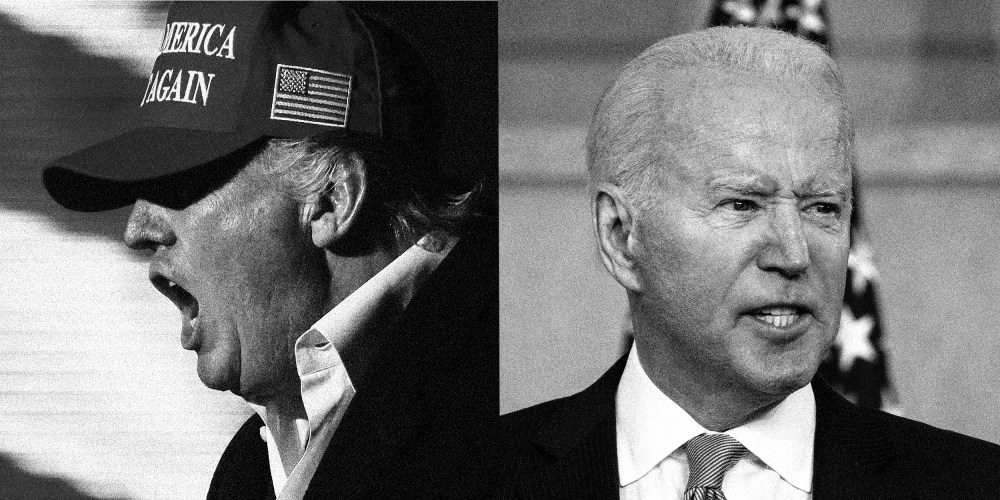
Not that it matters in the slightest, but when Donald Trump refused to commit to accepting the legitimacy of the 2020 election results, he had his reasons.
It wasn’t the facts that mattered; it was the ontology of Trumpism — the all-consuming persecution complex that characterizes his movement — that mattered most.
“You know that I’ve been complaining very strongly about the ballots,” the then-president rambled during a White House news conference, “and the ballots are a disaster.” Trump advised states to “get rid of the ballots,” which enterprising reporters translated into a slightly more coherent argument against the absentee and mail-in balloting regimes approved at the state level in response to Covid. Some of the issues Trump raised, like the accusation that the state of New York had mailed out ballots riddled with errors, were valid. Others, like the idea that West Virginians were “selling ballots” and that whole cases of military votes were thrown in the trash, were not.
All told, however, it wasn’t the facts that mattered; it was the ontology of Trumpism — the all-consuming persecution complex that characterizes his movement — that mattered most. Trump’s most stalwart supporters believed that American institutions were set against the president and, by proxy, themselves. To look too deeply into the substance of Trump’s allegations was to miss the point.

The former president’s critics correctly surmised that his rhetoric was dangerous. It created a psychological permission structure that would allow his voters to dismiss any evidence that invalidated their fears about a stolen election. Trump was playing with fire. It wouldn’t be long before that fire conflagrated into an unprecedented attack on the seat of American government, but that was no one’s intention in September 2020. At the time, it was all just talk.
To their credit, Democrats have integrated their hostility toward the rhetorical delegitimization of elections into their political identity. At least, they oppose it when Republicans are doing the delegitimizing. And yet, Democrats don’t seem to be above embracing unfounded attacks on the electoral process when it advances their interests. That’s exactly what President Joe Biden did during a news conference on Wednesday, and he seems to be dragging his party with him.
“Speaking of voting rights legislation,” one reporter asked the president, “if this isn’t passed, do you still believe the upcoming election will be fairly conducted and its results will be legitimate?”
To their credit, Democrats have integrated their hostility toward the rhetorical delegitimization of elections into their political identity.
Biden responded by noting that “it all depends” on whether his administration can “make the case to the American people” that the voting rights bill should become law. Biden’s contention that this year’s midterms would only be conditionally valid prompted reporters to follow up on this claim, whereupon Biden made everything worse.
“You said that it depends,” another reporter remarked. “Do you think that they would in any way be illegitimate?”
Biden doubled down. “I’m not going to say it’s going to be legit,” he declared. “The increase and the prospect of being illegitimate is in direct proportion to us not being able to get these reforms passed.” There was no ambiguity in the president’s remarks. Until and unless Congress passes Biden’s preferred electoral reforms into law, the legitimacy of this year’s elections will be in doubt. And since Biden’s preferred electoral reforms are unlikely to become law, the Democratic Party’s most faithful will have all the license they need to reject the legitimacy of an electoral outcome that does not favor their party’s candidates.

Biden managed to conscript much of his party into a rhetorical assault on the legitimacy of an election that all indications suggest favors the GOP. “Are you concerned that without these voting rights bills the election results won’t be legitimate?” CNN’s Kasie Hunt asked House Majority Whip Rep. James Clyburn, D-S.C., on Thursday. “I’m absolutely concerned about that,” he replied.
Vice President Kamala Harris agreed. When confronted with the similarities between Biden’s rhetoric and Trump’s, Harris dismissed the claim offhand. “We as America cannot afford to allow this blatant erosion of our democracy and, in particular, the right of all Americans who are eligible to vote to have access to the ballot unfettered,” she said.
We can expect that talking down the legitimacy of American elections will have a predictable partisan effect. In 2020, Gallup, which has gauged Americans’ confidence in elections on five occasions since 2004, found that 74 percent of Democrats believed that U.S. elections were valid compared with an abysmal 44 percent of Republicans. This is surely attributable to Republicans’ receptivity toward Trump’s rhetoric and Democrats’ hostility toward it. Historically, however, it’s Democratic voters who have expressed more skepticism in the legitimacy of the American electoral process. That makes sense because, historically, it’s Democratic politicians who have called the legitimacy of America’s elections into question. As late as 2018, a staggering two-thirds of Democrats told YouGov pollsters that Trump’s legitimacy was questionable because Russia “tampered with vote tallies on Election Day to help the president” in 2016. George W. Bush was “selected, not elected” in 2000, according to Hillary Clinton. Former Virginia Gov. Terry McAuliffe argued that the Republican-led state of Florida and the Supreme Court “tampered with the results” to deliver Bush into the White House. He did the same thing again four years later. “We actually won the last presidential election, folks,” he told a cheering crowd. “They stole the last presidential election.” As late as 2018, a staggering two-thirds of Democrats told YouGov pollsters that Trump’s legitimacy was questionable because Russia “tampered with vote tallies on Election Day to help the president” in 2016 — a theory for which there is precisely no evidence, but which was bolstered by the likes of Biden’s staff secretary, Neera Tanden. Americans, she argued, “have intuitive sense Russians did enough damage to affect more than 70k votes in 3 states.” No doubt, had Trump won re-election, a healthy number of Democrats would confess to their belief that his victory was a result of the full flowering of a conspiracy to weaponize the U.S. Postal Service — an allegation that was lent credence by Senate Democrats who actually held hearings on the issue. Why does he lie about this?Because he knows people have intuitive sense Russians did enough damage to affect more than 70k votes in 3 states https://t.co/VFiptUz6gV If White House press secretary Jen Psaki’s comments are any indication, there’s real tension between the political message Democrats are retailing in regard to the legitimacy of American elections and what they know to be the truth. When asked if the president had confidence in America’s elections even if his preferences didn’t become law, she said plainly: “yes.” But Psaki’s unequivocal rejection of this conspiracy theory was nowhere to be found in her appearance the following day on ABC’s “The View.” Asked why voters “should have faith in the legitimacy of the next election” in the absence of Democrats’ preferred reforms, Psaki clarified that Biden wasn’t “predicting” that the elections were not destined to be illegitimate, but that Republicans are actively seeking to undermine their legitimacy, which the president’s reforms would prevent. This statement is many things, but what it isn’t is an unqualified expression of confidence in the American electoral process. Either calling into question the credibility of American elections mortgages the stability of our democratic institutions, or it doesn’t. Either stoking paranoia and apprehension is wrong and dangerous, or it isn’t. The motives of those who apply these base tactics is immaterial. By flirting with the paranoid revisionism that overtook the GOP in the wake of the 2020 vote, Biden abandoned the moral high ground on the issue and ushered in a dangerous new phase in our collective fight against the paranoid nihilism that has become so fashionable in our politics. If neither party is willing to defend the electoral process unless it delivers outcomes they like, that process isn’t long for this world.
Noah Rothman
Noah Rothman is the associate editor of Commentary Magazine. 

