








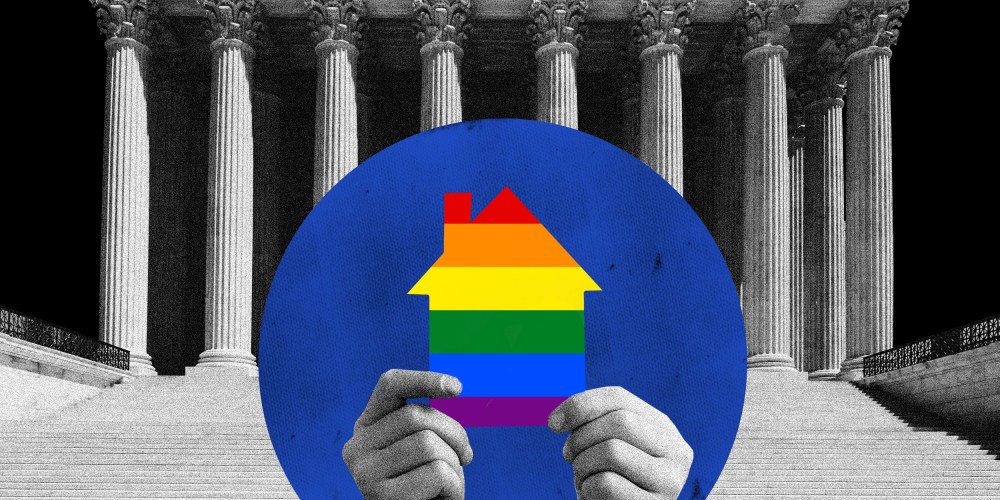
The latest chapter in a battle between two freedoms — the freedom for religious rights and the freedom from discrimination — was written by the Supreme Court on Thursday. And it is not favorable to those advocating for stronger anti-discrimination laws. In essence, in America today, governments can be forced to work with religious institutions that discriminate against gay and lesbian couples.
Thursday’s decision arguably halts precious and fragile progress made by the LGBTQ community.
The Catholic Social Services (CSS) is a religious agency that contracts with the city of Philadelphia to help place children with foster families. Based on its religious beliefs, CSS refuses to certify same-sex couples as foster parents. Philadelphia told CSS that it either had to agree to certify same-sex couples or it would stop referring children to the agency and would not enter into any future contracts with CSS, because Philadelphia has an anti-discrimination law and CSS was violating it.
In a unanimous decision, the court ruled in favor of CSS on the grounds that its rights under the free exercise clause of the First Amendment are violated if it has to choose between placing children with same-sex couples or losing their government contract. In other words, the court concluded that under the First Amendment’s freedom of religion, a government entity (the city of Philadelphia) must, in this circumstance, carve up its anti-discrimination policy and place children with a religious foster-care agency (Catholic Social Services) who refused to place children with same-sex couples.

Thursday’s decision arguably halts precious and fragile progress made by the LGBTQ community. The Supreme Court’s decision in 2015 that marriage is a fundamental right that cannot be denied on the basis of sexual orientation was a momentous part of this story, but hardly the final chapter. In the wake of that famous 2015 decision in Obergefell v. Hodges, there was a dark joke that went something like, “Congratulations same-sex couples, you can get married on Sunday night, but fired on Monday morning.” At the time, many states did not have laws preventing workplace discrimination on the basis of sexual orientation.
But just last year, it started to look like the march toward equal rights, not just to get married, but to be free from workplace retaliation on the basis of sexual orientation or gender identity, would continue. In June 2020, the court concluded that the Civil Rights Act protects individuals from workplace discrimination on the basis of sexual orientation or gender identity. It is of course important to remember that that 2020 decision was based on the court’s interpretation of a congressional statute and did not involve a religious freedom claim.
The court’s decision will raise questions about whether members of the LGBTQ community can legally be made to occupy a position as second-class citizens in American society.
One day after the 2020 election, the court heard arguments by phone in this case, one that raises a different iteration of a related question about LGBTQ rights. And we now know the answer to that question: The city of Philadelphia cannot threaten to end its contract with a Catholic foster care agency that refuses to place children with same-sex couples.
The court’s decision will raise questions about whether members of the LGBTQ community can legally be made to occupy a position as second-class citizens in American society. This decision may kick off a heated conversation between our elected branches (our lawmakers and president) and our appointed branch (our federal judges) about where and how to draw a line that protects both the freedom of religion and the right to be free from discrimination.
Even if Democrats can successfully clear the hurdle of enacting sweeping protections for LGBTQ Americans, the next hurdle waiting for them will be a First Amendment challenge to that law, and we now have more evidence for how the court may strike that balance.
One more point worth mentioning is how an ideologically divided Supreme Court can come to a unanimous decision on such a controversial question. The answer is it makes a narrow ruling that leaves almost all of the justices wanting something more — or less. Yes, the decision looks like a win for the court’s conservatives in that it favors the claims of a religious objector. But the decision is also something of a win for the court’s liberals, because the ruling does not go nearly as far as it could have. The court left undisturbed an important 1990 precedent where the court held that neutral, generally applicable laws are legal, even in the face of a complaint that that law violates the First Amendment’s Free Exercise clause. There the court rejected a claim by Native Americans who were punished for smoking peyote. The Native American plaintiffs explained that smoking peyote was part of a religious ceremony. The court said a state law prohibiting its use could still be applied to them. Conservatives appear ready, willing and excited to overturn that precedent in favor of a decision that is more protective of religious rights. But the court explicitly left that decision alone, which may be how Roberts obtained a unanimous result here. But it looks like it could just be a matter of time before the court revisits that 1990 decision. The current court has shown a willingness to prize claims made by religious objectors. We need only to think back to the court’s recent decisions on whether Covid-19 restrictions impermissibly burden religious rights to know this is a court that will be protective of religious objectors. The question for Americans will not be whether the court will look favorably on individuals and groups who walk into federal court alleging a violation of their religious freedoms. The question will be where, exactly, the court will draw the line in the future between anti-discrimination laws and the constitutionally protected freedom of religion. Thursday’s decision writes the next, but certainly not the last, portion of that story.
Jessica Levinson is a Loyola Law School professor and MS NOW columnist. 


