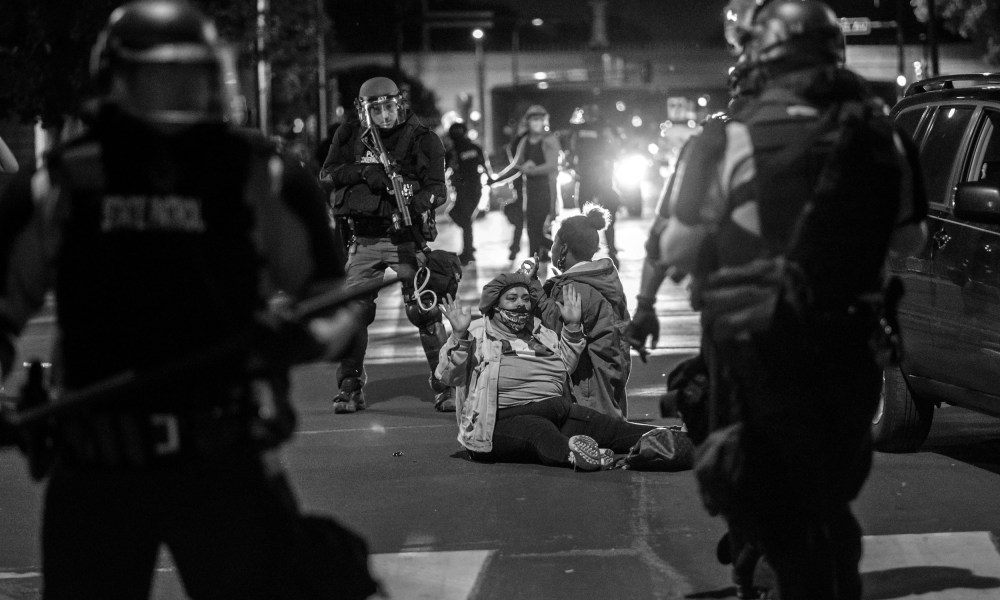
On the night of May 28, I was standing in front of a burning liquor store at the corner of East Lake Street and Minnehaha Avenue in Minneapolis. Three days had passed since the death of George Floyd in police custody, and no arrests had been made.
The idea that people of color who demonstrate for their rights — Black people, specifically — are inherently threatening and dangerous is commonplace in America.
Police had been run out of their precinct by protesters on one corner. On the opposite corner stood the still-smoldering ruins of an AutoZone that had been burned the night before. On a third corner, protesters had gathered, and on the corner behind me, the liquor store was in flames. I had stood at the intersection for six hours, watching the frustration grow.
I’m revisiting this scene now in light of a more recent event, when crowds of supporters of President Donald Trump swarmed the U.S. Capitol on Jan. 6, protesting the legitimacy of the election of President-elect Joe Biden.
Although some have drawn misguided parallels between the two, there is an important distinction here: Violence that is intended to spread democracy, end injustice and encourage fairness in the application of the rule of law has nothing in common with the wanton, anti-democratic riots of Jan. 6, fueled by QAnon and other conspiracy theories that tell the story of an election stolen by a Satan-worshipping cabal.

Jan. 6 was a violent riot in support of a coup attempt, and it should be met with nothing but universal scorn. The protests that swept the country after the death of George Floyd were the symptom of historically oppressed and disenfranchised people reaching a boiling point and taking a stand for their basic rights.
The idea that people of color who demonstrate for their rights — Black people, specifically — are inherently threatening and dangerous is commonplace in America. And the supporting narrative is that police are there to protect you from that, even though, as in this case, police were the proximate cause of the demonstrations.
But more than that, there’s a clear distinction that even well-intentioned people make, possibly inadvertently: that Black people with grievance are one step away from becoming violent, while white people with grievance are justifiably upset, fighting to defend their rights.
On that May evening in Minneapolis, I described the scene to my colleague Brian Williams, who was anchoring. I relayed how, even though the previous day’s protesters had been largely peaceful, police had responded by barricading the precinct and creating a human shield. This helped create “a new center of focus for the protesters,” as I reported, prompting them to target the police station and the armed officers who surrounded it; officers responded with tear gas.

By midnight, the impression a viewer might get from watching a police station’s being overrun by civilian protesters and buildings burning on the news was that it was a riot or that Minneapolis was burning. But it wasn’t, and I wanted to emphasize that an overwhelming majority of the protesters were — and remained — peaceful, not participating in any violence.
So I did. And that 20 seconds or so of my segment was the only part of several days of reporting that right-wing media outlets continued to circulate, which included my getting tear-gassed by authorities several times and being struck by a rubber bullet:
“I want to be clear in how I characterize this: This is mostly a protest. It is not, generally speaking, unruly. But fires have been started, and there is a crowd that is relishing that. There is a deep sense of grievance and complaint here, and that is the thing, that when you discount people who are doing things to public property that they shouldn’t be doing, it does have to be understood that this city has got, for the last several years, an issue with police, and it has a deep sense of grievance with inequality.”
An inaccurate blending of the events of those days became a regular laugh line for Trump.
By late in the presidential election, an inaccurate blending of the events of those days became a regular laugh line for Trump, who repeatedly told rallygoers some version of this story: “After a week and a half of terror, remember you had that idiot anchor from CNN standing: ‘This has been a friendly protest.’ And over his shoulder it looked like Berlin in its worst day during the war … the worst day they ever had.” (Just a note: I work for MSNBC.)
That was just part of the lie that has become part of right-wing lore about how the media embraced, downplayed and encouraged violence. That same clip, without context, made it to the floor of Congress as part of a hearing.
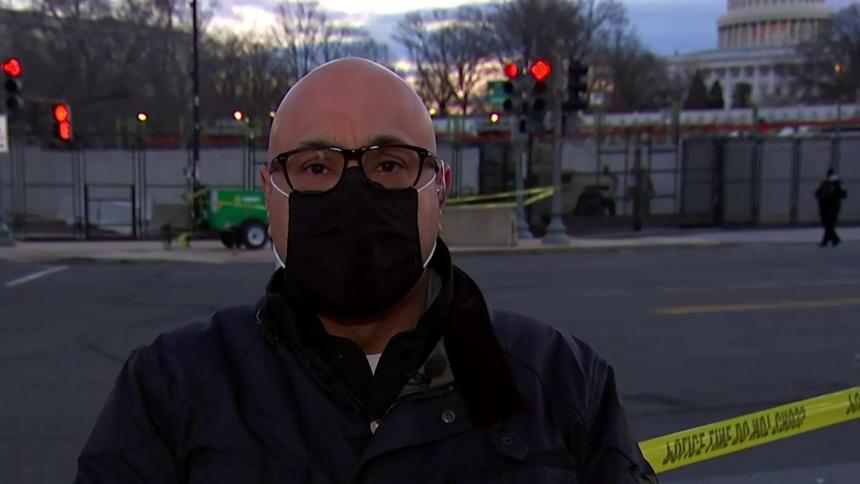
Most of the media didn’t excuse or condone violence, but some of us, like me, did seek to contextualize it. On that May night in Minneapolis and the days that followed there and in Chicago and in New York City, I provided hours and hours of reporting on the protest, including repeating the key fact that the overwhelming majority of protesters were peaceful and that they weren’t involved in any sort of violence or criminal behavior.
These were not violent protests; they were protests with violence. But whether one’s protest manifested in marching and chanting or looting and burning, there was an underlying grievance that needed to be, but often wasn’t, understood. Immediately after what I said on the now-famous edited clip, I told Williams what Black people had been telling me in the course of my reporting:
“Before we had video, how did we know about these things? Now we have video. We have three angles of this thing, and the people who are talking to me — I’m not an investigator, and I don’t have access to the information investigators have — but they are saying, ‘What more do you need?’”
Frustration with 400 years of racial inequality and injustice doesn’t always manifest neatly into organized nonviolent protest.
Many Black people and other people of color in America feel that the law doesn’t protect them equally, with the result that some may feel less compelled to follow the law. This isn’t — and never was — an excuse for lawlessness. Rather, it is an explanation for why frustration with 400 years of racial inequality and injustice doesn’t always manifest neatly into organized nonviolent protest. Looting and setting fire to a liquor store need to be understood in all of the texture and context that surround it.
As criticism of the alleged glorification of violence grew, I repeatedly underscored on my show that violent protest, including guerrilla tactics used by revolutionary soldiers in Lexington and Concord in the pursuit of independence from a country that taxed Americans but did not allow them democratic representation, are what this country was founded on. And that violence against rebellious slaveholding states is what won the Union the Civil War. And that violence against racial injustice was a critical part of the civil rights movement of the ’60s. What Gen. William Sherman and his 60,000 Union soldiers did on their 285-mile march from Atlanta to Savannah in 1864 was grotesque violence, largely against civilians, and it may have been the single most effective action to end the Civil War. So now, critics wonder, why is there widespread revulsion at the violence at the Capitol, when I and others have spent months saying violence can be a necessary part of protest? For starters, the Capitol is not a liquor store. I didn’t come up with that — Rabbi Yosie Levine of the Manhattan Jewish Center did in a message to his congregants about the attack on the Capitol, saying: “When someone breaks its windows, it’s not criminal mischief. It’s an assault on democracy and decency.” 8/13 And that’s the point. Violence always needs to be understood in context. The violence of the anti-apartheid movement, the Indian independence campaign — any violence at all that fights injustice — is violence with meaning behind it, borne of the failure of other means and methods of redress. The killing of Ahmaud Arbery by white vigilantes in Georgia and the killing of Floyd in Minneapolis are facts, authenticated and witnessed on video by millions. It’s also important to understand that there is complexity in the suffering that innocent people encounter in violence, even if it might be justified or explained. I spoke with a woman in Minneapolis who, though completely supportive of the social justice movements, lost not just her business (through which she employed family members), but also the building in which her hair salon was housed and which provided income from other businesses that leased space there. As a Black woman, she never wavered in her support for the social justice movement. As a member of a family that had lost its livelihood, she was angry. It’s also important to understand that there is complexity in the suffering that innocent people encounter in violence, even if it might be justified or explained. More recently, I spoke with Ian Williams, the wildly charismatic owner of Deadstock Coffee in Portland, Oregon. He told me he dreams of his shop’s becoming a gathering place, like a barbershop. As a young Black entrepreneur, he, too, supports the Black Lives Matter movement, but he is troubled by protests that still have many Portland businesses boarded up: “There were nights where we all sat outside, prepared to, like, take that term however you like, but ‘protecting our investments,’ right? And protecting our community,” he said. Williams’ commitment to the cause hasn’t wavered, but, he told me, he’s tired: “After a while, I was like: ‘All right, bro. … You guys are good. You don’t have to protest anymore.’ Like, just let me live my life, you know?” The effect of violence — the loss of life, of property and of the potential for prosperity that hits those who are part of the same fight — cannot be ignored and has not been ignored. But to compare the underlying goals of protests about injustice that have become violent at their edges to an anti-democratic uprising fueled by lies and conspiracy theories is to ignore history, and the truth.
Ali Velshi is the host of “Velshi,” which airs Saturdays and Sundays on MSNBC. He has been awarded the National Headliner Award for Business & Consumer Reporting for “How the Wheels Came Off,” a special on the near collapse of the American auto industry. His work on disabled workers and Chicago’s red-light camera scandal in 2016 earned him two News and Documentary Emmy Award nominations, adding to a nomination in 2010 for his terrorism coverage. 

Rabbi Yosie Levine of the Manhattan Jewish Center sent that line in a message to his congregants about the attack, saying of the Capitol, “when someone breaks its windows, it’s not criminal mischief. It’s an assault on democracy and decency.” #velshi