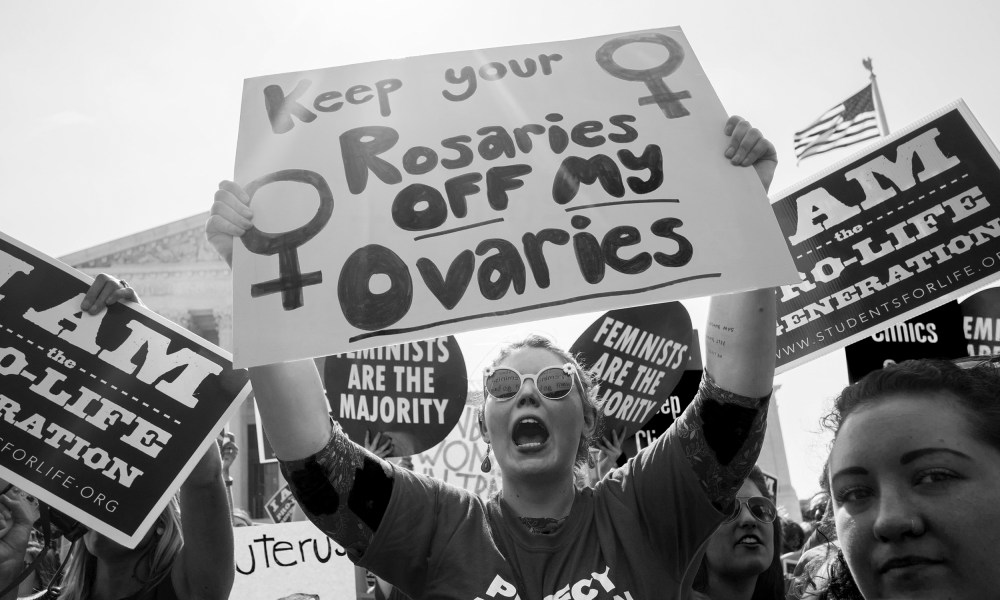
Forty-eight years ago today, the Supreme Court ruled that the 14th Amendment’s guarantee to the right to privacy protected a pregnant person’s right to terminate a pregnancy without excessive government restriction. Roe v. Wade was, of course, a game changer, a landmark case in abortion access.
Abortion is unique in that it is often treated as a religious issue, rather than a medical one.
And yet, not enough has changed in nearly 50 years — not legally, and not culturally.
Abortion is not treated like other kinds of medical procedures — not on the legal level, nor on the cultural interpersonal level. Abortion is unique in that it is often treated as a religious issue, rather than a medical one. As problematic as this has been in many cases, there is an opportunity for more religious leaders to encourage people to think differently about the issue, to educate people and talk more openly about it.
The religious right has dominated the national conversation about religion and abortion for decades, ever since evangelical Christians lost the right to run racially segregated schools and decided that abortion could be a galvanizing issue. Members of the religious right have used their considerable power again and again, mobilizing around politicians, legislation and judicial nominees (including Amy Coney Barrett).
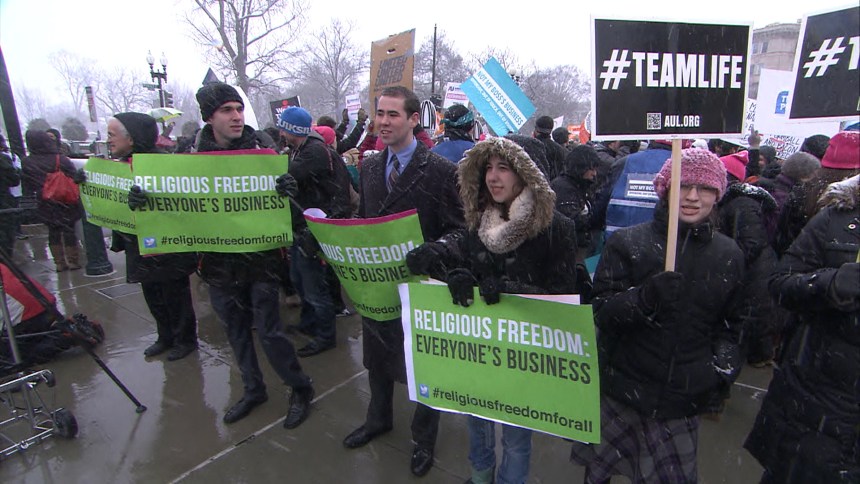
But conservative evangelicals did not always believe that abortion was wrong; for several years after Roe v. Wade, it was regarded as a purely personal matter. And they are not the only religious community with opinions about the topic.
The religious right may have the loudest voice when it comes to abortion, but there are numerous other religious approaches to the matter. Many Christian communities make space for abortion in their official denominational statements. Jewish law not only permits the termination of pregnancy; it requires it when the life of the pregnant person is at stake. Other religious communities have their own complex and nuanced approaches to the procedure.
The religious right may have the loudest voice when it comes to abortion, but there are numerous other religious approaches to the matter.
On Jan. 12, the Supreme Court issued its first reproductive rights-related ruling since the vocally anti-abortion Barrett was confirmed. The court decided that, even though telemedicine and pharmacy delivery would suffice as far as clinical requirements were concerned, people seeking mifepristone, commonly known as the “abortion pill,” for medication abortions would nonetheless be required — during a deadly pandemic — to travel to hospitals or clinics to pick up the pills.
This makes an already trying process more arduous and unnecessarily jeopardizes the health of pregnant people, to say nothing of undermining public health efforts. The decision is, many abortion access advocates worry, a chilling indication of rulings to come.

In her dissent, Justice Sonia Sotomayor wrote, “This country’s laws have long singled out abortions for more onerous treatment than other medical procedures that carry similar or greater risks.” Indeed, over 450 laws restricting access to reproductive health care have passed since 2011, and at least 18 cases in the lower courts could make their way to the Supreme Court and pose a real threat to Roe v. Wade.
Now, more than ever, we need to talk about abortion in our religious communities. We need to hear from, and talk about, those who support abortion rights and access precisely because of their religious and moral beliefs, not in spite of them.
Too many clergy behave as though the conversation has already been ceded to those who claim that faith and religious practice are wholly incompatible with the belief that everyone has the right to decide what happens to their own bodies. Even in liberal, suburban Jewish communities where people talk a lot about tikkun olam (repairing the world, social justice), congregants are surprised to learn about Judaism’s permissive approach. Because we don’t talk about it.
One in 4 people who can get pregnant will terminate a pregnancy by the age of 45. And they live in every religious community.
And more to the point, abortion touches each and every religious community, regardless of whether it is officially sanctioned. One in 4 people who can get pregnant will terminate a pregnancy by the age of 45. And they live in every religious community, in every walk of life, even if it’s not always discussed. Renee Bracey Sherman, the founder of We Testify, an organization that focuses on storytelling around abortion, said, “Everyone loves someone who has had an abortion, whether they know it or not.”
Silence from clergy doesn’t mean congregants don’t have legitimate pastoral needs in this department. Some people experience terminating a pregnancy as self-care, a cause for relief and even joy. For others, it may bring up complex feelings, or grief, or anger, or regret. Some may feel clear in their decision; others may agonize about what to do. Some may not have, or not feel they have, a choice, whether because of their economic or family situations, immigration status, abusive relationship dynamics or some other factor. And some people may wish to terminate a pregnancy but might not be able to.
Congregants may have concrete, material needs, as well. People who are denied access to reproductive health care — disproportionately those struggling financially, Black people, Indigenous people and people of color, young people, people living in rural communities, immigrants, people living with disabilities and LGBTQ people — are more likely to live in poverty and to remain in abusive relationships. But they are just as likely to be in need of abortions, which means laws restricting abortion access are directly linked with high rates of unsafe abortions. Many people experience significant stigma for having abortions or fear discussing it lest they be stigmatized or dissuaded if still in the process around it. But this isn’t how it has to be, and it certainly isn’t how it should be. Too many clergy have kept their distance from what they fear may be an unpleasant or polarizing topic. It’s time to educate our communities and make space for a conversation many have long desperately needed. Our religious communities should be places where anyone who has terminated a pregnancy, or may ever do so, feels welcome and supported. They should be places where people understand what their traditions teach about these issues. And they should be places where everyone understands the importance of fighting for reproductive health, rights and justice for everyone. Congregants are surprised to learn about Judaism’s permissive approach. Because we don’t talk about it. At the National Council of Jewish Women, where I serve as scholar in residence, we’ve begun to do just that. This summer, we launched Rabbis for Repro, a national network of over 1,000 rabbis and other Jewish clergy who have pledged to preach and teach about abortion. Feb. 12 and 13 will be our inaugural Repro Shabbat, when Jewish communities nationwide will celebrate the critical importance of advocating for reproductive health, rights and justice. We sent pledge signatories a little swag pack when they signed up that included a sticker that says “safe space to talk about reproductive freedom” for clergy to hang in their offices so anyone coming to speak with them will know that this, too, is a kosher topic of conversation should they choose to raise it. The Religious Coalition for Reproductive Choice also offers a wealth of resources for those in ministry settings, like training for clergy to offer better pastoral support to congregants making reproductive decisions and theological language to support reproductive freedom work. When religious communities claim their right to discuss and normalize abortion, they create more space for everyone in their congregations to tell the truth about their lives. They reclaim the moral authority of their traditions and own the holiness inherent in asserting our right to autonomy, agency, dignity and freedom. They assert the critical need for a more equitable, more just society. And they may galvanize their communities to fight for policies and legislation (like the Women’s Health Protection Act and the EACH Women Act) that can bring that more just society into being. It’s time for religious communities to take Sotomayor’s implicit advice to heart: to stop treating abortion like an unspeakable secret and to start normalizing it as the medical procedure that it is.
Rabbi Danya Ruttenberg
Rabbi Danya Ruttenberg serves as scholar in residence at the National Council of Jewish Women and is the author of seven books, including “Surprised by God” and “Nurture the Wow.”