









The cybersecurity news earlier this week was jarring, both in its scope and its severity. As NBC News reported, “Hackers who targeted the federal government appear to be part of a Russian intelligence campaign aimed at multiple U.S. agencies and companies, including the cybersecurity company FireEye, officials said Sunday.”
Initially, the public was alerted to the fact that U.S. Department of Commerce was breached. Then we learned of an intrusion at Treasury Department. It wasn’t long before the Department of Homeland Security had also reportedly fallen victim to “a major cyberespionage campaign.”
The list then grew to include the Pentagon, the U.S. Postal Service, and the National Institutes of Health.
On Tuesday, Sen. Richard Blumenthal (D-Conn.) said he’d received a classified briefing on the matter, which he described as “stunning.” The Connecticut Democrat added that the information he’d learned left him “deeply alarmed” and “downright scared.” A day later, Senate Minority Whip Dick Durbin (D-Ill.) told CNN the hack was “virtually a declaration of war by Russia on the United States.”
It was against this backdrop that Tom Bossert, who served as Donald Trump’s White House homeland security adviser, wrote a New York Times op-ed that argued, “The magnitude of this national security breach is hard to overstate.”
The Russians have had access to a considerable number of important and sensitive networks for six to nine months. The Russian S.V.R. will surely have used its access to further exploit and gain administrative control over the networks it considered priority targets. For those targets, the hackers will have long ago moved past their entry point, covered their tracks and gained what experts call “persistent access,” meaning the ability to infiltrate and control networks in a way that is hard to detect or remove.
Mindful of the electoral circumstances, Bossert noted that Donald Trump is poised to leave office with much of the U.S. government having been compromised by Russian intrusion, which warrants a significant response.
“President Trump must get past his grievances about the election and govern for the remainder of his term,” the op-ed concluded. “This moment requires unity, purpose and discipline. An intrusion so brazen and of this size and scope cannot be tolerated by any sovereign nation. We are sick, distracted, and now under cyberattack. Leadership is essential.”
It’s a compelling call, though there’s little to suggest Bossert’s former boss has any intention of taking the advice.
For one thing, Donald Trump has gone from doing little actual work to doing no work at all. The New York Times recently reported that the president “barely shows up to work” anymore. Soon after, the Washington Post quoted a senior administration official saying, “The large majority of his time has been unstructured, in the Oval [Office], just going nuts about voter fraud…. That occupies seemingly every waking moment of his day.”
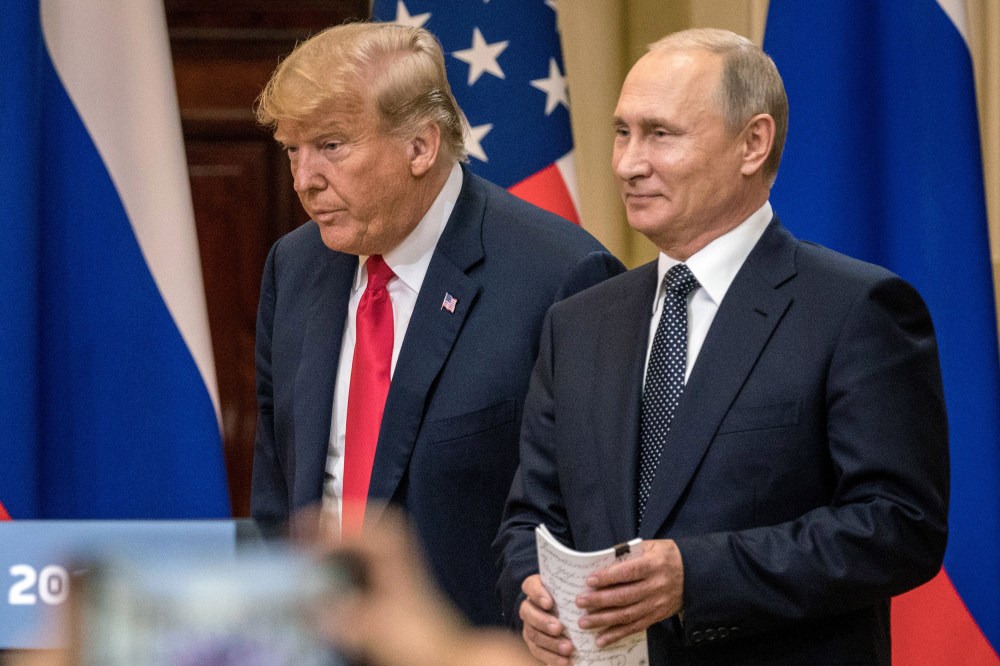
The Associated Press also reported that Trump’s involvement in the day-to-day governing of the nation “has nearly stopped,” and the Republican no longer bothers with policy briefings. Complicating matters, of course, is the outgoing American president’s profound weakness toward Moscow and the embrace of a soft-on-Russia posture that obviously isn’t working. A Washington Post analysis noted yesterday: [I]n this moment, it’s worth noting how Trump and the White House had assured that their approach was having the desired effect. Trump might not have talked tough on Russia — preferring to instead talk about how he wanted to have a good relationship with Putin — but the argument was that his administration’s actions were picking up the slack. We were assured this approach — bifurcated as it was — was working. This argument now appears discredited. It’s also worth emphasizing for context that Trump has experimented with all kinds of responses to Russia’s attack on U.S. elections in 2016, including an emphasis that it happened on Barack Obama’s watch. The subtext was hardly subtle: Moscow might have targeted us for a cyberattack before 2017, but Putin respects Donald Trump’s awesomeness too much to even consider such a thing now. Perhaps this helps explain the Republican’s reticence this week in response to the latest attack. Could it be that Trump is not only reluctant to criticize his Russian benefactors, but he doesn’t want to admit that his entire posture has been a failure?
Steve Benen is a producer for "The Rachel Maddow Show," the editor of MaddowBlog and an MS NOW political contributor. He's also the bestselling author of "Ministry of Truth: Democracy, Reality, and the Republicans' War on the Recent Past."
Latest Post
Recommended


