








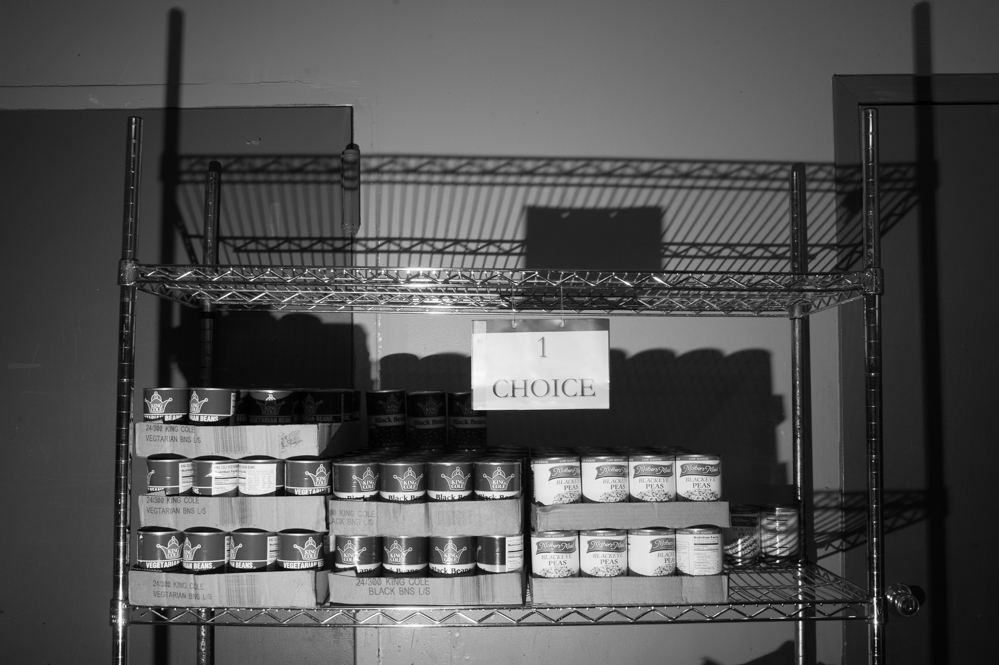
A visit to a typical New York food pantry is supposed to get you nine meals, enough to last for three days. While the pantry bags may sometimes include fresh produce or fresh bread, most of the items distributed are a little more humble than that: Maybe some canned chicken, some rice, a couple single-serving packets of oatmeal. Some recipients may be able to stretch their monthly allotment further than others, but that bag of food will never be more than a stopgap to get you to the next paycheck, the next round of food stamp benefits, or—in especially desperate times—the next food pantry visit.
Now, even that short-term safety net is becoming more threadbare than ever. On November 1, a $5 billion automatic cut to food stamp benefits pushed America’s already historic levels of hunger and food insecurity even higher. The result was a sharp spike in the number of people accessing emergency food services.
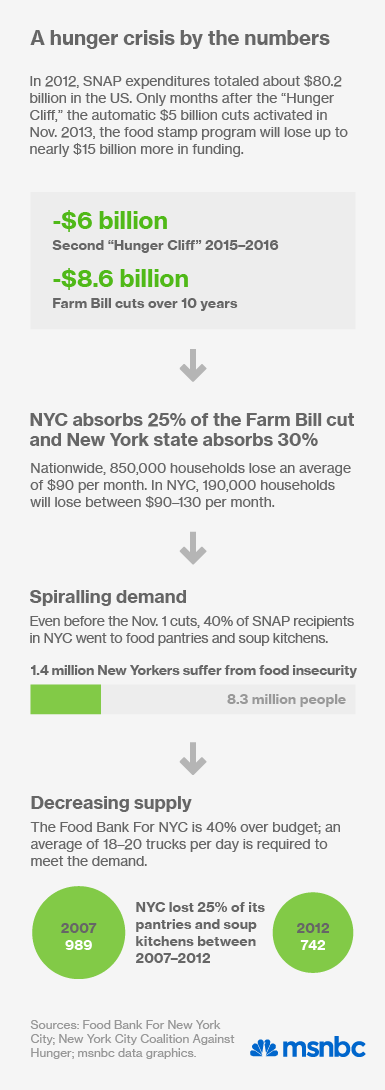
In New York, the increased demand has been more than many food pantries are able to handle. Over the next month, nearly a quarter of the city’s pantries have had to conserve resources by cutting down on the amount of food they put in each recipient’s bag. Slightly more than a quarter of the city’s food pantries and soup kitchens have begun to turn people away due to lack of food, according to a survey by Food Bank For New York City. Some 522 food pantries and 138 soup kitchens participated in the survey.
Food Bank For New York City’s research looked only at the immediate aftermath of the cuts, but since then the problem seems to have gotten significantly worse. When the food bank held its annual conference on January 15, attended by over 500 representatives of the New York’s food pantries and soup kitchens, “over half of the room said that we’re absolutely rationing the amount of food we give people,” said food bank President Margarette Purvis.
What’s happening in New York is a testament to just how dire America’s hunger crisis has become. America’s most populous city also has what is perhaps the country’s most robust emergency food infrastructure, yet it is still flailing to address skyrocketing food insecurity and greater demand for emergency services. In 2013, Food Bank For New York City—America’s largest food bank—delivered 71 million pounds of food to nearly 750 agencies around the city. Yet the food bank, its member agencies, and hundreds of other organizations providing emergency food assistance around the city, are still finding it impossible to keep up with the growing pace of food insecurity.
“I don’t think it’s ever been the way it is now…It seems like we just see more and more people coming in here,” said Community Health Action of Staten Island executive director Diane Arneth.
In a city of 8.3 million people, as many as 1.4 million residents suffer from food insecurity according to the New York City Coalition Against Hunger’s 2013 Hunger Report [PDF], which uses data from the USDA and adopts the agency’s definition of food security as “access … to enough food for an active, healthy life.” That number is likely to go up before it goes down, advocates say.
Death By A Thousand Cuts
“What’s happened in New York is pretty similar to what’s happened in the rest of the country. Like everything else here, it’s exaggerated and bigger, but the trends tend to be the same,” said Joel Berg, New York City Coalition Against Hunger (NYCCAH) executive director and former advisor to President Bill Clinton. The modern hunger crisis “can be directly traced to the Reagan era and the replacement of living wage jobs with poverty jobs or no jobs at all,” Berg told msnbc.
Federal nutrition programs had expanded dramatically in the decade before President Reagan took office, but his administration put a decisive end to the forward momentum. In a 1983 Christian Science Monitor op-ed called “The return of hunger to America,” Democratic presidential candidate and South Carolina Senator Ernest Hollings noted that Reagan had successfully slashed at least $5.9 billion (or nearly $13.6 billion, in 2014 dollars) out of food stamps.
In the late 70s, hunger in the United States appeared to be nearing extinction. In New York, says Berg, there was so little need for emergency food services that in 1978 the city had only 28 operating feeding agencies. By 2014, that number had ballooned to about 1,000 agencies.
Granted, there was a slight dip in nationwide food insecurity figures during the boom times of the late 90s and early aughts, according to USDA figures. Yet the brief dip didn’t last long, thanks in part to President Clinton’s 1996 welfare cuts and the lack of any concerted federal anti-hunger effort.
The 2008 financial collapse vastly hiked the number of hungry people in New York and across the U.S. Between 2006 and 2012, according to NYCCAH estimates, roughly 200,000 New Yorkers became food insecure. To make matters worse, the same economic forces that added those 200,000 to the ranks of the needy also decimated the non-profit safety net which was supposed to catch them. Between 2007 and 2012, New York lost 25% of its food pantries and soup kitchens.
The 2009 federal stimulus bill helped to limit the damage by adding back $45.2 billion to the food stamp program and raised the cap on maximum benefits. Yet food insecurity never returned to pre-recession levels, and November’s $5 billion cut wound up making things worse.
In fact, the Food Bank For New York City reports that its member pantries and soup kitchens saw a greater increase in demand as an immediate result of the food stamp cuts than they did in the weeks after Hurricane Sandy slammed the city in 2012.
Now another cut is coming. President Obama recently signed a law that will cut food stamps by an estimated $8.6 billion over the next 10 years. The cuts, which eliminate “Heat and Eat” policies in 15 states and Washington, D.C., will cause 850,000 households around the country to lose an average of $90 per month. Roughly 190,000 of those households are in New York City alone.

The day before Obama signed the law, Berg held a NYCCAH staff meeting where he said “people were practically in tears thinking about what’s going to happen.”
“We’ve been socialized in America expecting some sort of Frank Capra-esque happy ending, or that somehow we’re going to cope…That’s just not the case,” said Berg. “People are going to suffer more.”
“It’s Going to Be Chaos”
If New York were a country, then Staten Island would be the closest thing it has to a red state. The city’s so-called “forgotten borough” is also its whitest and its most conservative; plus, it has a higher median household income than Manhattan. Yet the island also has its pockets of desperation: Isolated, poorer neighborhoods, occupied largely by people of color.
Community Health Action of Staten Island (CHASI) does what it can to feed those neighborhoods. For years, the non-profit has operated a food pantry along the north shore of the island, in the predominantly low-income neighborhood of Port Richmond. CHASI’s pantry is a “client choice” location, meaning that clients get to choose between different kinds of bread, produce, cereal, and so on.
The pantry also provides assistance in filling out applications for food stamp benefits—something that Food Bank for New York City now strongly encourages all of its member pantries to do, as part of its “all of the above” strategy for dealing with hunger. Yet even coaxing hungry people to ask for federal assistance can be a challenge in the city’s most conservative borough.
“There’s that stigma there that prevents a lot of people from even taking that first step of coming here,” CHASI executive director Diane Arneth told msnbc. Staten Islanders who are new to food insecurity will often flatly refuse to sign up for food stamps if they are referred to by that name; instead, CHASI urges its staff and volunteers to refer to the benefits program by its more recent moniker, SNAP (Supplemental Nutrition Assistance Program).
Many of CHASI’s regulars are already signed up for SNAP and other forms of government assistance. Several of the people msnbc encountered while visiting the pantry were also on federal disability benefits, for reasons ranging from difficulty walking to mental illness. The disabled and elderly are expected to be disproportionately affected by the most recent $8.6 billion cut to food stamps.
David Atkinson, 66, is among the pantry regulars who rely on disability benefits. He said he has been unable to work since his wife died about five years ago, leaving him with crippling depression. They had been living in North Carolina when she passed away, after which Atkinson returned to his hometown of New York, where he knew he could navigate the local welfare system well enough to survive.
Since moving to Staten Island, Atkinson has become a regular fixture at CHASI. At first, he just sat in on whatever communal events they offered; he even attended substance abuse support groups, despite not being a recovering addict himself. Eventually, Arneth invited him to join CHASI’s board of directors. “I’m the only poor man sitting at the table,” he told msnbc, chuckling. In person, Atkinson is soft-spoken and well groomed. Visiting the CHASI pantry, he wears a tie, pin-stripe shirt, gray slacks and a leather jacket. For the most part his demeanor is gentle and only a little bit melancholy, but he stutters slightly when he discusses the death of his wife and his voice rises in agitation when he considers the possible fallout of yet more food stamp cuts. “We can only do as much as we can do, but it’s going to be chaos,” he said. “People are going to be stealing out of all of the supermarkets. They’re going to be stealing from the neighborhood stores. And they’re going to be good at it and steal some more. Look at it this way, if you have less food stamps, you’ve got to spend more cash, right? So if you need more cash, who are you going to go to? You’re going to knock somebody in the head.” Fear of possible violence was on the minds of many of the food insecure people interviewed by msnbc. More than a few voiced their concern that more desperate people in the neighborhoods might resort to crime as food became increasingly scarce. “It’s going to get the point where if they keep doing these cuts, you know who’s going to be hurt the most? The senior citizens,” said Robin Setzer, a grandmother and regular CHASI food pantry client. “Why? Because they’re easy targets. People are going to start robbing each other again, they’re going to start sticking them up, hurting them, getting their food taken from them, getting their money taken from them, and why? Because the government won’t take care of nobody. They keep taking from them.” Purvis, the Food Bank For New York City president, said that security has become a growing concern among the food bank’s member organizations as the demand for emergency food service rises. Some pantry operators are reluctant to keep their sites open late at night, she said, despite high need among the working poor who are unable to come during the day. “We have had more and more instances of people having security at their sites,” said Purvis. “You know, you don’t want it to be obvious, we don’t want it to feel like a police state, but we’ve had situations where it’s less than ideal. And I’m going to leave it at that.” Fighting the New Normal When Purvis compares the fallout of Hurricane Sandy to the aftermath of national food stamp cuts, she distinguishes between natural disaster and “man-made disaster.” But when she steps back and surveys the hunger pandemic that has blanketed her city, she calls it—not without some grim resignation—”the new normal.” Emergency food organizations across the United States are now acclimating themselves to a perpetual hunger emergency. Food Bank For New York City, the largest organization of its kind, is better equipped than most to weather the never-ending crisis. Few other food banks have access to the sort of fundraising opportunities that come with residing in the nation’s cultural and economic capital. Similarly, no other food bank can boast of having both celebrity chef Mario Batali and veteran actor Stanley Tucci on its board of directors. Food Bank For New York City’s network is vast, and its resources are substantial. And yet the food bank is now 40% over budget. In its struggle to keep up with the new normal, Food Bank For New York City has stretched its finances to the breaking point. At the organization’s supply hub, the strain is palpable. Food Bank For New York City owns and operates a 90,000 square foot warehouse in the south Bronx, which at any given point houses between 3 and 4 million pounds of food collected through bulk purchases, individual donations and gifts from overstocked large retailers such as Target. Before the November 1 cuts, a fleet of 15 trucks would distribute the warehouse’s food, and other necessities such as diapers and pet food, to pantries and soup kitchens all over the city. Now the average number of trucks on the road is closer to 18 or 20 per day, though on at least one occasion the food bank has had to contract out as many as 31 trucks for one day’s worth of deliveries. “It even takes an effect on our machinery, the way it just continues operating…The more work they have to do, they more they have to provide, the more those machines have to run,” the food bank’s director of food distribution for the Bronx Daryl Gardner said. “And the hours, and stuff like that, it takes an effect on the operation.” No matter how hard they push, it’s never entirely enough. That’s why New York City Coalition Against Hunger (NYCCAH) is pushing for the city government to get more involved. NYCCAH’s Berg has been meeting with staff from the young administration of Mayor Bill de Blasio and trying to persuade them to sign onto the organization’s “Food Secure NYC 2018” plan. The plan calls for policies such as aggressive job creation, a bigger nutrition safety net, and universal free school lunches. Berg said he is “very, very, very optimistic” regarding the chances that de Blasio will adopt some of NYCCAH’s proposals. But the mayor has yet to make any firm commitments, and with new food stamp cuts scheduled to take effect, time is running out for many of the city’s most vulnerable residents. When asked what happens to those who aren’t able to receive emergency food assistance—to the people who can’t access the last line of defense against hunger—Purvis said she has been asking herself the same question. “The way I got myself to go to sleep for a couple of nights was that I honestly prayed that they went to another program,” she said. “It is probably more likely that people have gone to bed hungry.”
Ned Resnikoff is an urban policy analyst, researcher, writer, and editor. His byline has appeared in a variety of publications, including the New York Times, San Francisco Chronicle, Dissent, and The Nation. He writes the newsletter Public Comment, which can be found at publiccomment.blog. Recommended


