








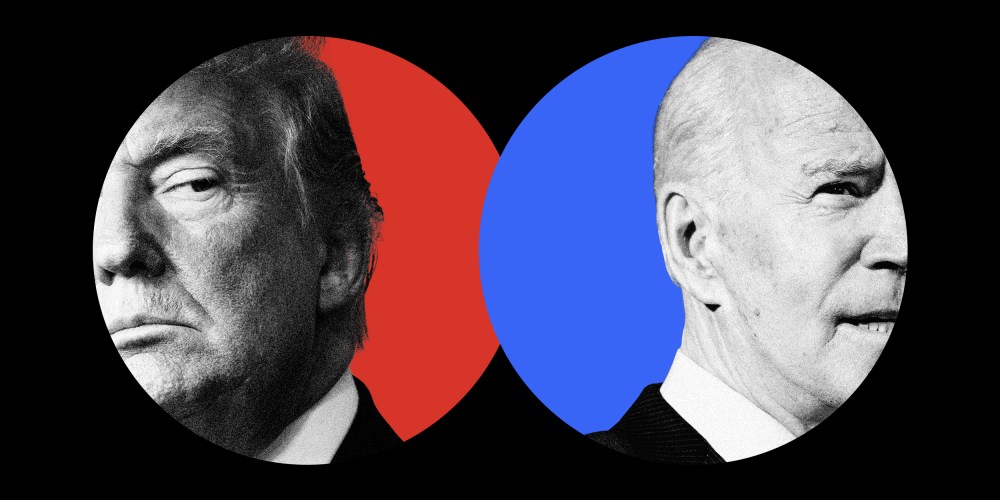
In some other dimension, some other timeline, President Donald Trump and former Vice President Joe Biden square off against each other Thursday night in their second of three debates. In this universe, the two presidential contenders will be addressing entirely different audiences from entirely different locations, confronting entirely different realities.
And yet, we probably would have ended up describing the debate that way anyways. So did we really lose all that much from not having the candidates together in the same place?
In this universe, the two presidential contenders will be addressing entirely different audiences from entirely different locations.
After the president tested positive for the coronavirus this month, throwing a giant and possibly infectious wrench into the plans for the final sprint, the Commission on Presidential Debates opted to make Thursday night’s scheduled town hall-style debate a virtual one. As we well know, Trump’s camp refused, leading to two days of the campaigns’ volleying statements at each other like a demented game of badminton, each accusing the other of dodging the event, before the commission finally threw up its hands and canceled the whole thing last Friday.
By that point, Team Biden had opted to schedule a solo town hall for Thursday night, hosted by ABC News. On Wednesday, NBC News announced that Trump would be holding a town hall meeting on its network — at the exact same time as Biden’s. (MSNBC.com, which will also carry the event, is part of NBC News Group.) The network drew some heat for the choice, with critics questioning the decision to allow the president to counterprogram Biden’s event.
Controversy aside, thinking back on last month’s absolute train wreck of a first debate, it’s hard to see what we could have gained from a town hall featuring Trump and Biden together, either IRL or across a Zoom call. The only benefit likely would have depended on the moderator’s ability to shut down Trump’s microphone.
On paper, the idea of having Trump and Biden address the same voter — and that person’s concerns — sounds like a useful way to compare and contrast the two men. But so far, in practice, this has translated into less a debate and more an hour and a half of both men trying to drown one another out by falling back on their respective political résumés. For Biden, that means trying to show empathy and connection while delivering as many canned policy sound bites as possible. For Trump, that means opening his mouth and letting whatever combination of fearmongering and half-truths rattling around his head come tumbling out. Even in a virtual setting, they might not be talking over each other, but they’d definitely be talking past each other. Does either candidate really need his opponent there for that? As we prep for this onslaught of airtime from the candidates, here are some links to start your day with:
Hayes Brown is a writer and editor for MS NOW Daily. 


