








UPDATE (April 8, 2024, 6:38 a.m. ET): The undefeated South Carolina women’s squad held off Caitlin Clark and the Iowa Hawkeyes to win the Women’s March Madness championship on Sunday, 87-75.
Tickets to the NCAA women’s Final Four — that begins Friday night with South Carolina playing North Carolina State and Iowa playing UConn — were selling for about twice as much as tickets to the men’s tournament this week. Monday night’s Elite Eight matchup that Iowa won over LSU attracted more TV viewers than any game in the men’s tournament has this year. Also, more people watched UConn’s women’s team beat the University of Southern California on Monday than watched UConn’s men’s team defeat Illinois in their Elite Eight matchup. This weekend, Iowa’s Caitlin Clark, the greatest Division I scorer ever, is on a quest to win a national championship before she turns pro.
Why is there so much more interest in the women’s tournament this year?
Why is there so much more interest in the women’s tournament this year? The women’s game has more compelling star players and coaches and more compelling storylines. Ticket prices and television ratings reflect that.
In a column I wrote six years ago, I bemoaned the fact that so few people who filled out a men’s tournament bracket filled out one for the women’s tournament. Either they didn’t care to, or they didn’t know how to. As for the not knowing how part: When I wrote that column, there were fewer resources to help casual fans fill out a women’s bracket. If you weren’t a women’s basketball junkie, then there wasn’t much out there that could help you become a quick study and take part in the fun. Her Hoop Stats, a leader in tracking many different types of women’s basketball data, had only been around a year.
There were still more men’s brackets filled out this year, and when it comes to the price of tickets, it’s worth noting that the women’s Final Four is being played in an arena that holds 19,432 and the men’s Final Four is being played in a stadium that holds 63,400. Still, ESPN collected 3.25 million women’s bracket entries which is a 56% increase from last year. CBS reported a 126% increase in women’s brackets.
Ahead of the women’s Final Four, there’s a laundry list of on-court storylines: In addition to Clark’s quest to add a championship to her scoring records, there’s UConn’s Paige Bueckers, the 2021 player of the year, who returned as an even better player following multiple knee surgeries. The South Carolina Gamecocks, who fell to Iowa in last year’s Final Four and then graduated five seniors, haven’t lost a game since. They enter the Final Four a perfect 36-0. And North Carolina State, the team few people expected to still be dancing, features a dynamic point guard in Saniya Rivers, who transferred from South Carolina and will be playing her former team Friday night.
But also, there are off-the-court stories on the women’s side that have amassed a lot of attention. The Portland regional, which featured University of Southern California rookie sensation JuJu Watkins and Stanford’s WNBA-bound Cameron Brink, had an uneven three-point line that needed to be fixed. Texas head coach Vic Shaefer remarked that he has a lot of colleagues who would say that something like this “only” happens in women’s basketball. Three years following the infamous weight room incident, the NCAA still makes mistakes that tarnish the reputation of women’s basketball.
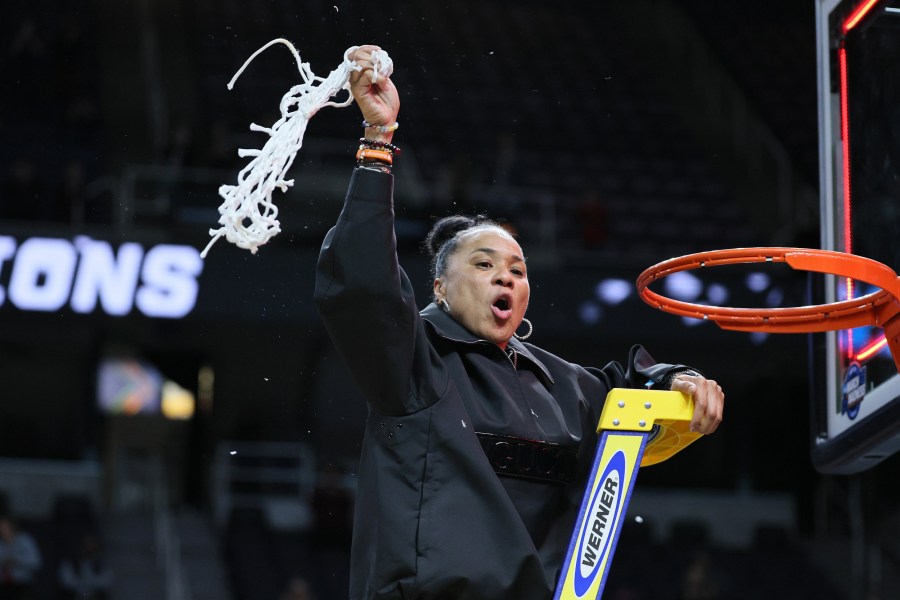
Also, LSU’s head coach Kim Mulkey threatened to sue The Washington Post over a long-form feature about the coach’s backstory and legacy — before the story was even published. You also can’t forget about Mulkey and South Carolina head coach Dawn Staley’s sideline fashion. Both head coaches bring a unique level of glam and glitz to the game.
LSU’s Angel Reese, the star of last year’s national championship team, took the mic after falling 94-87 to Iowa and tearfully reflected upon how her mental health has at times suffered during her whirlwind rise to fame.
And don’t forget when the Utah women’s basketball team were targets, during the opening rounds, of racist slurs near their hotel in Coeur d’Alene, Idaho, located 30 miles away from where they played their games in Spokane.
The South Carolina Gamecocks, who fell to Iowa in last year’s Final Four and then graduated five seniors, haven’t lost a game since.
Reese’s teammate Aneesa Morrow put it this way: “When we go out and perform in games, we’re not only playing a basketball game, we’re fighting battles for sexism, racism, everything that people don’t know.” That’s a given in women’s basketball and generally speaking in women’s sports.
There hasn’t been much of a comparison on the men’s side, as far as compelling stories go. The UConn men have a chance to repeat as national champions, Purdue has a back-to-back player of the year in Zach Edey, and NC State’s star player is a fifth-year player DJ Burns Jr., a lovable 6’9” big man who has skills that aren’t transferrable to the NBA.
Something we need to talk about as these women’s sports athletes get the stardom they deserve: They’re also getting attacked in a way the men have never experienced. Add racism to that equation, and the hatred is indescribable. https://t.co/AWZhVJVasZ
— Amanda Christovich (@achristovichh) April 2, 2024
Lebron James suggested a reason for why there has been more intrigue and star power involved in the women’s tournament. “I don’t think there’s much difference between the men’s and women’s game when it comes to college basketball,” he said Wednesday. “I think the popularity comes in with the icons that they have in the women’s game.”
Women’s college basketball players can only declare for the WNBA draft when they turn 22 in their draft year or the year when they are set to graduate, and over multiple years in college, the country gets to know their game. As James put it, “You’re able to build a real iconic legacy at a program.” And with name, image and likeness (NIL) endorsements, the country gets to know their brand as well. Clark has been in a State Farm ad, Bueckers has a Gatorade commercial out, and Reese did a promotional campaign for Amazon with her LSU teammate Flau’Jae Johnson.
As the NBA continues to struggle to develop domestic players and acquire more generational talents, the eligibility rules on the women’s side sound like they could be beneficial to the men’s side. Remember, the best players in men’s college basketball can declare for the NBA after one year.

The narrative that the women’s tournament is far superior to the men’s might shock some people, but those who have been on the ground reporting on the sport or coaching and playing the game are feeling like WNBA legend Diana Taurasi who, at a recent USA Basketball practice, asked, “Where have all of these people been?”
The truth is there was a time when women’s college basketball drew the millions of viewers it’s attracting today. According to women’s sports journalist Lindsay Gibbs of the Power Plays Newsletter, in 1995, 7.4 million people watched UConn play Tennesse in the women’s championship game. So what happened? CBS didn’t renew its rights to broadcast the game, and ESPN took over. “It took 28 years for the women’s national championship game to make it back onto network television,” Gibbs wrote. “The drought ended last year, when the national championship game between LSU and Iowa was broadcast on ABC and drew 9.9 million viewers.” This same sentiment was echoed by Staley. She was asked what’s different about right now, and she credited different decision-makers in the rooms who put the sport on platforms where it can be better seen and heard. “There’s new leadership when it comes to the decision-makers of our game,” she said during her pre-Final Four news conference. “And I do think they’re taking it more personal to allow our game to grow and continue to grow.” “We’ve known it could be this — if you treat it the right way, if you invest in it,” Cheryl Reeve, USA Basketball women’s national team head coach, said. “Invest in it the same way and have the same mindset as you do men’s sports. This is what can happen. I hope it continues to grow.” But remember, the mania that the country has about women’s basketball right now doesn’t have to end with Sunday’s NCAA championship game. With Clark, Reese and Brink headed to the pros in just a few weeks, there’s an opportunity for the WNBA to benefit in ways that it hasn’t before. What else did Iowa-LSU's 12.3 million top? UConn head coach Geno Auriemma has watched many stars from his program, including four-time national champion Breanna Stewart, achieve a bump in coverage during the NCAA tournament that goes away when they’re drafted into the WNBA. “The WNBA, I don’t think, has done a great enough job of marketing their individual stars, for whatever reason, because there’s been a lot of them,” he said on Friday during pre-Final Four media availability. But, it looks like the WNBA is taking steps to bridge that gap. It has launched a “Welcome to the league” television ad campaign during the women’s tournament, and it’s put up billboards around Cleveland, where the women’s Final Four is being played. That campaign includes some of the league’s brightest stars, including Stewart, Staley’s former player A’ja Wilson, and Arike Ogwunbowale, who six years ago made multiple buzzer-beating shots that brought Notre Dame a national championship. Those shots Ogwunbowale made six years ago deserved more attention. They deserved the kind of attention all women’s college basketball games are getting now. Finally. It’s about time. CORRECTION (April 6, 2024, 6:10 p.m. ET): Due to an editing error, a previous version of this article misstated the age at which women’s college basketball players can declare for the WNBA draft. They can declare as long as they turn 22 in a draft year, they but don’t need to be 22 to declare.
Jackie Powell
Jackie Powell has covered women's basketball since 2019, including college basketball, the WNBA and international and high school prospects. Her work has appeared in Bleacher Report, Yahoo Sports, The Next, Sports Illustrated, the Hartford Courant, SLAM and Harper's Bazaar, and she hosts the "Locked on Women's Basketball" podcast every other week. She also is a Lady Gaga stan, a connoisseur of pop music and a mental health advocate. 

🔲 10.4 million for Purdue-Tennessee men's Elite 8 on Sunday
🔲 9.5 million for 2024 Golden Globes
🔲 12.1 million for final round of the Masters last year
🔲 4 of 5 games from 2023 NBA Finals
🔲 Every World Series game in 2023 https://t.co/ge1Ra5rfvV