Maybe it’s because the organization I lead supports 38 million students in 73,000 of our nation’s schools, but I see up close, day in and day out, the sensitivity and the astounding intelligence of youth. And these days I also see them struggling to cope with the hurdles being thrown at them in a world characterized by uncertainty.
But what frustrates me the most – in these days of national turmoil and historic consequence, whether it be to our health, our economic wherewithal, or our social well-being – is that the “youth voice” so often goes unnoticed or unsolicited.
One of the many things I love about working with kids is that youth have always been problem-solvers creating catalytic change in American culture. Whether it was getting their parents to stop smoking, wear seatbelts, advocating for an end to the war in Vietnam, or lowering the voting age, kids have been, and always will be, our greatest engines of change.
But right now, kids are deeply affected by what we’re all enduring in this year of seemingly insurmountable hurdles. And reaching out to them to know exactly what they think, feel, worry about, and yes, fear, is simple common sense.

That’s why, on a regular basis at GENYOUth we tap the ingenuity and honesty of youth through a series of surveys designed to provide a glimpse into the inner lives and aspirations of this remarkable next generation.
We’ve all watched our kids wrestle over the past three months as the world around them has shaken on its axis – first the global pandemic, then the devastating economic fallout, and most recently the sometimes violent social unrest over race that has gripped the nation.
But do we know how kids are actually doing?
We just completed what is, as far as I know, the first national study on the subject of how teens are coping with COVID-19. Our goal? To understand what teens say distresses them most, and what they say they need right now to navigate these uncertain times.
Make no mistake about it, the pandemic is the most life-altering global event they have ever experienced. But how are they building resilience? In what ways are they hurting? And how can schools, parents, caregivers, community partners, and government leaders develop support systems to help youth cope?
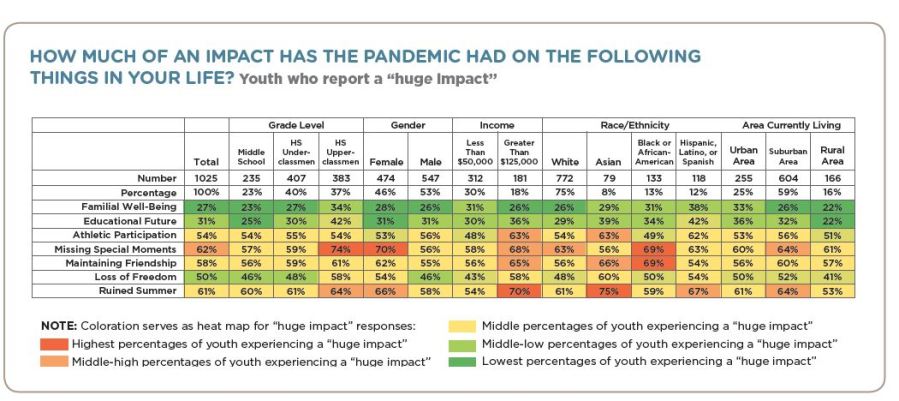
Findings from our survey, entitled “Life Disrupted: The Impact of COVID-19 on Teens,” can be viewed in detail here. We deployed our survey questionnaire last month with a nationally representative sample of teens aged 13 to 18. The top-line highlights are revealing:
62 percent of youth say they’re experiencing, in the terminology of the survey, a “huge impact” when it comes to special moments in their lives. A big slice of an entire generation has missed out on proms, dances, concerts, and graduation ceremonies.
61 percent are experiencing a huge impact when it comes to having summer plans cancelled, along with activities outside school, such as camping, scouting, religious activities, sports, and clubs. A chunk of their adolescence has vanished.
58 percent are experiencing a huge impact in the area of friendships. Being able to stay close to friends has become harder without being able to see them in-person at school, or to interact with them via activities and gatherings. And is anything more important to teens than friends?

54 percent of youth are experiencing a huge impact when it comes to athletic participation. Loss of a season (or more) of sports and the ability to maintain conditioning, both physical and mental, can lead to losing a key part of one’s identity. For talented athletes, sports can offer an opportunity to change their lives forever through scholarships, which the pandemic has disrupted.
50 percent say they are experiencing a huge impact when it comes to freedom and control. Thanks to the pandemic, teens are no longer living their lives the way they want to. They, like us, are less able to exert control and make their own choices freely.
31 percent are experiencing a huge impact on their educational future. They’re struggling not to fall behind in school and be ready academically for next year. The college exploration and application processes have been altered. And many students aren’t able to do the extracurriculars needed to be a successful college applicant.
Importantly, disruptions from the pandemic are hurting some youth more than others, including African American youth, youth living in urban areas, youth living in households whose income is below $50,000 annually, and, especially, among girls.
But on the positive side:
Youth have their eye on a new and better future, and are displaying admirable resilience and even optimism as they experience a reset on life; and
Adults are listening to them, teens are getting adult support generally, they’re engaging in self-help, and they’re seeing silver linings. It’s in the area of economics and financial security that our survey reveals perhaps the most sobering realities: When asked about Familial Well-Being, 27 percent of teens say that the pandemic has had a “huge impact” on family life, which includes “having basic needs met.” 88 percent are worried or sad about their family’s ability to buy what they need and pay bills, including more than a third (38 percent) who are “really are worried or sad.” “A feeling of financial security” is desperately needed by 17 percent of youth. As the pandemic and its economic impacts continue or even accelerate, giving youth a sense that their family will have their basic needs met is critical for coping. Youth, who are particularly distressed, need this even more, with 24 percent saying they need this “right now.” An economy in free-fall is one in which financial hardships create food insecurity, and the inability to pay the mortgage, rent, or family expenses. Youth are already clearly seeing the impacts of job losses, wage reductions, and extended unemployment for their family members and possibly for themselves. Here’s the thing. Whether it’s pandemic-related illnesses, the ongoing economic fallout, or the social and racial unrest around the burgeoning Black Lives Matter social-justice movement, the challenges for our kids just keep coming. They’re seeing things, they’re absorbing things, they’re trying mightily to interpret and understand them, and they’re doing their best to cope. Listening to their voices on these topics is of utmost importance to all of us. Our survey’s results suggest exactly that — that adults can best support and guide youth by listening to them. Rather than making flawed assumptions about what youth are feeling, trust teens to articulate what helps them cope the most, what they are not getting that they need, and where they are feeling the most distress. Using these insights, adults can find more, and more effective, ways to help strengthen teens’ resilience, especially for those suffering the most from what our world is throwing at them. Knowing your value is about understanding real worth and value, whether it’s one’s own worth or that of someone, or something, else. I’m here to tell you that among the most valuable things on earth are the opinions and perceptions of young people, especially about the seemingly shattered state of our nation right now. The “youth voice” is worth its weight in gold. Let’s stay cognizant of the domino effects of public health, economic, and social events on this next generation. That what happens in our country and around the globe has many and varied impacts. That the casualties of those impacts mustn’t be a state of tension, worry, and insecurity on the part of our nation’s kids. And that the only thing of more value to our nation and our world than our youth is elevating their voices – and then listening to them. Alexis Glick is Chief Executive Officer of GENYOUth, a nonprofit organization dedicated to nurturing child health and wellness through programs presented in partnership with the National Football League and the National Dairy Council. Glick also serves as a frequent contributor to many national and international news programs, providing her perspective on global business topics of importance, the financial markets and CEO leadership trends. Prior to GENYOUth’s inception, Glick previously served as a senior media executive, and also appeared in the anchor role on NBC’s Today Show and CNBC’s Squawk Box. In addition to her current executive responsibilities at GENYOUth, and enjoying her active role as mom to four kids, Glick is active in several national and local non-profit institutions. She is a frequent, strategic advisor to CEOs for some of the largest international, blue-chip and Fortune 500 companies on issues relating to media strategy, business development, investor relations and communications and advises professional athletes on social media, branding and public speaking.
Alexis Glick Recommended