








The COVID-19 crisis has impacted Americans across every racial, social and political line. Yet, in many ways, women have been hit the hardest in terms mental health, lost wages, jobs and burden of care. They are also the majority of our essential workers.
Because women are facing unprecedented economic and health challenges and also carry the disproportionate burdens of home school and family care responsibilities, it’s reasonable to wonder if women may be less likely to show up at the voting booth come Election Day.
But new data from my non-partisan, non-profit organization, All In Together, alongside Lake Research Partners and Emerson College Polling, shows that the majority of women – 82 percent – say they will almost certainly vote in the presidential election.
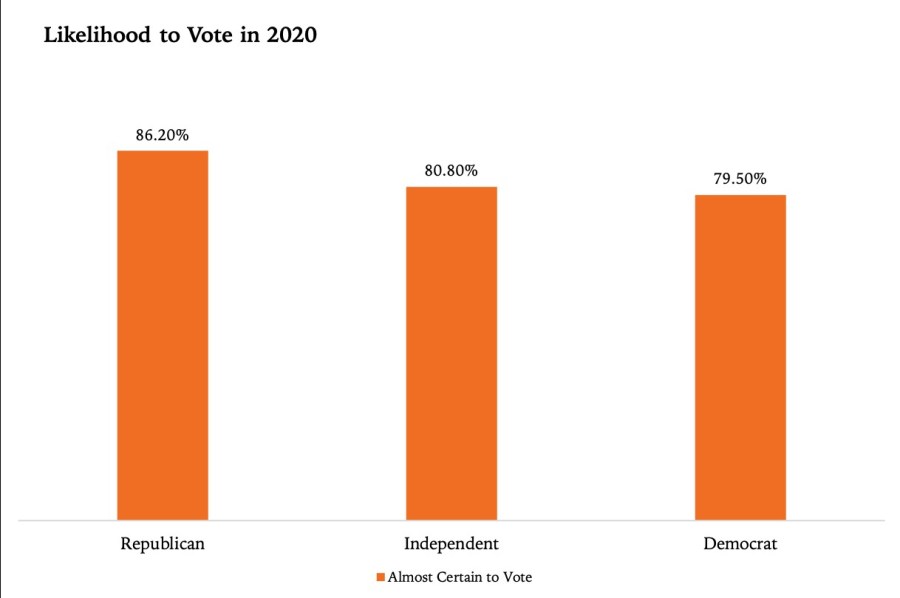
And we’re seeing this across political parties too. 86 percent of Republican women, 82 percent of Independent women and 80 percent of Democratic women say they plan to vote, according to our survey data. We spoke to 1,000 registered women voters nationwide from May 8 to 9.
What is also encouraging is that, according to our data, even many women who are deeply burdened by the COVID-19 crisis still view their vote as important. Among women voters who said they are struggling to manage their work and family obligations, we found they have a higher propensity to take actions connected to the election. This includes donating to a political campaign (33 percent) and supporting a political candidate on social media (50 percent).
These women voters struggling to juggle work, family and health are also united in feeling they have a very important role in protecting their families and communities (60 percent). This sense of responsibility seems to be connected to their commitment to vote.
That’s good news for our democracy. When women participate politically, everyone benefits. And of course, given the unique challenges women are facing in this time of crisis, those votes help hold elected leaders accountable for addressing women’s critical needs.
How race factors in
While white women are most likely to say they will vote (88 percent), black women are also highly committed to voting with 78 percent saying they are almost certain to vote in November. We already know that black women are the turnout engine of democratic politics. From 2000 to 2017, the number of black women eligible to vote increased by 31 percent . And black women are among the most active voters. In the 2018 midterms 57 percent of eligible black women voted, the highest of any group. Our data shows that they are likely to remain a powerful and important force in November and their commitment to turnout remains strong, despite the terrible and disproportionate toll COVID-19 has taken on black America.
Despite the hopeful signs that women remain deeply committed to voting despite the pandemic, Latina voters may the exception. Latina women we surveyed are struggling most to manage work and family burdens. Fifty-seven percent said they are struggling a lot or somewhat to manage work and family (compared to 37 percent women overall). That is a huge differential and speaks to just how much the COVID-19 crisis has hit Latinas.
We also found that 37 percent of Latinas said the COVID-19 crisis increased the amount of care they are providing to their children by a lot (compared to 18 percent of women overall). Similarly, 38 percent said the COVID-19 crisis increased the amount of care they are providing their parents or other relatives either a lot or somewhat (compared to 30 percent of women overall). Given these stresses, Latina voters are less interested in the election – 20 percent say they are definitely not going to vote (compared to 4 percent of women overall). What does this mean? The COVID-19 crisis threatens to derail the gains in voter participation Latina women have been making. Latinas are the second largest and second-fastest-growing population of women of color voters in the United States. The 2018 mid-terms saw major gains in Latina turnout. It would be a huge loss if those gains were undermined by the COVID-19 crisis in 2020. It’s important to note the critical importance of Asian, Native and Pacific Islander women in this context too. While the sample in our study was not large enough to report, other studies report that the number of AANPI women eligible to vote grew at a faster rate than any other racial group, increasing by 97 percent in 17 years! The bottom line is that women’s votes are essential in this and every election and the more women realize the power and potential of their vote, the more representative and effective our democracy. Voting is one of the most essential ways we prove that we know our value and ensure our elected officials do to. Lauren Leader is Co-Founder and CEO of All In Together, a non-partisan non-profit dedicated to women’s civic education and participation. She is also a part-time elected councilwoman in Harrison, NY and a frequent contributor on MSNBC and other outlets. You can follow her on Twitter @laurenleaderAIT.
Lauren Leader
Lauren Leader is the co-founder and CEO of All In Together. She is a frequent contributor to Know Your Value. She tweets @laurenleaderAIT Recommended


