








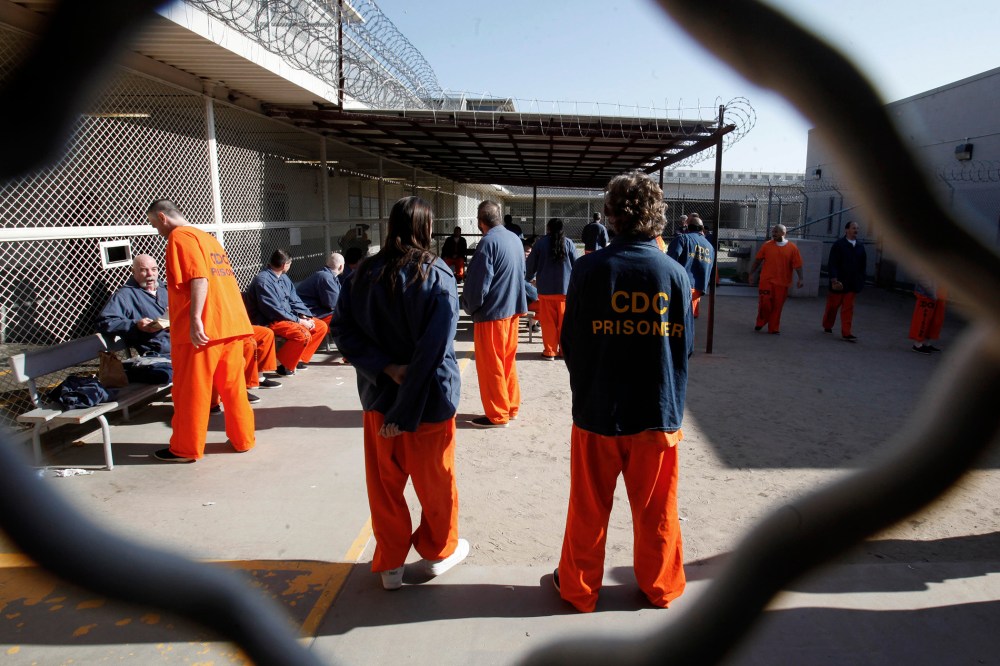
The Justice Department said Thursday that it will expand on President Obama’s move last month to commute the sentences of eight people serving long sentences for drug crimes.
In remarks prepared for a meeting of the New York State Bar Association’s Criminal Justice Section’s annual meeting, Deputy Attorney General James Cole asked attorneys around the country to help the DOJ find men and women serving time for non-violent, low-level offenses that might carry much shorter sentences today.
“We need to identify these individuals and get well-prepared petitions into the Department of Justice,” Cole said in his remarks. The Bureau of Prisons will advise inmates about the new opportunity, but the Justice Department is also urging defense attorneys to be proactive. “This is where you can help. We are looking to the New York State Bar Association and other bar associations to assist potential candidates for executive clemency. “
Cole’s announcement is the latest in the administration’s efforts to tackle problems surrounding the massive sentencing disparities for certain drug crimes. When Congress passed the Fair Sentencing Act in 2010, it eliminated sentencing disparities between crack and powder cocaine, but there are still some 8,000 people serving time for crimes that no longer carry the same prison terms.
Ezekiel Edwards, director of the ACLU’s Criminal Law Reform Project, says that this is an important step, but that the DOJ should aim to put fewer people into prison for long sentences while it looks for inmates eligible for clemency. “While it’s incredibly important to do what Deputy Attorney General Cole suggests, many of the same laws that put people in prison for decades for nonviolent drug offenses are still in play,” Edwards said. “It’s critical at the front end that the DOJ and US attorneys across the country start implementing fairer and more humane charging practices so we’re not having to revisit the same questions in 10, 20, 30 years for a new group of people.”
“What it means for African-American communities and communities of color is you’re really tearing apart families for long periods of time,” says Vincent Southerland, senior counsel with the NAACP Legal Defense Fund’s Criminal Justice Project. “When they return to their communities, they’re shut out of economic, educational and other opportunities that really relegate them to second class citizenship, and that has a devastating impact on everyone.”
In August, Attorney General Eric Holder announced new federal drug sentencing guidelines designed to reduce the number of people facing harsh sentences for low-level, non-violent offenses. When he unveiled the new guidelines, Holder decried “draconian mandatory minimum sentences” and pointed to racial disparities in the criminal justice system. “There is a history of racial disparities in the application of our criminal laws — everything from the death penalty to enforcement of our drug laws,” he said.
The DOJ initiative comes just ahead of legislative efforts to address sentencing discrepancies and reduce long prison terms for low-level crimes. Sens. Dick Durbin and Mike Lee introduced a bill last year that would allow prisoners convicted under the old laws to petition to their sentences in line with the new law. The Senate Judiciary Committee passed the Smarter Sentencing Act on Thursday.
Reform advocates believe both executive and legislative efforts are needed to make a real impact on the U.S. prison system. “These two processes, commutation and legislation, are not mutually exclusive,” Marc Mauer, Executive Director of the Sentencing Project, told msnbc. “We’ve been long advocating for sentencing reform more broadly, and there is no area where it’s more important than federal drug policy.” In his remarks, Cole acknowledged that this initiative is a necessary but insufficient step towards dealing with mass incarceration. He said, “Our discussion here today is an initial step in this process and the first of, what I hope, will be an ongoing dialogue. Through our collective efforts, we can safeguard public safety while ensuring “fundamental ideals of justice and fairness” in our criminal justice system.” Julie Stewart, president of Families Against Mandatory Minimums, welcomed Cole’s announcement but said that the administration should look at the clemency applications it already has. “I’m very excited that the president wants to do more clemencies, because it’s a power that has been underutilized for many administrations now,” Stewart says. “He’s asking for cases, that’s great, but i don’t think he has to look very far. The Office of the Pardon Attorney has thousands of applications just sitting there.” Although he recently granted clemency to eight people imprisoned for crack cocaine offenses, Obama has made less use of the clemency power than prior presidents. According to ProPublica, Obama has granted 39 pardons and denied more than a thousand, and has granted clemency at a rate lower than any of his recent predecessors.
Adam Serwer
Meredith Clark
Meredith Clark is a freelance writer and editor. She was previously a senior news producer for "Patriot Act with Hasan Minhaj," a reporter with MSNBC.com, the digital politics and culture editor at Glamour and a senior news and politics editor at Refinery29. She has written for Vulture, Rolling Stone, Self, Marie Claire, Cosmopolitan, The Daily Beast and Bustle. Recommended



