








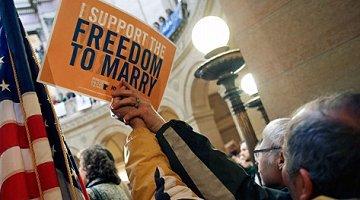
When it comes to the debate over marriage equality and civil rights, we tend to hear familiar arguments focused on predictable angles. Proponents talk about justice, fairness, equality, equal protection under the law, and the rights of citizenship. Opponents talk about religion and “traditional family values.”
But once in a while, we get a curve ball. Joan McCarter, for example, flagged this exchange on Fox Business between Stuart Varney and controversial Fox analyst Charles Payne.
Varney: We’re not going to pass judgment on same-sex marriage. That’s not for us to do. Absolutely not for us to do. We’re a financial program, so I think it’s our duty to point out the financial angle here. Let’s suppose that same-sex marriage goes through fully at the federal level. That opens up, I’m told, 1,100 federal benefits that could flow to same-sex married couples. In particular, in Social Security, the surviving spouse of a same-sex marriage would get Social Security benefits. That is an unfunded liability that adds to the liability in Social Security tens of billions of dollars.
Payne: Well, it’s going to tax the system more….
At a certain level, I don’t much care about the fiscal aspect of the debate. It’s not like I’d be persuaded by someone arguing, “I’d like to create an America in which there are no second-class citizens, but if it means a fiscal strain on the government, forget it.”
That said, if anyone is going to consider the fiscal angle, it’s at least worth getting the facts straight — and in this case, the Fox analysts weren’t telling viewers the whole story.
Neil Irwin had a good report on this the other day:
The last time the Congressional Budget Office looked at the question was nearly a decade ago, but in 2004, the CBO found that federal recognition of gay marriages would actually increase tax receipts by 0.1 percent, amid offsetting forces. […]
Recommended


On the spending side, one of the biggest impacts is on Social Security and other federal programs. As the 2004 CBO report notes, “As a general rule, married people fare better under Social Security than single people do, and married couples with one earner fare better than two-earner couples do.” At the simplest level, more married couples means a more generous Social Security system, due to survivor benefits that allow a widow or widower to continue receiving benefits after their spouse dies. The CBO reckoned those numbers would be relatively modest, however, because gay couples are more likely to both be wage earners than straight couples, and because they are the same gender, it is less likely that one will dramatically outlive the other. The CBO estimated the increased federal spending due to same-sex marriage at about $200 million a year from 2010 to 2014, a pittance in the context of the federal budget.
Suzy Khimm reported in March that fiscal conservatives “should love gay marriage,” citing studies showing improved state finances in Maine and Rhode Island after the states extended equal marriage rights to all.
And David Nather added this week, “The good news for the federal government: Same-sex marriage might actually be good for the deficit…. [T]he bottom line is that the deficit could actually go down a bit.”
Again, for many of us, the argument over marriage equality is about basic human decency and American civil rights. Period. Full stop.
If, however, we’re going to look at this from a fiscal angle — or if you’re a Fox host suggesting marriage equality will necessitate cuts to Social Security — let’s acknowledge that basic human decency happens to be pretty good for the bottom line, too.
The place for in-depth analysis, commentary and informed perspectives.
