










As the global crisis intensifies, Republicans have embraced a series of specific economic policies: aggressive government spending, Federal Reserve intervention, direct federal payments to individuals, widespread rescues of domestic industries on the brink, and an enthusiastic embrace of Keynesian economics.
It’s against this backdrop that the headline on Jamelle Bouie’s latest New York Times column is instantly memorable: “The Era of Small Government Is Over.”
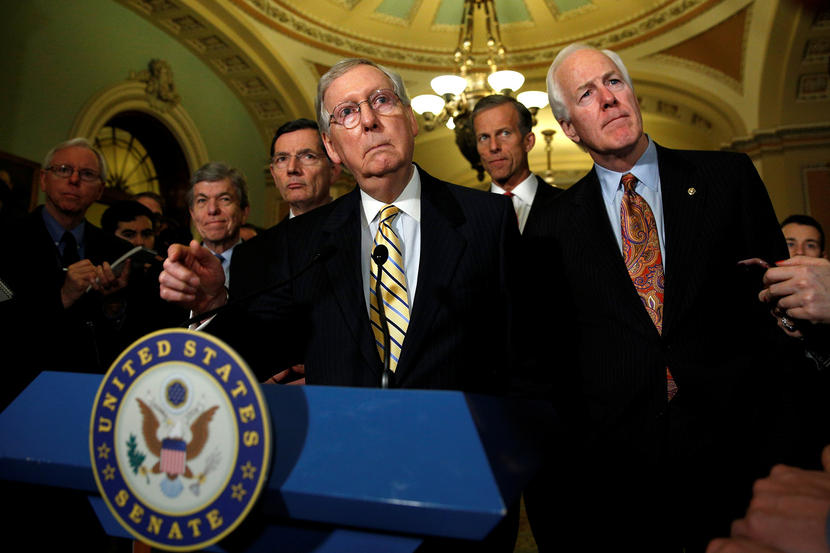
A reporter asked Senate Majority Leader Mitch McConnell (R-Ky.) yesterday what prompted his party to shift its thinking so quickly and so dramatically.
“We occasionally have these great crises and, when they occur, we are able to rise above our normal partisanship and, in many times, our normal positions because these are not normal times,” McConnell told reporters in a briefing room that was rearranged to put physical distance between participants. “This is not an ordinary situation so it requires extraordinary measures.”
Around the same time, Treasury Secretary Steven Mnuchin was asked about possible concerns about the federal budget deficit. Not surprisingly, he replied that those considerations would have to wait.
All of these new Republican positions are, to be sure, the right ones. But for those of us who followed the Great Recession — and policymakers’ efforts to combat that crisis — it’s hard not to notice that GOP officials have adopted an entirely new economic philosophy.
Indeed, when the economy was falling off a cliff in 2009, Republicans rejected the very idea of a federal stimulus package, stressed deficit reduction, endorsed a lengthy government spending freeze, and urged the Federal Reserve not to take steps to help the economy recover. Even after then-President Barack Obama signed the Recovery Act into law in early 2009, several GOP governors said they didn’t want any resources from the new law, insisting at the time that the nation couldn’t afford to spend the money. Accused of trying to sabotage the economy because there was a Democrat in the White House, Republicans took great offense — insisting that their positions were simply an extension of their genuine beliefs about economic policy. Evidently, they’ve since replaced those beliefs with the opposite positions.
The place for in-depth analysis, commentary and informed perspectives.
Latest Post
Recommended

