








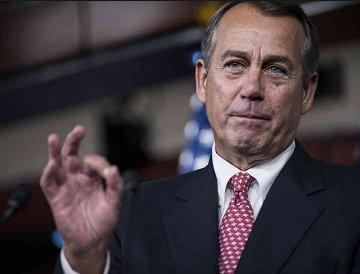
When we think about the sphere of influence for the Speaker of the House, we would ordinarily think first of the House majority caucus. After all, that would make sense — John Boehner should have power on the Hill, where he leads over 200 federal lawmakers who chose to put a gavel in his hands and put behind only the Vice President in the presidential line of succession.
But in practice, Boehner’s sphere of influence is fairly limited in the chamber he ostensibly leads. His operation is far more impressive about a mile and a half away from the Capitol, in the city’s lobbying corridor.
A top aide to Speaker John Boehner (R-Ohio) is leaving his post to run the Washington office of American Express, becoming the third-high ranking staffer to depart the office in recent months.
Brett Loper, one of Boehner’s key conduits to the White House during the doomed “fiscal cliff” negotiations of 2012, is returning to K Street after a brief stint in the Speaker’s office where he most recently served as deputy chief of staff.
The Speaker’s chief of staff, Barry Jackson, left in Feburary to work at two separate firms — Brownstein Hyatt Farber Schreck, a lobby shop, and Lindsey Group, an economic advisory firm. Earlier in February, Boehner’s health adviser, Emily Porter, left to become a vice president at the lobbying firm Nickles Group.
As these departures mount, it’s only natural to wonder if the Speaker’s career is in in decline, and there are rumors that Boehner, frustrated by his complete inability to govern, may retire in the near future. The resignations will only further fuel the speculation.
But there is another explanation — there’s long been a revolving door in Boehner’s office, with aides (a) leaving his staff to become lobbyists; (b) leaving lobbying to join his staff; or (c) occasionally making more than one trip in each direction.
Indeed, in a statement thanking Loper for his service, the Speaker said the staffer “will be missed throughout Boehnerland, our Conference, and the entire House.”
This may sound like an odd choice of words, but for a significant group of people, “Boehnerland” is an actual thing.
Long-time readers may recall that this has been an ongoing area of interest for me, dating back to 2010 when I first learned what “Boehnerland” is.
He maintains especially tight ties with a circle of lobbyists and former aides representing some of the nation’s biggest businesses, including Goldman Sachs, Google, Citigroup, R. J. Reynolds, MillerCoors and UPS.
Recommended


They have contributed hundreds of thousands of dollars to his campaigns, provided him with rides on their corporate jets, socialized with him at luxury golf resorts and waterfront bashes and are now leading fund-raising efforts for his Boehner for Speaker campaign, which is soliciting checks of up to $37,800 each, the maximum allowed.
Some of the lobbyists readily acknowledge routinely seeking his office’s help — calling the congressman and his aides as often as several times a week — to advance their agenda in Washington. And in many cases, Mr. Boehner has helped them out.
Of course he has; many of these lobbyists worked in his office.
While many lawmakers in each party have networks of donors, lobbyists and former aides who now represent corporate interests, Mr. Boehner’s ties seem especially deep. His clique of friends and current and former staff members even has a nickname on Capitol Hill, Boehner Land. The members of this inner circle said their association with Mr. Boehner translates into open access to him and his staff.
It’s probably worth emphasizing that all of this is legal and permissible under congressional ethics rules. The point isn’t that Boehner is guilty of anything untoward; rather, the point is Boehner takes his relationship with DC’s lobbying industry quite seriously.
And as we talked about last fall, this relationship manifests itself in ways that reinforce its value. When Congress worked on a jobs bill in 2010, Boehner and his team huddled with corporate lobbyists. When work on Wall Street reform got underway, Boehner and the GOP huddled with industry lobbyists. When Congress worked on health care reform, Boehner and the GOP huddled with insurance lobbyists. When an energy/climate bill started advancing, the GOP huddled with energy lobbyists. In 2012, when the STOCK Act was being considered, the GOP huddled with financial industry lobbyists.
This is just Boehner’s m.o. And as more staffers depart the Speaker’s office for more lobbying gigs, the population of Boehnerland just keeps growing.
The place for in-depth analysis, commentary and informed perspectives.
