








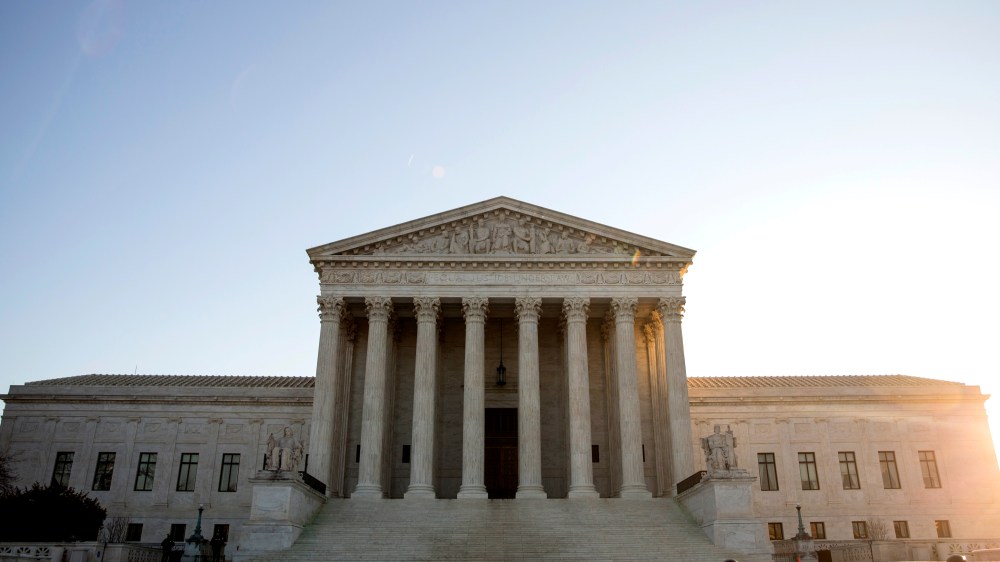
When the Supreme Court hears a new case against Obamacare on Wednesday, the arguments will be very different than past litigation about President Obama’s signature domestic achievement. This case is not about the Constitution, or health care regulation, or even the limits on the president’s authority.
This case is just about how Congress expresses itself.
The nation’s highest court must decide whether the Democratic Congress of 2010 created Obamacare as a national policy providing health care funding for the whole nation, or whether it only meant to grant health care funding to Americans in certain states.
In other words, did the Democrats design Obamacare as “health care for all,” or “health care for some”?
%22Democrats%20did%20not%20sneak%20a%20secret%20trick%20into%20Obamacare%20to%20discriminate%20against%20Americans%20who%20happen%20to%20live%20in%20places%20where%20politicians%20are%20skeptical%20of%20Obamacare.%22′
Whatever one thinks about the wisdom of Obamacare, obviously its legislative intent was health care for all. That is what Democratic lawmakers said at the time they passed the law. It’s what they say now. It is also what most Republican lawmakers have said.
Indeed, that national approach is what makes Obamacare controversial – most politicians agree it is an expensive national program, they just disagree over whether that’s a good thing. (Liberals generally cheer more government health care spending; conservatives do not.)
For years, even the law’s biggest critics have emphasized its federal structure. They argue Obamacare is too big, too expensive and too dominated by the federal government. They do not usually argue, however, that Obamacare is too small, or too cheap, or too flexible in its deference to state governments that want to duck the law’s requirements.
That is what makes this week’s arguments so odd.
On Wednesday, the challengers in King v. Burwell must convince the Supreme Court that Obamacare is actually much smaller than everyone thought; that it restricts rather than expands national health care funding; and that the Democrats in Congress intended to essentially kneecap their new policy when they wrote this law.
That case is built on the argument that Democrats actually wrote the law to provide health care funding – through new subsidies – only for Americans living in states that created their own health care markets. Under this theory, all other Americans who want health care insurance get no subsidies. (“Health care for some.”)
Again, while that approach doesn’t fit with most people’s understanding of Obamacare, the challengers cite a line in the law that could be interpreted for that outcome.
In what looks like a drafting error, one sentence in the Obamacare statute authorizes subsidies for health care markets “established by the State,” without referencing the intended subsidies for markets established by the federal government.
RELATED: Procedural problem could derail Obamacare lawsuit
“Congress could not have chosen clearer language to express its intent to limit subsidies to state Exchanges,” argues the challengers’ brief.
Based on that interpretation, they’re asking the justices to cut off the money currently flowing to eight million Americans in 34 states who use the federal exchanges.
In its brief, the Obama administration says the challengers are “seizing on isolated phrases” to distort the law and turn it on its head, undercutting the very health care funding it was designed to provide. The brief emphasizes that the Democratic Congress “did not adopt such a self-defeating scheme.” That is what this entire case boils down to – what did those Democrats intend five years ago this month? This is not exactly familiar territory for a blockbuster case. %22This%20is%20not%20exactly%20familiar%20territory%20for%20a%20blockbuster%20case.%22′ Usually the Supreme Court’s major cases focus on the Constitution. Then the debates over “intent” turn on the mindset of the Founding Fathers: Did they want to protect free speech for corporations as well as people? Did they intend to secure gun rights for individuals as well as militias? Lawyers press those arguments with historical research, political philosophy and dictionaries long out of print. The battles are nuanced, and very debatable. This week’s arguments don’t require that kind of effort – an app or a few recent newspaper articles would cover it. Democrats did not sneak a secret trick into Obamacare to discriminate against Americans who happen to live in places where politicians are skeptical of Obamacare. That is as far-fetched as it sounds. RELATED: Anti-ACA case descends into gibberish To be sure, the challengers also cite cases that involve far more complex explorations of Congressional intent — and there are plenty of examples where part of a statute is ambiguous or complicated. Sometimes the plain meaning of a word changes over time. Sometimes a throwaway line becomes crucial when invoked for new authority. Sometimes a court must interpret an obscure law for the first time in a new context. There is a whole body of law that tackles those real dilemmas, where lawyers parse a law’s “plain meaning,” technical legal meaning, context, purpose and effect. There are whole books about this sort of thing, about the “cannons of construction” that help interpret how Congress “constructs” its legislation. One could even apply those formal methods to this this case – there are rules about strictly applying the “literal meaning” of a statute’s words, and there are exceptions to those rules for when the literal interpretation would deliver absurd results undermining the law’s goal. (A literal interpretation could restrict the Obamacare funding; the exception would reinstate it to support the goal of national health care.) That approach, however, takes this whole charade way too seriously. This is not a difficult case about legislative intent — it’s an argumentative case about politics. There’s nothing wrong with arguing against Obamacare, of course, or arguing that America would be better off without it. But that’s a policy debate for the voters and the Congress, not for judges to seize and resolve.
Ari Melber
Ari Melber, an Emmy Award-winning journalist, writer and attorney, is the host of “The Beat with Ari Melber” airing nightly at 6 p.m. ET on MSNBC. He also serves as MSNBC’s chief legal correspondent and an NBC News legal analyst. Before joining MSNBC, Melber practiced First Amendment law and served as a legislative aide in the U.S. Senate. He received a J.D. from Cornell Law School and is a member of the New York Bar. Recommended


