The Rachel Maddow Show WEEKNIGHTS 9PM ETMorning Joe WEEKDAYS 6AM ETDeadline: White House with Nicolle Wallace Weekdays 4PM ETThe Beat with Ari Melber Weeknights 6PM ETThe Weeknight Weeknights 7PM ETAll in with Chris Hayes TUESDAY-FRIDAY 8PM ETThe Briefing with Jen Psaki TUESDAYS – FRIDAYS 9PM ETThe Last Word with Lawrence O’Donnel Weeknights 10PM ETThe 11th Hour with Stephanie Ruhle Weeknights 11PM ET
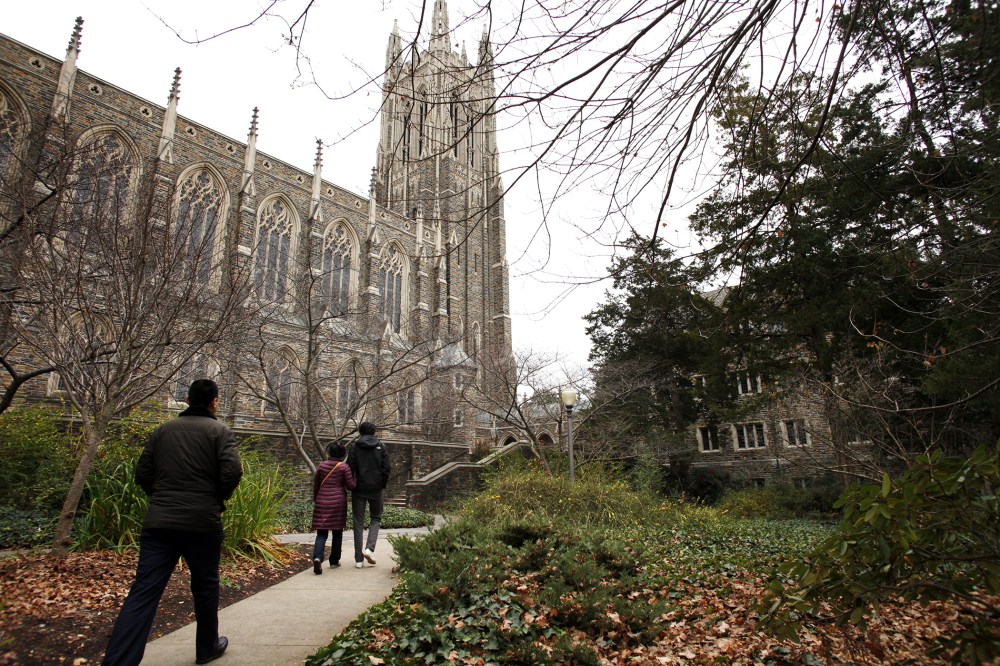
Duke has become the center of a controversy over whether to broadcast a Muslim call to prayer from the university chapel bell tower.
The Duke Chapel on campus at Duke University in Durham, N.C., Dec. 13, 2012.TRAVIS DOVE/The New York Times/R
By
Nisha Chittal
Duke University found itself at the center of a controversy this week when it announced plans to allow a Muslim call to prayer from the university chapel’s famed bell tower — and then reversed its decision after outcry from Christian evangelist Franklin Graham.
Earlier this week, the North Carolina university had announced it would allow the school’s Muslim Students Association to broadcast a Muslim call-to-prayer, known as “adhan,” on Fridays from the bell tower of the school’s chapel. Muslim prayers have taken place at Duke previously in the chapel basement, but the call to prayer has not previously been broadcast from the chapel bell tower.
On Wednesday, Christy Lohr Sapp, an associate dean for religious life at Duke, wrote in an opinion piece in the Raleigh News Observer: “With the recent attacks in Paris and Pakistan and renewed conflict in Nigeria, there is much negative press focused on parts of the Muslim world. From ISIS to Boko Haram to al-Qaida, Muslims in the media are portrayed as angry aggressors driven by values that are anti-education and anti-Western. Yet, at Duke University, the Muslim community represents a strikingly different face of Islam than is seen on the nightly news: one that is peaceful and prayerful. This face of the faith will be given more of a voice as the Duke Muslim community begins chanting the adhan, the call to prayer, from the Duke Chapel bell tower on Fridays beginning this week. It will be chanted by Muslim students prior to the jummah prayer service that takes place in the chapel basement each Friday afternoon.”
Sapp added: “This opportunity represents a larger commitment to religious pluralism that is at the heart of Duke’s mission and connects the university to national trends in religious accommodation.”
“Perhaps, too, this small token of welcome will provide a platform for a truer voice to resonate: a voice that challenges media stereotypes of Muslims, a voice of wisdom, a voice prayer and a voice of peace,” she wrote.
However, Sapp’s optimistic vision was short-lived: the decision was reversed before the first call-to-prayer, which had been scheduled for this Friday, could even take place.
The decision received swift backlash from some Christian leaders, notably from evangelist leader Franklin Graham, who posted on his Facebook page: “Duke University announced today that they will have a Muslim call to prayer from their chapel bell tower every Friday. As Christianity is being excluded from the public square and followers of Islam are raping, butchering, and beheading Christians, Jews, and anyone who doesn’t submit to their Sharia Islamic law, Duke is promoting this in the name of religious pluralism. I call on the donors and alumni to withhold their support from Duke until this policy is reversed.”
Graham’s Facebook post was re-shared over 62,000 times and received over 10,000 comments, many of whom expressed agreement with Graham and called on Duke alumni to pressure the university to change its decision.
Late on Thursday, Duke issued a statement reversing the decision. “It was clear that what was conceived as an effort to unify was not having the intended effect,” said Michael Schoenfeld, vice president for public affairs at Duke. “Duke remains committed to fostering an inclusive, tolerant and welcoming campus for all of its students,” Schoenfeld added.
Duke says that more than 700 of its 15,000 undergraduate and graduate students identify as Muslim, which is just under 5% of the school’s population. Though they are a minority on campus, the effort would have communicated to the Muslim community “that it is welcome here, that its worship matters, that these prayers enhance the community and that all are invited to stop on a Friday afternoon and pray,” Sapp wrote in her op-ed about the original decision to broadcast the call-to-prayer.
Schoenfeld said in his statement that Muslim prayers will still continue to be held in the chapel basement, and that Muslim students will now gather on the quadrangle outside the chapel for a call-to-prayer, before moving indoors to the basement for the remaining prayers. msnbc has reached out to both Sapp and Schoenfeld for comment but have not heard back at this time.
Omid Safi, director of Duke’s Islamic Studies Center, responded to the reversal on Twitter, expressing disappointment and pointing the finger at Graham.
1/2: Proud of @DukeU for being a home to many different religious communities, and a commitment to celebrating our particularities.
Safi spoke to msnbc by phone after leaving the Friday Muslim prayers. “It was packed more than usual,” Safi said. “Several members of the non Muslim community showed up in support and solidarity. Inside Duke, there’s actually tremendous disappointment about Duke’s reconsidering of this decision, and there was a really great sense that this was an opportunity for us to highlight and celebrate our diverse and pluralistic community.”
Safi said he believed the major reason for the university’s reversal of its decision was that Muslim students had begun to receive threats. “There were a number of threats made against the Muslim community here, and police deemed them to be credible enough to take them seriously,” Safi said. He added that while he personally found Franklin Graham’s comments to big “bigoted,” he wanted to caution that there is “no proof that threats are coming from his community.” He said Graham’s comments have, however, “thrown fuel on the fire.”
Imam Adeel Zeb, Duke’s Muslim chaplain and director of Muslim life on campus, led the modified Friday prayer service. Zeb told msnbc that “hundreds” attended the service. And though the reversal of the decision was “disheartening,” he said the campus community on Friday “showed their support and love and that meant a lot.” Zeb said he believed the threats and pressure to cancel the call to prayer came largely from individuals outside of the Duke community. Within the campus community, Duke Muslim students felt “very supported,” and “morale is up,” he said.
The Duke Muslim Students Association also posted an update on their Facebook page and Twitter handle on Friday morning, posting a link to a Change.org petition and asking the Duke community to “continue supporting religious diversity, acceptance, and coexistence.”
The petition, which lists its author as “Anonymous Duke Muslim student,” has 158 signatures. However, the petition does not appear to ask for a specific action from Duke leadership, and instead bills itself as a “statement of support” that aims to “show that Duke students are also tolerant of religious pluralism and are ready for this next step towards coexistence, despite intolerant comments and threats from others.” Msnbc has reached out to the Duke Muslim Students Association for comment but have not heard back at this time.
“I don’t think this is the last chapter in this discussion,” Safi said. “As long as the security issue can be addressed, there’s interest at Duke in revisiting this issue. As someone who loves this place and is a proud member of the Duke community, I hope we can stand up for the values of inclusion and pluralism that have been hallmarks of this university.”










 — omid safi (@ostadjaan) January 15, 2015
