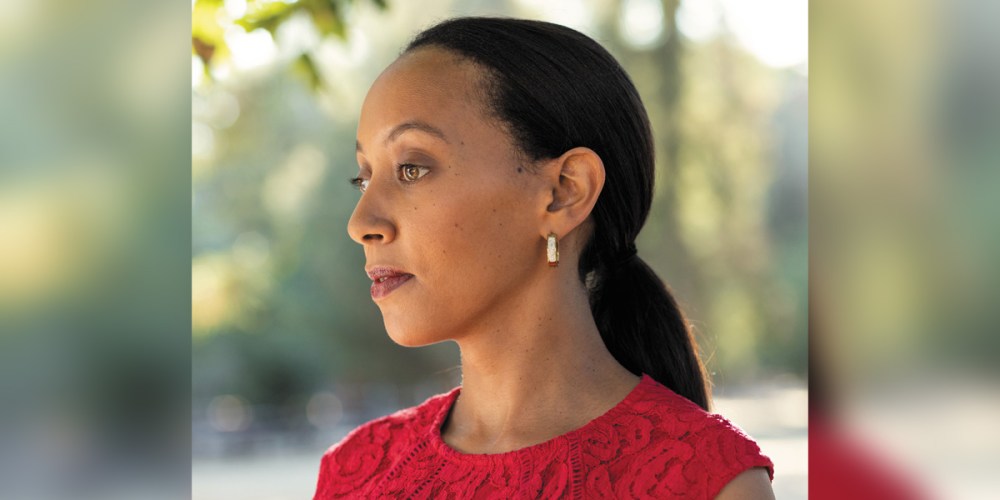
The sky’s the limit for Haben Girma.
The disability rights attorney, who became the first deafblind woman to graduate from Harvard Law School in 2013, has made it her mission to advocate for equal opportunities for people with disabilities.

In her new book, “Haben: The Deafblind Woman Who Conquered Harvard Law,” Girma details growing up as a child of Eritrean refugees who had to learn how to navigate in a world designed for people who see and hear. Later in life, she began traveling the world to teach the benefits of an inclusive society; President Obama named her a White House Champion of Change, and she also received the Helen Keller achievement award.
Girma recently sat down with MSNBC’s Yasmin Vossoughian to discuss her work, plans for the future and why society must work harder to embrace people with disabilities.
Vossoughian started the interview by commenting on Girma’s lap device and translator. “The way you’re communicating is so incredible to me,” she said.
Girma explained her hearing translator, Arianne, types what people say and do into a special computer that wirelessly feeds the information to a Braille computer Girma holds. She runs her fingers over the dots to read, and she responds through speech. She speaks in a high register, but clearly, as she is able to hear high-pitched tones and has practiced her speech for years. She also travels with her seeing eye dog, Mylo. It all takes work, but she was inspired by her parents to forge a path and strive for equality.
“My parents came to the United States seeking opportunities, and they found it’s not geography that creates freedom; it’s people and communities that create freedom,” Girma said. “All of us face a choice to accept unfairness or advocate for justice.”
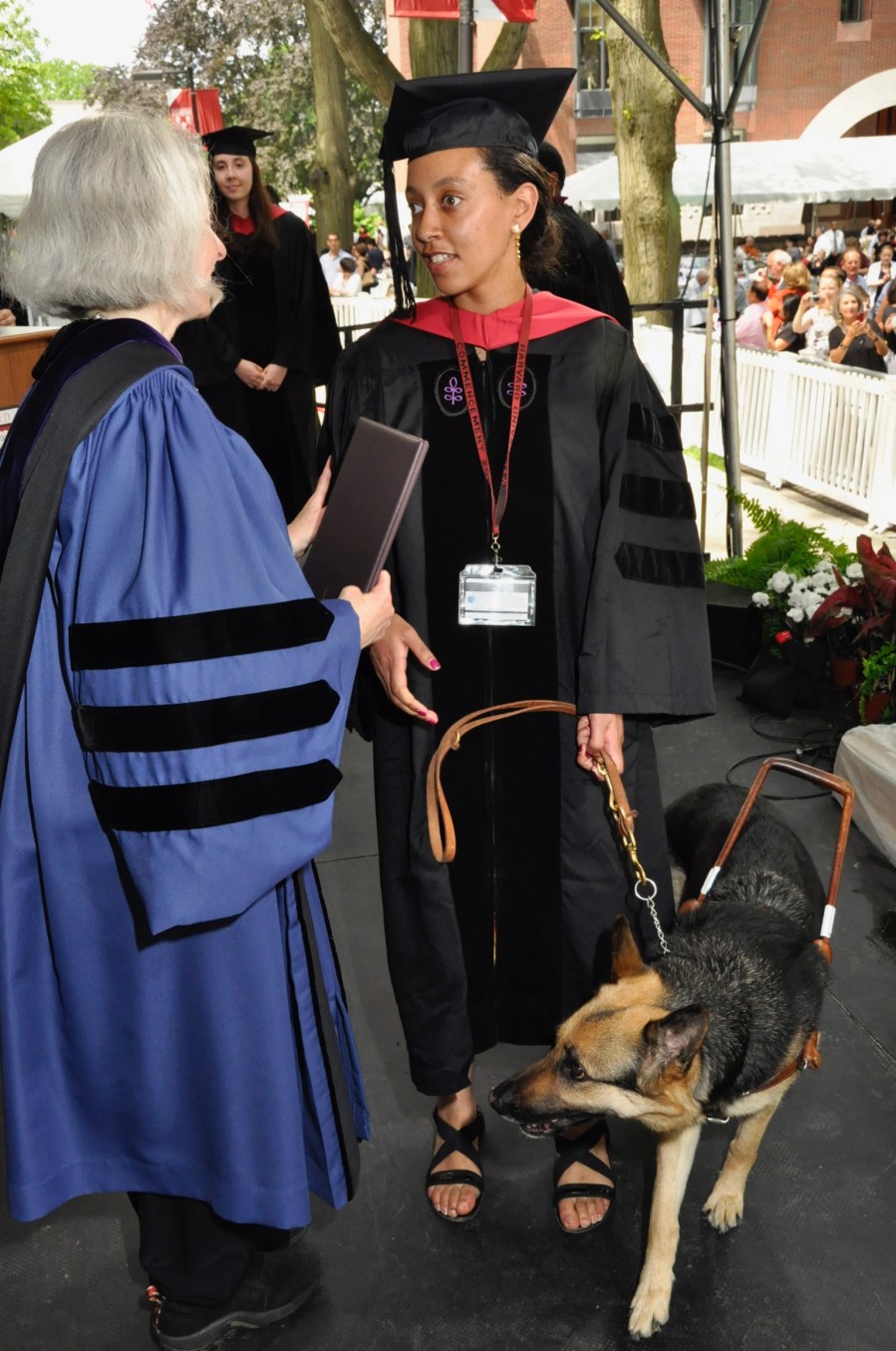
Growing up in Oakland, California, Girma heard stories from her parents about “advocacy, fighting for freedom, the war [between Eritrea and Ethiopia],” she said. “That taught me to be persistent. It’s OK to face the unknown … you’ll pioneer your way. So those lessons have helped me as a deafblind woman … learn to advocate so that I have a place at the table.”
That journey has been a long one for Girma, who attended a mainstream school and didn’t realize until she was about eight years old that there was anything different about her. Girma said her first impulse was to shrink down, to hide, to try to act like everyone else.
A formative experience at a college cafeteria
But over time she met role models with disabilities who inspired her to push for more. As a high schooler she convinced her parents to allow her to go to Mali on a program to rebuild a school, for example. It wasn’t always easy or comfortable: In college in Oregon, she was provided with Braille course materials and other accessibility accommodations. But the cafeteria was another story.
“There was a print menu on the wall and that was it,” Girma said. “Blindness wasn’t the problem. Disability is never the problem. The problem was the format of the menu.”
She asked the dining manager about posting the menu online or in Braille, or emailing it to her. The manager declined, saying he had 1,000 students to serve and couldn’t make changes for just one. Girma put up with the situation for several months, telling herself that she at least had food and that there are bigger problems people with disabilities face.

But after several months, friends reminded her of her parents’ lesson: It was her choice to accept the unfairness or advocate. So Girma did her research, showed the dining manager that the school was subject to the Americans with Disabilities Act regulations and warned him that she would take legal action if necessary. The next day the manager apologized and promised to make the menus accessible, which helped not only Girma but another blind student who matriculated the following year.
“That taught me that when I advocate, it’s not just about me,” Girma said. “It helps all the people who come after me. It benefits our entire community. That experience inspired me to become an attorney for people with disabilities.”
Attending Harvard Law
“It’s difficult for anybody, even those who can see and hear, to get into somewhere like Harvard Law School and succeed,” Vossoughian said. “How did you get there?”
Girma explained she hadn’t planned to apply to Harvard Law, which she thought would be “snobbish,” but an advisor warned her that “a lot of non-disabled law graduates are struggling to get a job” so she should apply to top schools.
She brought to Harvard her years of skills from navigating high school and college, both in terms of the physical grounds and in her comfort level approaching professors to explain the accommodations she needed.
She also got her first taste of writing legal arguments, including for one case that she ultimately worked on after she graduated. The case was filed on behalf of the National Federation of the Blind against the online document service Scribd. Blind readers and writers wanted to be able to access the content on its subscription service, so the Federation and lawyers like Girma reached out several times asking them to work together on a fix. Scribd never responded, Girma said.
“So we sued them,” Girma added. “And then they responded saying they don’t have to make their website accessible because the Americans with Disabilities Act, according to their attorney, only applies to physical places, not digital places. We argued yes, it does apply to digital places … so it went back and forth.” The case, for which Girma wrote the arguments, went to a judge who ultimately ruled the ADA does apply to online places. Girma has been involved in several other cases on behalf of people with disabilities, and she now focuses on advocacy work. Those efforts attracted the attention of the Obama Administration, which in 2015 invited her to the White House to meet the president and give a speech introducing the ceremony to celebrate the 25th anniversary of the ADA. Before the meeting with Obama, Girma asked his advisor Valerie Jarrett if the president would type on a machine himself to speak to her, or if he would ask someone else to do so. “A lot of people are uncomfortable with something that’s different … they come up with all kinds of excuses that basically say ‘this is weird; I don’t want to get involved,’” Girma explained. But Obama wasn’t. “He graciously switched from speaking to typing so that I could access his words. And we had an awesome conversation.” Today Girma travels the world to teach about the importance of inclusion, especially on the part of employers. She recalled applying for countless jobs during college and being called in for an interview only for the employer to write her off as soon she met them. It taught her that hard work isn’t enough. “I had worked hard, and I was still being denied access,” she said. “Working hard is not enough when there’s ableism … we also need society to remove the barriers … that’s when we have full inclusion.” “What are some of the active measures you think society needs to take?” Vossoughian asked. Girma said that in the digital realm she would like to see captions for all videos and descriptions for all images, noting that there are widely available web content accessibility guidelines that teach developers how to create accessible services. But the real key is at the workplace. “Let’s encourage employers to hire more people with disabilities,” she said. “Stop assuming we’re incompetent. We are talented; we work hard. It’s just ableism, the assumption that people with disabilities are inferior, that gets in our way. And we need society, especially employers, to remove those barriers.” Know Your Value editors, writers and experts take care to recommend items we really like and hope you’ll enjoy! Just so you know, Know Your Value does have affiliate relationships. So, while every product is independently selected, if you buy something through our links, we may get a small share of the revenue.
Julianne Pepitone
Julianne is the senior technology writer for NBC News Digital, covering large consumer tech companies' (Apple, Google, Facebook, etc.) news and trends, as well as cybersecurity. She also writes and appears in original videos for NBCNews.com, and speaks as an expert guest on live shows across the NBC and MSNBC networks.
She previously worked at CNNMoney.com where she covered large techs from a business angle, as well as the intersection of the tech and media industries.
In addition to NBC and CNN online properties, Julianne has written for several national magazines and online publications including Esquire, Self, Popular Mechanics and Cosmopolitan. Recommended


A worldwide message