








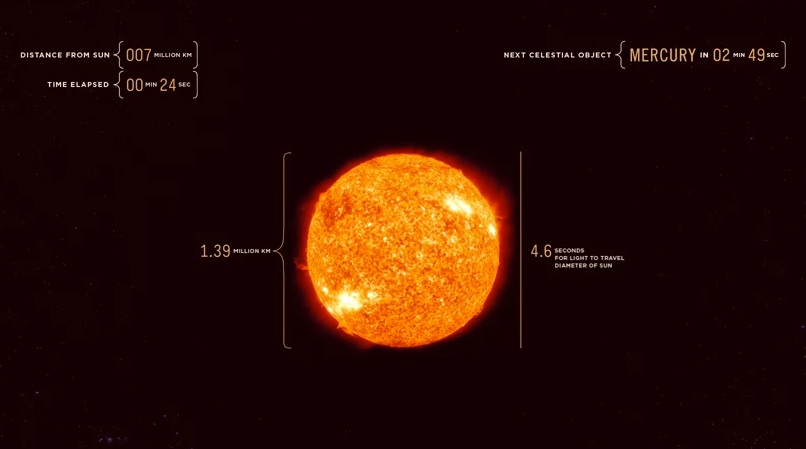
Ever wonder what it would be like to travel at the speed of light? A new video by Alphonse Swinehart on Vimeo lets you get a sense. Within our Solar System, that is.
The speed of light is just under 300,000,000 meters per second, which probably means nothing to you in practical terms. In units we are more familiar with that’s 671 million miles per hour. Fast, right? Yes, very fast. But interestingly enough, the distances between objects in our Solar System, our galaxy, and our Universe are so large, that it might seem slow too.
“Riding Light” was created by Swinehart to illustrate this paradox. Starting at the Sun and traveling outward, the video progresses “at the speed of light” as if the viewer were a photon leaving the Sun and streaming through the Solar System (simplified of course). The video is in real time too, so as the Sun is 8.3 light-minutes away from Earth, i.e., it takes 8.3 minutes to reach Earth’s orbit. Swinehart stops the video just after Jupiter (43.2 light-minutes) to keep the running time under and hour(!). [For reference the light travel time from the Sun to each of the planets can be found here.]
Riding Light from Alphonse Swinehart on Vimeo.
Now imagine the video kept going.
Saturn would be an additional 36.1 minutes and Neptune an additional 3 hours. At 18 hours, we’d finally reach Voyager 1 on its way out of our Solar System. After that, we’d spend up to a year making our way past the Oort Cloud cometary reservoir that marks the limit of our Sun’s gravitational sway. And then after 4 years, 2 months, and 12 days, we’d finally pass another star, Proxima Centauri. I know the internet is fun and all, but a 4 year video might actually break it (and break me).
We astronomers toss out distances in light-years all the time, but this should really drive home the fact that a light year is large, large distance. In fact, we use light-years because if we were to stick with miles or kilometers, the numbers would get absurdly large and too unwieldy for our calculations. The same thing goes for light-years actually, once we start moving out farther into the Milky Way and then on to other galaxies. We’ve had to create larger and larger units of distance to deal with the vastness of our Universe: feet to meters to miles to light-years to parsecs to redshift. I believe the Animaniacs said it best: “It’s a great big Universe.” Here’s some geek that takes less than a light-year to read: Keep on geeking! @Summer_Ash, In-house Astrophysicist
Summer Ash Recommended

