








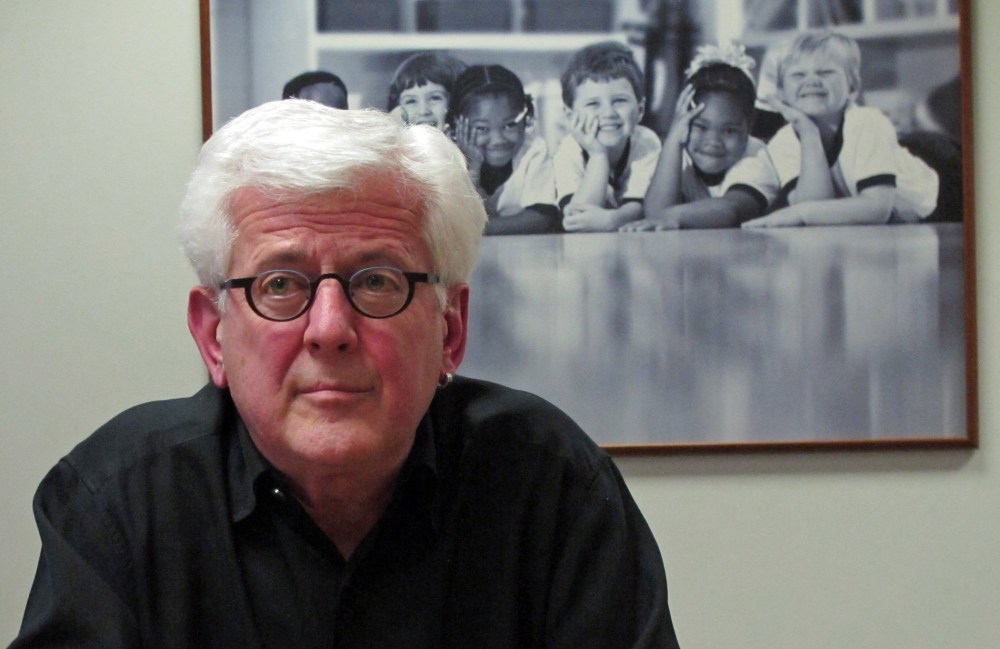
When Peter Brownlie arrived in Kansas nearly 15 years ago to become the head of Planned Parenthood of Kansas and Mid-Missouri, he knew he was forging into a fray. Brownlie had worked with Planned Parenthood for most of the past 40 years, serving as an administrator in Michigan, Indiana and Texas.
Then he went to Kansas, which had long been considered the main battleground of the so-called abortion wars. In 1991, anti-abortion activists laid siege to Wichita in what they called the Summer of Mercy, in which thousands of anti-abortion activists led a weeks-long protest and attempted blockade of abortion access in the city. Most of their attention was directed at the clinic run by Dr. George Tiller. Two years later, he was shot by a woman who had been part of those protests. Tiller returned to work the next day.
Leading Planned Parenthood in that climate made Brownlie one of the most visible (and targeted) pro-choice advocates in Kansas — a circumstance he would feel acutely when his colleague Dr. Tiller was murdered while at church in 2009.
After Tiller’s death, Brownlie says, the stakes were higher, but the locus of fighting had also shifted. He spent much of the last decade in court rooms – fighting restrictive anti-reproductive rights legislation and defending his chapter of Planned Parenthood in a grand jury investigation and a lengthy criminal case. (All charges were dropped last year, and the law license of the attorney general involved in those cases got suspended.)
Brownlie says that 40 years after Roe v. Wade, the country is nearing the end of this fight. “We have not won yet politically,” he says, “but we will.”
Last month Brownlie, now 68, announced that he would retire next year. MaddowBlog had the opportunity to talk to him about his long career. An edited transcript of the interview is posted below.
MaddowBlog: You have been a reproductive rights advocate for 40-plus years. While a lot has changed in those years, the issues of abortion and contraception are still very much unsettled. Does that surprise you?
Peter Brownlie: I do not think that it will always be this contentious. And at the same time I am surprised that 40 years after Roe v. Wade and 50 years after the pill, we are still having some of the political arguments that we are having now. But my perspective is that we are in the latter stages of this whole battle over abortion and family planning. I think we, those that take the pro-choice position that Planned Parenthood does, we have essentially won this whole issue. Certainly with regard to people’s private behavior and beliefs. We haven’t won yet politically, but we will.
What I mean is that at this point, virtually every heterosexual person male or female in this country has used contraception of one sort or another in their lives. Virtually everybody knows somebody that has had an abortion, often someone they are close to, a friend or a relative or a partner. The vast majority, if you look at public opinion polling, the majority of Americans want abortion to be available in some way. They do not want Roe v. Wade overturned.
So we have won in terms of people’s private behavior and private beliefs.
What I see is that the political fighting about this is unpleasant and intimidating for most people. It is irrelevant for many people, who think, “I am going to go about my way and make my own decisions, and screw whatever the politicians are arguing about.” But time is on our side. And demographics are on our side.
I think what we are seeing is a backlash from so-called conservative politicians who know that they are running out of time. We are becoming an increasingly multicultural, diverse society. We are an increasingly tolerant and accepting society. Just look what gone on with gay rights. And that is going to happen on our issues, it is just going to take a bit longer.
MB: Can you characterize the change since you first starting doing this?
PB: I think the anti-abortion strategies changed with the rise of the various think tanks, the rise of certain organizations like ALEC, increasingly anti-choice organizations focused more on political and legislative organizing and less on direct action.
Whenever an issue about reproductive choice has been on the ballot like personhood amendments as in Colorado, Mississippi and North Dakota, when there have been public votes on these issues – the public has been consistent in voting down those restrictions. The majority of Americans has been consistent for 40 years in saying they do not want abortion outlawed.
Hard-core anti-abortion organizations, like Operation Rescue has only really succeed here in Kansas in accomplishing their goal, and it was only temporary – by indirectly inciting someone to kill Dr. Tiller.
MB: You had already been the head of Planned Parenthood Kansas and Mid-Missouri for several years when Dr. George Tiller was murdered. How did this affect you and your work? PB: I knew Dr. Tiller before I arrived in Kansas and when I moved here I got to know him better, and got to know his family a bit. On a personal level, his death was deeply disturbing and saddening. And I was really angry. It really pissed me off that someone would think that there is any justification for going into his church and assassinate him. It, of course, made all of us who are involved in abortion services heighten our scrutiny and security. And made us redouble our efforts to make sure that our patients and staff are safe. It was a very traumatic time. It increased my sense of risk and the risk for our physicians. MB: Why do you think Kansas became ground zero for the fight over abortion rights? PB: I can only speculate. It is almost paradoxical that Kansas has turned into the center of the reproductive rights fight nationally. Kansas has had a long history of populism and progressive politics. Kansas was one of the early states that liberalized its abortion laws before Roe v. Wade, in the late 1960s. It is home to a whole host of Republican moderates. But my speculation is that we are a relatively small state – we have a population of about 2.5 million – it is fairly easy with modest amounts of money to organize politically. And while we have a long progressive history, we also have a very strong Evangelical Christian tradition in much of the state. I think the best I can tell, that national organizations, national anti-abortion groups – deliberately saw Kansas as an opportunity to test out strategies and tactics. To see if it can be made to work in Kansas, maybe it can be used elsewhere. So it is a combination of geography, demography and tradition. And they have been successful since the so-called Summer of Mercy in 1991. MB: When you arrived in Kansas, what did you think you would be focusing on and what did you end up doing? PB: I certainly early on hoped that more of my work would have been directed toward programs and program development. Expanding services, increasing access and less time spent defending and reacting to assault legislative and otherwise on my work. I think many of us in the early ‘70s — with Roe v. Wade and with the introduction of the pill a decade before and the changing culture with the sexual revolution and the Women’s Movement — hoped that real change would occur. And it has been much slower than I would have ever guessed. I would never have guessed that in a Republican presidential primary in 2012 that we would hear people denouncing the use of birth control. Or opposing sex education and medically accurate information for school kids or young adults. So we have certainly had to deal with external attacks and pressures to a greater extent than I would have expected 35, 40 years ago. Just within Planned Parenthood, which I think is one of the most wonderful organizations in the world, it has made us resilient and tough and hardened our resolve to make sure we defend the rights of the people who come to us and need our services. So despite the fact that it has been challenging and stressful it has also really been, and I mean this very sincerely, it has been an honor for me to be able to do this work, and to work with so many fine people around the country.
Kathleen Osborn Recommended


