








An hour or so after news arrived last month that a Ferguson, Missouri, police officer would not be charged in Michael Brown’s death, some of the protesters outside the city’s Police Department took up a new rallying cry—“not one dime”—in support of a shopping boycott planned for Black Friday.
That same night, 1,000 miles away in New York City, a veteran Occupy Wall Street activist was arrested for splashing fake blood on NYPD Commissioner William Bratton during a protest in support of Brown.
As the emerging, nationwide push for police and criminal justice reform gathers steam, it’s being boosted by numerous factors. Among them are remnants of the Occupy movement, and, more importantly, the broader concerns over economic inequality and insecurity that spurred it.
RELATED: After Ferguson, some see a movement taking shape
Ferguson itself — where comfortable, white suburbanites coexist uneasily with poorer black newcomers from St. Louis — is ground zero for that feeling.
“Local Ferguson leaders have the sense that their lives and their community are not valued,” said Chenjerai Kumanyika, a communications professor at Clemson University who has traveled to Ferguson for protests. “So, when they look at the economic state of their community, and the fact that both businesses and courts prey on them economically, and then they look at these verdicts, there’s this sense that our community is marginalized.”
And, Kumanyika added, an awareness of the growing wealth gap is one reason among many why the Ferguson protests have so far had staying power. “What we’re seeing now has gained a certain momentum both because people can see the inequality, and they’re affected by it,” he said.
Of course, the central thrust of protests in recent weeks has been to end unfair treatment of minorities by police and the criminal justice system, not to address economic concerns. And at the vanguard has been an impressive group of young, minority activists, many from the St. Louis area, who were spurred to action by Brown’s death.
What we’re seeing is its own movement, not an extension of Occupy Wall Street.

Still, last week, Ferguson protesters — including Tef Poe, a founder of the St. Louis-area protest group Hands Up United, formed in response to Brown’s death — joined low-wage workers fighting for a higher minimum wage on the picket line, after those workers had earlier lent support to the Ferguson protests. In cities across the country, low-wage workers — many of whom, of course, are young minorities — paused for one minute to hold their hands up in silence, to show solidarity with the Ferguson movement.
“You do not sell loosies on the streets of Staten Island if you are making a livable wage,” said Rep. Keith Ellison, a Minnesota Democrat, at a congressional hearing on civil rights Tuesday. “Dealing with the economic deprivation that kindles these situations is incredibly important.”
Eric Garner was selling loose cigarettes on a Staten Island street when he was placed in a fatal choke-hold by an NYPD officer who was trying to arrest him.
The young leaders spearheading the push for police reform don’t tend to shy away from economic critiques in discussing what’s motivating them. Tory Russell, another Hands Up United co-founder, said he convinced his family to participate in the Black Friday boycott, and noted that the action may have cost retailers an estimated $7 billion.
RELATED: Fast food workers’ strike fueled by other low-wage employees, Eric Garner
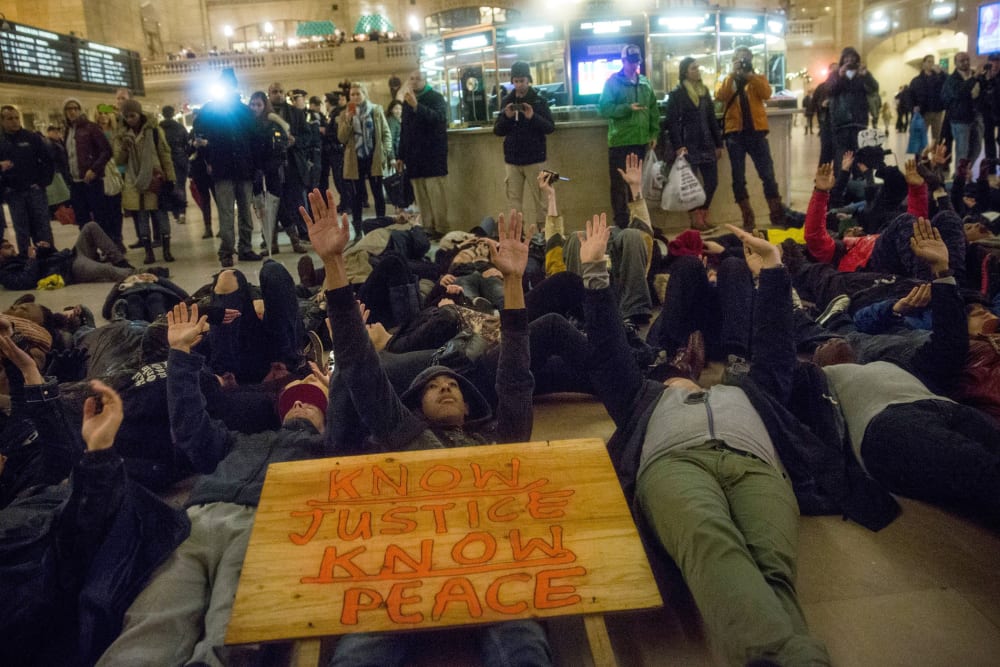
“Maybe that $7 billion that was lost, maybe it’ll shorten the hours in a sweatshop somewhere that I don’t know about,” Russell said Monday at a sit-down with press and other activists in New York. Many of the recent protests have focused on shutting down malls, Wal-Marts, and other large retailers, in order to send a message that society values black dollars, but not black lives. New York protesters chose Macy’s as the site of a “die-in” held last week as holiday shoppers looked on. A rumor has circulated among protesters that Wal-Mart donated money to the defense fund of Darren Wilson, the one-time Ferguson police officer who shot and killed Brown. Wal-Mart has denied doing so. But the rumor’s staying power suggests that few protesters see the mega-store and its ilk as being on their side. Another St. Louis-area activist at Monday’s event suggested that efforts by local police to stop people from shopping at Wal-Mart out of concerns for security were perhaps the only recent move by law enforcement she supported. As for Occupy Wall Street, some of its tactics, from the macro the micro, have shown up in the recent movement. The strategy of using civil disobedience, rather than relying on sanctioned marches and press conferences, came in part from Occupy — though also, of course, from the Civil Rights Movement of the 1960s. And at a protest outside a government building in St. Louis not long after Brown’s death, participants snapped their fingers to quietly signal agreement with the speaker — a technique popularized at Zuccotti Park in lower Manhattan. Activists with ties to the Anonymous collective — which played a key role in promoting the early Occupy protests — have been even more visible than those from Occupy itself. Anonymous members helped shut down the phone lines of the Ferguson Police Department at one point, and had a well-publicized spat with a Ku Klux Klan member in Ferguson last month. Some Ferguson activists see Occupy as a cautionary tale: After making a major media splash in late 2011, the largely leaderless movement gradually disintegrated amid infighting and a lack of direction. With that example in mind, there has been a concerted effort to elevate leaders and put forward a clear set of demands. RELATED: Poll finds big racial split on Brown, Garner decisions There’s also a wariness that allowing the movement to be defined too broadly beyond its core themes of police and criminal justice reform could diffuse its impact. “They are walking that balance of trying to connect the injustice that we see with law enforcement to a series of other oppressive systems, while at the same time trying to focus on one thing,” said Kumanyika. “But there’s definitely an understanding that these things are linked.”
Zachary Roth Recommended


